In brief
The Ramesseum is the temple of ‘millions of years’ of Ramses II (Ramesses II), on the west bank at Thebes. Its modern name comes from Jean-François Champollion, who visited the site in 1829 and read ‘Ramses’ on the walls; the Egyptians called it the ‘Mansion of millions of years of Usermaatre-Setepenre united with Thebes in the domain of Amun’. According to Guy Lecuyot, of the CNRS, construction began before the end of the second year of the reign, and the decoration was undertaken from the fifth year, probably being completed around year 21.
What you discover
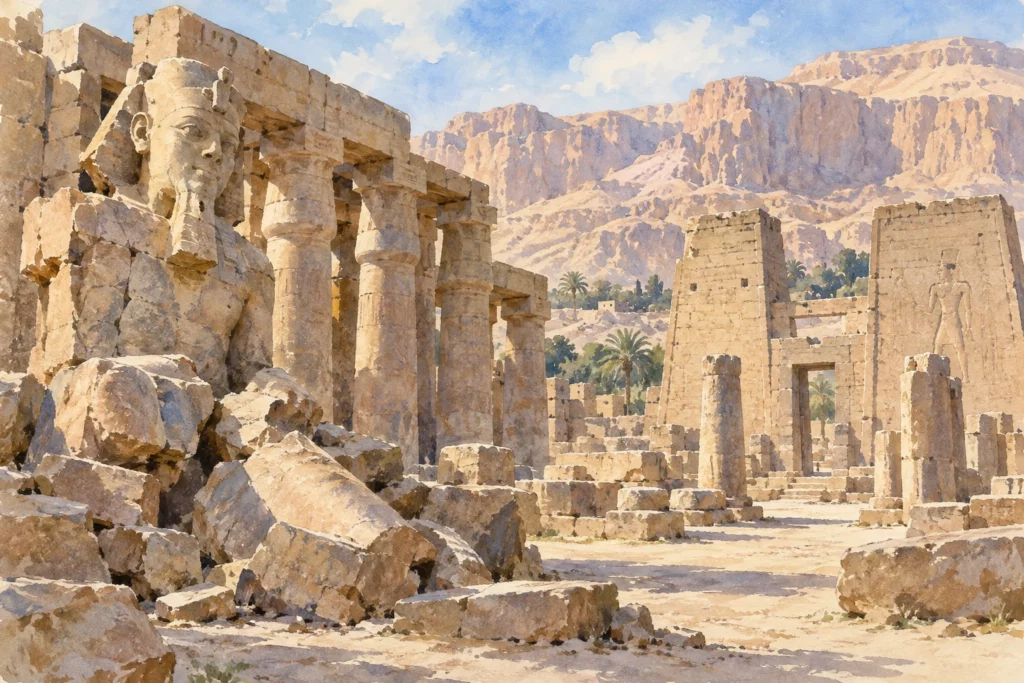
The monument is in ruins, but its size remains imposing: about 220 m from north to south and more than 280 m from east to west, nearly six hectares (the Association pour la sauvegarde du Ramesseum speaks of about ten hectares). The two stone temples, of sandstone from Gebel el-Silsila, occupy the centre; around them, on three sides, the mudbrick annexes are lined up. Their irregular trapezoidal plan is explained, according to Lecuyot, by respect for the foundations of a small temple of Seti I and by the orientation of the axis towards Luxor Temple. In the second court lay a colossus whose upper part Belzoni had shipped to the consul Salt; this bust is now in the British Museum.
Its history
Two senior officials, Penre and then Amenemone, directed the building work; Lecuyot points out that they were above all high-ranking officers rather than architects in the modern sense. In Antiquity, the place was sometimes identified with the ‘tomb of Osymandyas’ described by Diodorus Siculus, a link that Champollion defended and that other scholars, such as Letronne or Mariette, rejected. Jollois and Devilliers gave the first study and the first plans of it in 1821 in the Description de l’Égypte. Lepsius drew up in 1844–1845 the plan of the ruined parts of the sanctuary.
What to look at
Look at the vaulted mudbrick storerooms, part of whose vaults survive and which make the Ramesseum a rare example of a temple with numerous warehouses. In the north-west corner, a more monumental group comprised a treasury flanked by twelve storerooms, preceded by a colonnade of 28 stone columns; at the back of the court, a pedestal marked the place of the royal throne. On an architrave of the hypostyle hall, Ramses II had a wish inscribed: that the storerooms of provisions be filled up to the sky and the treasury with gold, electrum and precious stones.
Why this place matters
The Ramesseum shows that a temple of millions of years was also an economic institution. A letter from the scribe Panehsy, in year 24, refers to at least 48,190 people employed by the temple of Amun, and Lecuyot gives the provisions planned for the Opet festival (11,400 loaves and cakes). The place also became a model for Medinet Habu. The temple has been inscribed with ‘Ancient Thebes with its Necropolis’ since 1979, and a Franco-Egyptian mission (CNRS, Association pour la sauvegarde du Ramesseum, Egyptian Ministry of Antiquities) has long been working there. The identification with the monument described by Diodorus remains, for its part, debated.
Sources
Consulted on 30 September 2026: Guy Lecuyot (CNRS), The Ramesseum (Egypt), Recent Archaeological Research; Association pour la sauvegarde du Ramesseum (in French); Ancient Thebes with its Necropolis, UNESCO World Heritage Centre.