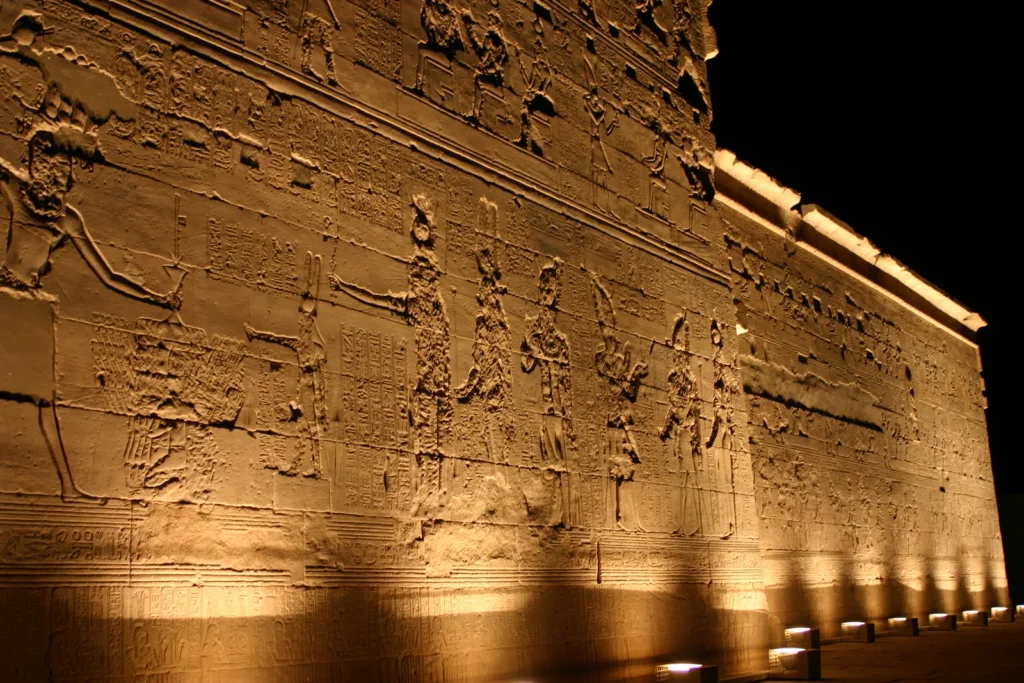
On 24 August AD 394, near the gate of Hadrian, a priest named Esmet-Akhom carved a few hieroglyphs beside a figure of the god Mandulis. It is the latest dated hieroglyphic inscription known in Egypt. At Philae, this discreet testimony stands alongside the great pylons of Isis, the columns of the kiosk of Trajan and the traces of a Christian church. The island thus brings together several histories: that of the sanctuaries, that of relations between Egypt and Nubia, then that of a rescue that moved the monuments to Agilkia. To understand what one visits today, these three dimensions must be kept together.
Philae and Agilkia, two islands to tell apart
Philae lay in the region of the First Cataract, about seven kilometres south of Aswan. The ancient island measured some 385 metres from south to north and 176 metres at its widest. The Nile and the neighbouring islands formed its religious setting as much as its landscape: one reached the sanctuary by water, and certain ceremonies took the deities from one bank to the other.
The visible monuments were dismantled and then rebuilt a few hundred metres away, on Agilkia. They are still referred to as Philae, but the ground the visitor walks on is no longer that of the ancient island. The stones are ancient; their foundations and their relationship to the banks also belong to a modern conservation operation.
The name Philae corresponds to the Greek Philai (Φίλαι), handed down in the Latin form Philae. It refers to the island, not to a single temple. The main temple is dedicated to Isis: speaking of the ‘temple of Philae’ is convenient, but the expression leaves in the shadow the other sanctuaries that occupied the same place.
A sanctuary enlarged over several centuries
The kiosk of Nectanebo I recalls that the monumental history of Philae predates the Ptolemies. This king of the 30th Dynasty reigned in the 4th century BC. A gateway of his sanctuary was later incorporated into the first pylon of the great temple. The surviving complex was therefore not conceived in a single stroke: the builders took over earlier buildings, extended the routes and added new places of worship.
The main structures of the temple of Isis go back to the 3rd and 2nd centuries BC. Ptolemy II Philadelphus played a major role in its development; other Ptolemaic sovereigns continued the building and decoration. After the Roman conquest of 30 BC, the emperors continued to have themselves depicted in the traditional language of Egyptian temples, making offerings to the gods like pharaohs.
The distinction between the Ptolemaic and Roman periods remains necessary, but it does not correspond to a break in all practices. A single building may combine an early construction, later decoration and inscriptions added long afterwards. The names of the sovereigns carved on the walls date first and foremost the interventions in which they appear.
The great temple of Isis and the mammisi
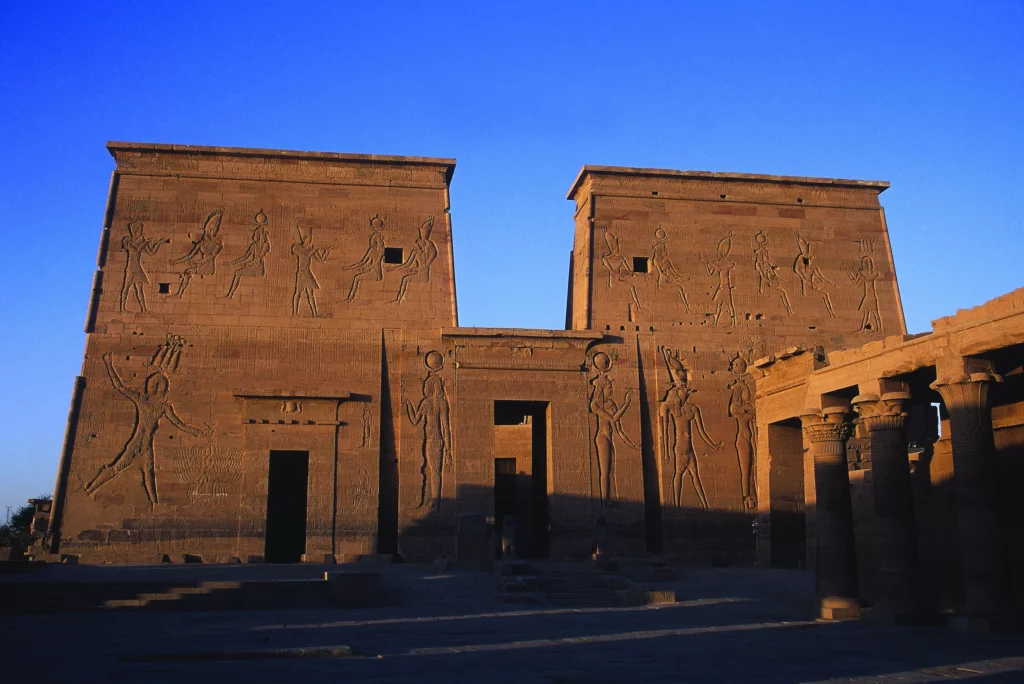
From the southern area, the colonnades lead to the first pylon. Beyond it open the court, the mammisi, then the second pylon and the inner rooms. The passages and thresholds organise a progression towards the sanctuary. The open appearance of some parts of the route should not make us forget the spaces reserved for the service of the cult.
The mammisi is the divine ‘birth house’. A scene there shows Isis suckling Horus in the marshes. It recalls the protection of the child, heir of Osiris, and gives the motherhood of Isis a central place in the local theology. The royal offerings and the divine scenes belong to the same religious whole.
The main temple also preserves traces of its transformations. In the pronaos, the columned hall preceding the inner spaces, crosses and Christian inscriptions bear witness to another use. The article Philae, sanctuary of Isis presents its route and decoration in more detail.
Around Isis, the other monuments
At the south-western tip, the kiosk of Nectanebo I marks an earlier state of the sanctuary, remodelled under the Ptolemies. East of the great temple, the sanctuary of Hathor bears decoration of Ptolemaic sovereigns and of Augustus. It recalls that the island hosted several deities, even if Isis dominates its religious landscape.
Other buildings completed this group: a temple of Imhotep, a sanctuary of the Nubian god Arensnuphis, a chapel of Mandulis, and a temple devoted to the cult of Augustus in the northern area. Their states of preservation are uneven. They prevent Philae from being reduced to the succession of the two pylons of the main temple alone.
The kiosk of Trajan, a silhouette and an unfinished project
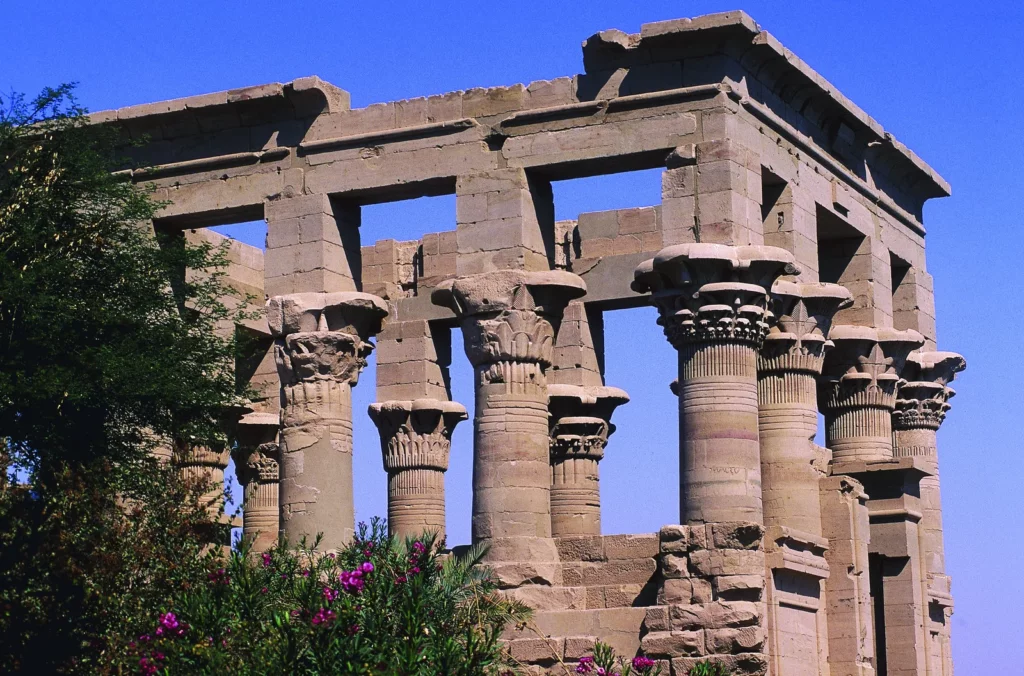
On the east bank, south of the temple of Hathor, the kiosk of Trajan forms a rectangular pavilion whose columns are linked by low walls. Its roof has disappeared. In the decorated parts, Trajan makes offerings to Isis, Osiris and Horus; a large part of the surfaces was left without reliefs.
Its name does not guarantee that the whole building was constructed under Trajan. The date of the main structure remains debated, and an origin under Augustus has been proposed. A function as a resting place during processions is probable, but no inscription establishes it with certainty. These reservations allow us to look differently at a monument often reduced to its silhouette. The article on the kiosk of Trajan is devoted to it.
The gate of Hadrian and the island of Osiris
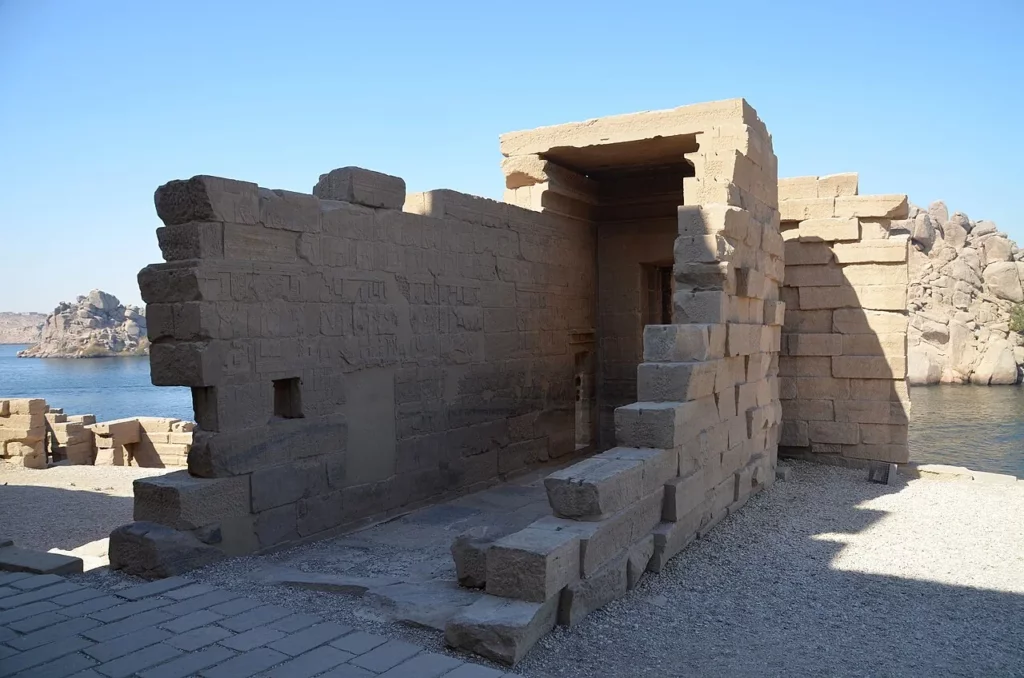
West of the temple of Isis, the gate of Hadrian opens another route. This passage with carved walls faced the island of Biggeh, where religious tradition placed the Abaton, one of the tombs of Osiris. The barque of Isis set out from this area to reach the god’s place of worship.
The texts carved on the gate include the Abaton decree, relating to the cult of Osiris. Its decoration is not limited to the reign of Hadrian: it was continued under his successors, into the second half of the 2nd century AD. The article on the gate of Hadrian distinguishes this monument from the kiosk on the other side of the island.
A place of pilgrimage between Egypt and Nubia
Philae attracted visitors from Egypt and from the southern regions. The presence of Meroitic delegations and offerings from the south shows that the political frontier did not interrupt religious relations. The cult of Isis linked communities that shared neither the same rulers nor always the same languages.
In the middle of the 5th century AD, an agreement with the Blemmyes and the Nobadae still guaranteed their access to the sanctuary and the possibility of temporarily taking the statue of Isis to their country. These journeys shed light on the role of the landing stages and processions: the cult did not remain shut away in the rooms of the great temple.
The last hieroglyphs and the Christian transformation
The inscription of Esmet-Akhom, dated AD 394, is a landmark in the history of writing. It does not give the date of the disappearance of the whole of Egyptian religion. Traditional practices and officiants are still attested in the following century, when Christianity was already established in the region.
The end of the cults remains debated. Procopius tells of a closure ordered by Justinian around 535–537, with the arrest of the priests and the dispatch of the statues to Constantinople. The research presented by Holger Kockelmann invites us to qualify this account: the last known officiants date from 456–457, and the imperial decision may have come after organised worship had ceased. An administrative date is therefore not enough to establish the last rite performed.
In the 6th century, under Bishop Theodore, the pronaos of the temple of Isis was turned into the church of St Stephen. Some images were erased, other walls received crosses and inscriptions. These marks remain witnesses to the history of the building, just like the Ptolemaic and Roman reliefs.
Monuments threatened by the dams
The rise of the waters did not begin with the High Dam alone. The first Aswan Dam had already altered the environment of Philae and exposed its monuments to flooding. With the new dam, the island found itself in the reservoir between the two structures. The walls and foundations underwent lasting immersion, documented in particular by UNESCO in a 1972 report.
The International Campaign to Save the Monuments of Nubia was launched in 1960. For Philae, the decision to dismantle and rebuild on Agilkia was taken in 1968. Work began in 1972; reconstruction on the receiving island started in 1977. UNESCO’s chronology places the completion of the transfer in August 1979 and the end of the international campaign on 10 March 1980.
A cofferdam made it possible to isolate the monuments and work on their dismantling. The blocks were marked, moved and rebuilt on an island prepared to receive the whole complex. The figures and dates tell the story of a work site, but the joints between the stones still give a concrete reading of it.
Visiting an authentic complex in a transformed landscape
Since 1979 Philae has been part of the World Heritage property entitled Nubian Monuments from Abu Simbel to Philae. UNESCO stresses that the care taken in the reconstruction preserved the authenticity of the form and design of the monuments. The move did not turn them into copies.
It did, however, change their surroundings. Old views show the original island, its banks and buildings that are not all found on Agilkia. A contemporary photograph is not enough to reconstruct the ancient crossings to Biggeh. Comparing an old plan with the present route helps to distinguish the historic sanctuary from the island laid out to preserve it.
On the visit, a few details deserve a pause: the varied capitals of the colonnades, Isis and Horus in the mammisi, the surfaces left smooth on the kiosk, the inscriptions near the gate of Hadrian and the crosses of the pronaos. Among these traces, one finds the gestures of the builders, the priests and those who made it possible for the monuments to stand above the water.
Sources
- Holger Kockelmann, ‘Philae’, UCLA Encyclopedia of Egyptology, 2012, historical and archaeological study, especially pp. 4–8.
- Egyptian Ministry of Tourism and Antiquities, Philae.
- UNESCO, World Heritage Centre, Nubian Monuments from Abu Simbel to Philae, for the rescue, the inscription and the authenticity of the relocated monuments.
- UNESCO, chronology of the International Campaign to Save the Monuments of Nubia, for the stages from 1968 to 1980.
- UNESCO, Report on Philae, a 1972 report on the immersion and the rescue project.
References consulted on 20 November 2026.
Photo credits
Photographs P1799 (side of the temple of Isis, at night) and P0380 (part of the kiosk of Trajan) were supplied by Charles Rossignol, from the Visite Égypte photo library.
Gate of Hadrian: photograph © Carole Raddato, 13 February 2020, original file and attribution, under the licence Creative Commons Attribution-ShareAlike 2.0. Reduced in size and converted to WebP, without cropping or retouching, reused under the same licence.