In brief
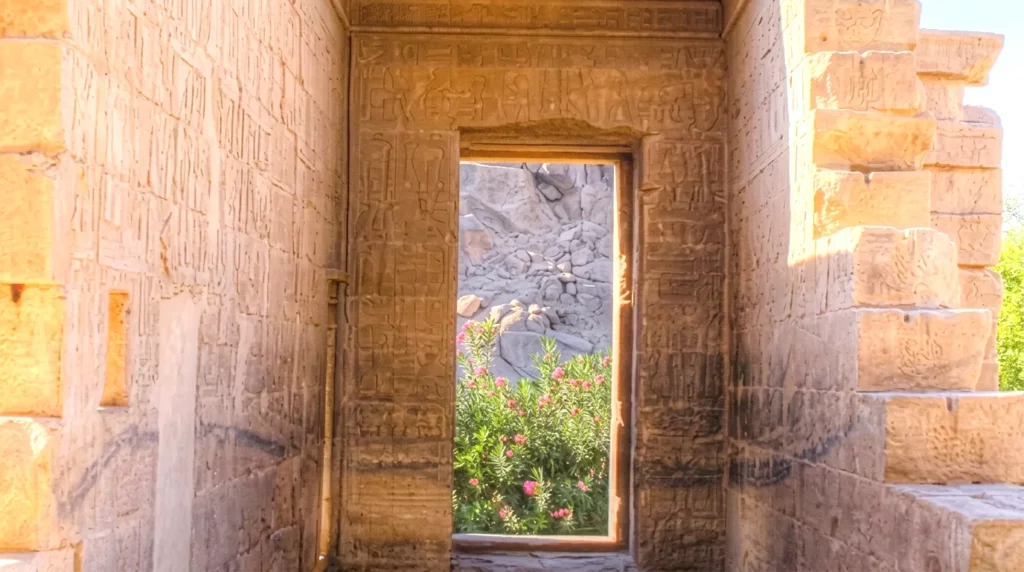
West of the temple of Isis, the gate of Hadrian formed a passage towards the bank of Philae, opposite the island of Biggeh. Religious tradition placed there the Abaton, one of the tombs of Osiris, which the barque of Isis came to visit. The carved walls of the gate preserve scenes and texts linked to this cult. The monument bears the name of Hadrian, but its decoration was continued under several emperors of the 2nd century AD.
What you discover
The gate appears as a corridor-like passage with decorated side walls. It lies level with the pronaos of the temple of Isis, the columned hall that precedes the inner spaces. This arrangement is distinct from the kiosk of Trajan, a columned pavilion on the east bank.
In the ancient setting, the gate faced the landing chapel of Biggeh. It served as the starting point for the procession of the barque of Isis to the place of worship of Osiris. Now rebuilt on Agilkia, it keeps its stones and reliefs, but its relationship with the neighbouring island must be studied from the ancient geography.
What to look at
The Abaton decree sets out rules relating to the cult of Osiris on Biggeh. Another text records the donation of a vineyard to the temple of Isis. These inscriptions bring together the rites and the resources and arrangements that kept them running.
A figure of the Nubian god Mandulis is accompanied by a later testimony: the inscription carved by Esmet-Akhom on 24 August AD 394. It is the latest dated hieroglyphic text known in Egypt. This date concerns an act of writing; it is not that of the closure of the sanctuary.
Its history
Hadrian reigned from AD 117 to 138. The decoration of the gate spans roughly 117 to 180, with interventions under Marcus Aurelius and Lucius Verus. Some reliefs remained unfinished. This passage belongs to the last great phase of monumental decoration of the temples of Philae.
The gate was dismantled and then rebuilt with the main monuments of the island during the rescue carried out under UNESCO’s auspices in the 1970s. To place this monument within the sanctuary, Philae, the island of Isis: history and monuments links the buildings, the cults and their modern move.
Sources
- Holger Kockelmann, ‘Philae’, UCLA Encyclopedia of Egyptology, 2012, historical and archaeological study, especially pp. 4–8.
- Egyptian Ministry of Tourism and Antiquities, Philae.
- UNESCO, World Heritage Centre, Nubian Monuments from Abu Simbel to Philae, for the rescue, the inscription and the authenticity of the relocated monuments.
References consulted on 20 November 2026.