In brief
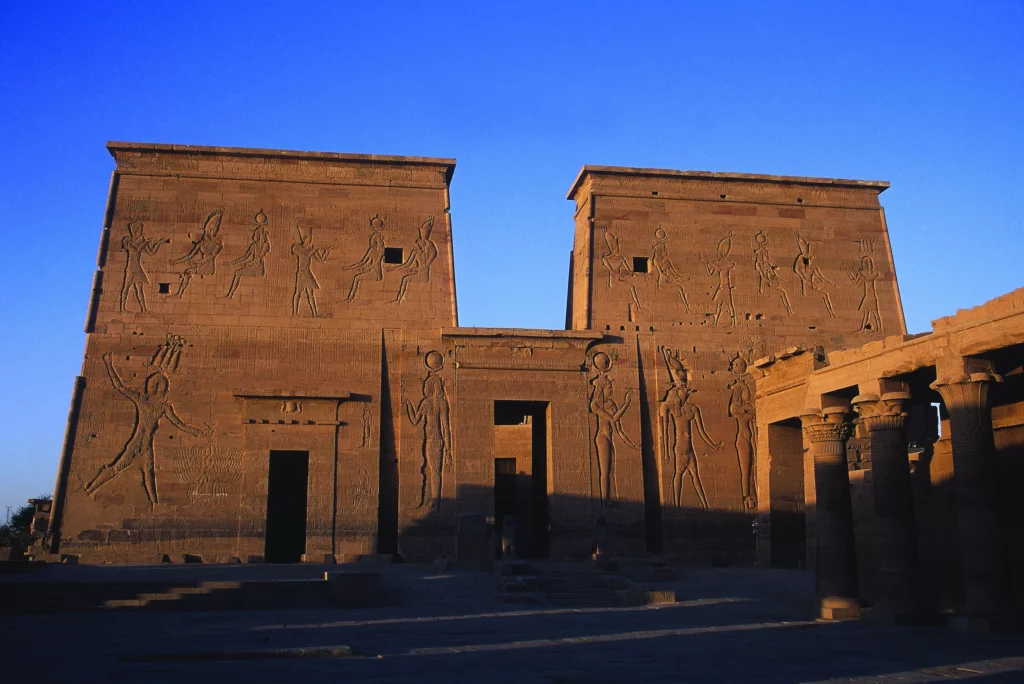
The great sanctuary of Isis occupied Philae, a small island about 385 metres by 176, in the middle of the First Cataract, some 7 kilometres south of Aswan. Two thirds of the surviving buildings date from the Ptolemaic period; the temple of Isis, built in the 3rd and 2nd centuries BC, was decorated from the time of Ptolemy II Philadelphus (285–246 BC), then completed under the Roman emperors. Threatened by the Aswan High Dam, the whole complex was dismantled and rebuilt between 1972 and 1980, as part of the UNESCO campaign, on the neighbouring island of Agilkia. The temple you visit is therefore both authentic and relocated.
What you discover
The boat lands on a reshaped island: an Italian-Egyptian mission moved almost all the monuments of Philae a few hundred metres north-west, to Agilkia, whose ground lies 13 metres higher than that of the ancient island. The work required the building of a sand-filled cofferdam of about 35,000 square metres around the submerged island. The orientation and general layout of the buildings were preserved.
At the south-western tip, a kiosk of Nectanebo I (30th Dynasty), restored under Ptolemy II, opens the route. Colonnades lead to the first pylon of the temple of Isis, which incorporates a gateway of the earlier Late Period sanctuary, a modest predecessor of the Ptolemaic temple. Beyond extend the court and the mammisi, the ‘birth house’, then the second pylon and the inner rooms. East of the temple, a small temple of Hathor was decorated under Ptolemy VI, Ptolemy VIII and Augustus. The kiosk of Trajan and the gate of Hadrian have their own articles.
What to look at
In the mammisi, a scene shows Isis suckling her son Horus in the marshes, an image at the heart of the theology of the place: here the goddess is above all the mother who protects the heir of Osiris.
Another, discreet detail marks the end of a script: a figure of the Nubian god Mandulis accompanied by the latest dated hieroglyphic inscription in Egypt, carved on 24 August AD 394 by the priest Esmet-Akhom. In the second eastern colonnade, a room served the cult of the Meroites, whose presence at Philae was already noted by Strabo at the end of the 1st century BC.
Finally, look at the walls of the pronaos: it was turned into the church of St Stephen by Bishop Theodore in the 6th century, and many inscriptions were then deliberately erased. Carved crosses and erased inscriptions thus layer two religions on the same stone.
Its history
The ancient name of the island, (Pa-)Iarek, is probably of Nubian origin; its meaning remains obscure. Philae was a great place of pilgrimage for the Egyptians and for the peoples of the south: in the 3rd century AD, Meroitic delegations travelled there regularly and offered cult objects. In 451–452, an agreement concluded between the Roman officer Maximinus and the Blemmyes and Nobadae still guaranteed them free access to the temple and the right to take the statue of Isis to their country for a time.
The end of the cult remains debated. According to Procopius, the general Narses closed the temple on Justinian’s orders around 535–537, arrested the priests and sent the statues to Constantinople. Holger Kockelmann considers this account exaggerated: the last known officiants on the island date from 456–457, and the Justinianic closure would have been merely symbolic. The date when the rites actually ceased therefore remains uncertain.
Sources
Consulted on 30 September 2026: Holger Kockelmann, ‘Philae’, UCLA Encyclopedia of Egyptology, 2012; Philae, Egyptian Ministry of Tourism and Antiquities; Nubian Monuments from Abu Simbel to Philae, UNESCO World Heritage Centre.