In brief
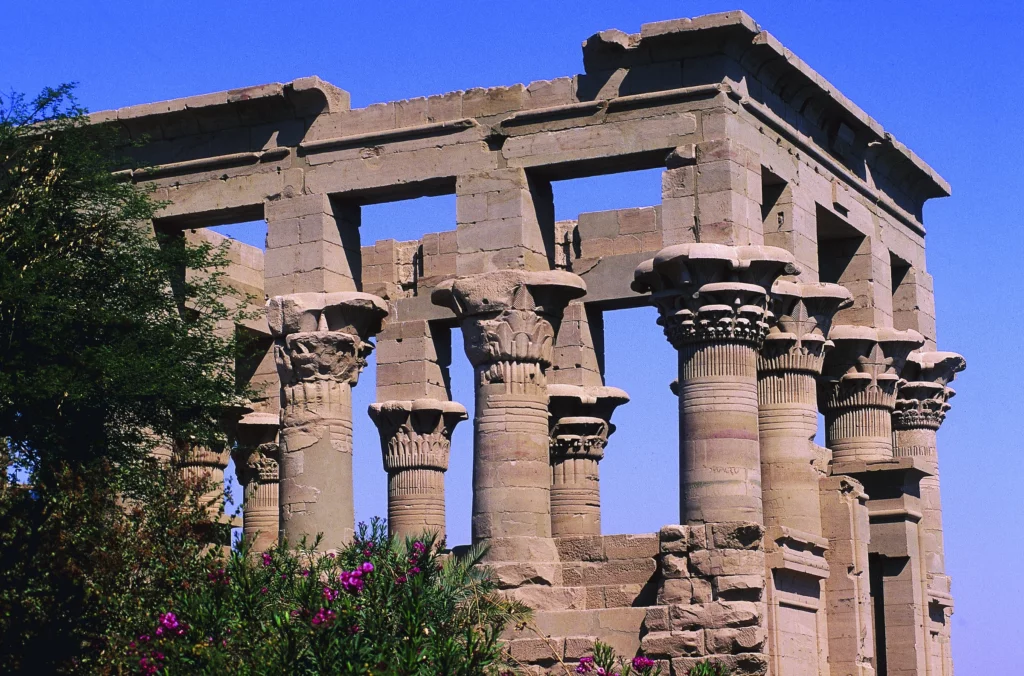
The kiosk of Trajan stands on the east bank of Philae, south of the temple of Hathor. Its columns with floral capitals, linked by screen walls, form one of the best-known silhouettes of the site. The name of Trajan is linked to the offering scenes that depict him, but the construction of the building may be earlier. Like the other great monuments of Philae, it was moved to the island of Agilkia during the UNESCO rescue campaign.
What you discover
The rectangular pavilion has fourteen columns. Its roof has disappeared and the low walls let the eye pass freely. It belongs to the Roman-period additions to the sanctuary of Isis, without being on its own an independent temple comparable to the great temple nearby.
The gate of Hadrian lies in another area, west of the temple of Isis. The two monuments have different forms and functions.
What to look at
Only the screen walls on the south side received two offering scenes under Trajan. There the emperor honours the deities of the sanctuary, Isis, Osiris and Horus. Elsewhere, the surfaces remained smooth. Parts of the capitals and of the dies, the blocks placed above the columns, also keep reserves of uncarved stone.
This unfinished state makes the work of the site visible. Assembling the pavilion and carrying out its decoration were two separate operations; a sovereign’s name in a relief does not automatically date all the stones of the building.
Its history
Trajan reigned from AD 98 to 117. The decoration of the kiosk belongs to his time. Construction as early as the reign of Augustus has, however, been proposed, notably in Holger Kockelmann’s synthesis. The chronology of the main structure remains debated.
The kiosk probably served as a resting place during processions. This function remains an interpretation, in the absence of an inscription that states it clearly. Its opening onto the river recalls the importance of routes by water in the working of Philae.
The rescue work carried out from 1972 allowed it to be dismantled and then rebuilt on Agilkia. The surviving silhouette now combines ancient stones and modern restoration assemblies.
Sources
- Holger Kockelmann, ‘Philae’, UCLA Encyclopedia of Egyptology, 2012, historical and archaeological study, especially pp. 4–8.
- Egyptian Ministry of Tourism and Antiquities, Philae.
- UNESCO, World Heritage Centre, Nubian Monuments from Abu Simbel to Philae, for the rescue, the inscription and the authenticity of the relocated monuments.
References consulted on 20 November 2026.