In brief
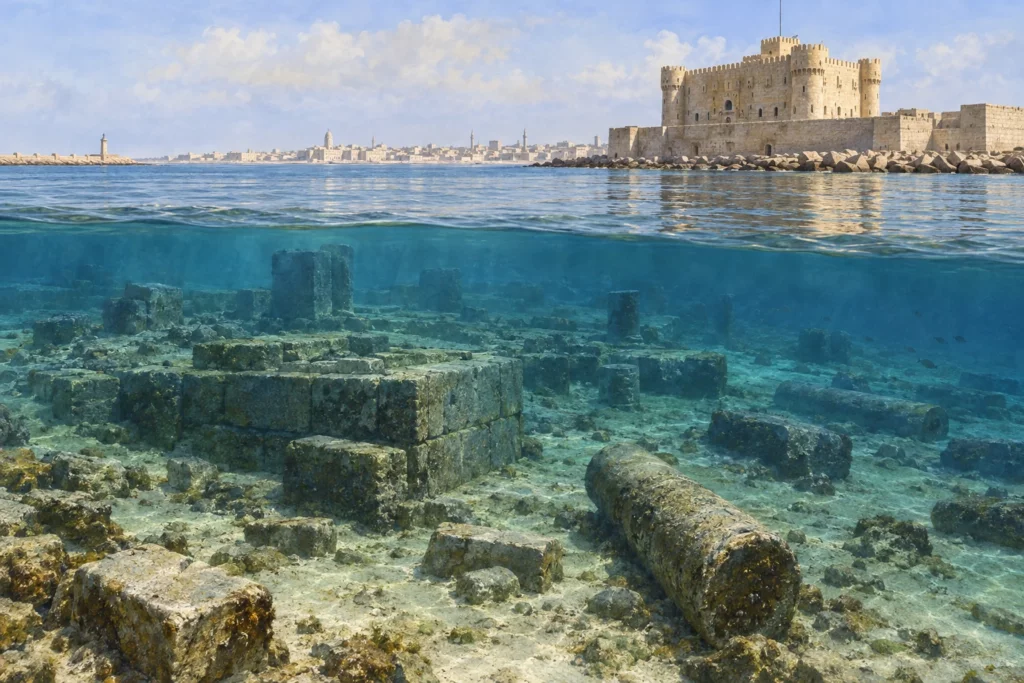
The lighthouse of Alexandria stood at the eastern tip of the former island of Pharos, at the entrance to the great harbour of the Ptolemaic capital. According to a late text, the Suda, work began in 297 BC under Ptolemy I; the building was completed under Ptolemy II, at the time of the 124th Olympiad, that is between 283 and 281 BC. Counted among the Seven Wonders of the World, it no longer stands. The Qaitbay fort now occupies its site, and part of its ruins lies under the sea, mixed with blocks of other origins.
What you discover
At the tip, the silhouette that dominates is that of a fortress: a square keep reinforced by a round turret at each of its corners, within an enclosure. This is the fort built by the Mamluk sultan Qaitbay, who in June 1477 visited the site of the ruined lighthouse and, according to the chronicler Ibn Iyas, ordered a tower to be built on the old foundations. The fort was later strengthened by the Mamluks, the Ottomans and Muhammad Ali, damaged by the British bombardment of 1882, and its keep was then rebuilt from 1939. Nothing of the ancient building is therefore visible on land.
The archaeological site is underwater, east of the fort: a jumble of ancient blocks over about 115 metres from north to south and 140 metres from east to west, at depths of 5 to 8 metres. More than 4,000 blocks have been recorded there: columns, architectural elements and fragments of statues.
What to look at
Among these blocks, thirty-five pharaonic fragments, most of them inscribed, call for caution. They include pieces of two pairs of obelisks of Seti I, closed papyriform columns and architraves of Apries, as well as sphinxes, the oldest bearing the name of Senusret III and the most recent that of Psamtik II. These pieces are much earlier than the foundation of Alexandria; they were therefore brought from other Egyptian sites to adorn the Greek city. Their presence at the foot of the fort is a reminder that not every block submerged here belongs to the lighthouse. Nineteen of them are now displayed in the open-air museum of Kom el-Dikka, where the royal cartouches can be read out of the water.
Its history
Ancient images and medieval descriptions make it possible to reconstruct a tower in three superimposed sections, square, then octagonal, then circular, topped by a statue. Tradition places a fire at the top, but how fire and statue coexisted remains unresolved, and the exact height of the building has not been established. The lighthouse stood for nearly sixteen centuries. The earthquake and tsunami of 8 August 1303 brought about its collapse; the restoration ordered in 1304 by the emir Baybars al-Dawadar was not carried out, and the ruins served as a quarry before being taken by the sea. The fall of the lighthouse left a gap in the defence of the harbour, which the Qaitbay fort filled more than a century and a half later.
Sources
Consulted on 30 September 2026: The lighthouse of Alexandria, Pharos programme, Centre d’études alexandrines (in French); Georges Soukiassian, Fragments pharaoniques du site sous-marin du fort Qaitbay (Alexandrie), Études alexandrines 55, Centre d’études alexandrines (in French); Kathrin Machinek, ‘Le fort Qaitbay, successeur du phare’, Pharos programme, Centre d’études alexandrines (in French).