In brief
The Qaitbay fort occupies the eastern end of the former island of Pharos, at the entrance to the Eastern Harbour of Alexandria. The Mamluk sultan al-Ashraf Qaitbay, who came to visit the place in 1477, had a tall square tower built there; according to the Egyptian Ministry of Tourism and Antiquities, the work lasted from 1477 to 1479 (AH 882–884). The structure was meant to protect the harbour and the city against corsairs and the Ottoman threat. It stands on the site of the ancient lighthouse, which collapsed in 1303 after a violent earthquake, and its builders reused the blocks of the ruin. The fort is therefore not a reconstruction of the lighthouse, but a fortress of the late 15th century, remodelled over four centuries.
What you discover
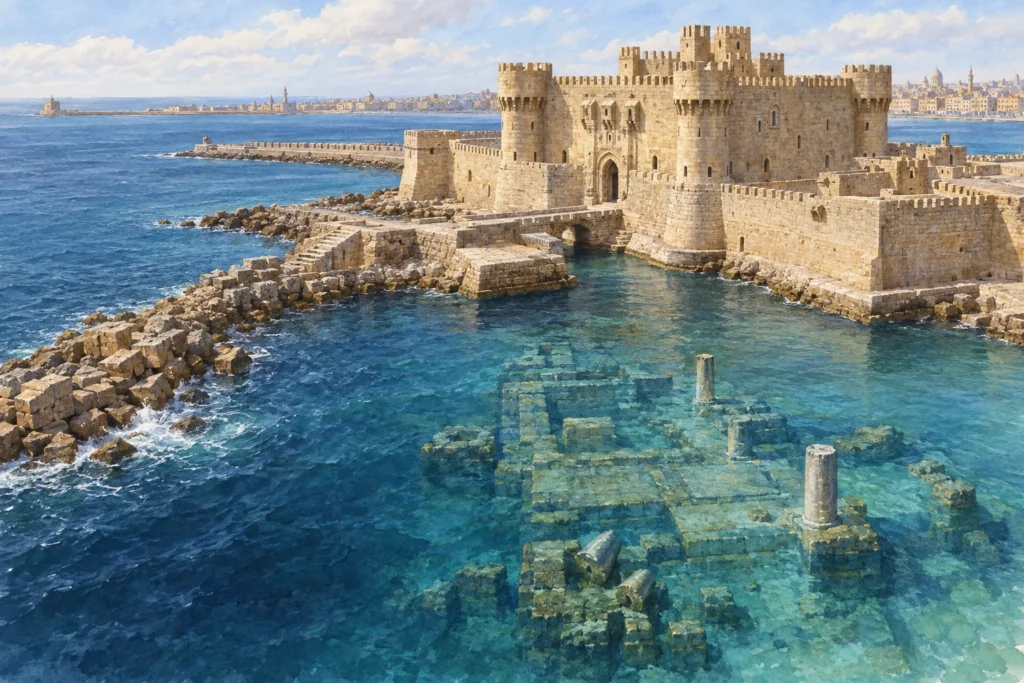
The complex, built of limestone, covers about 17,550 square metres. An outer enclosure punctuated by defensive towers surrounds the whole; an inner enclosure closes the courtyard of the citadel and houses rooms, some used as barracks, others as storerooms. In the centre stands the keep, a massive square tower on three levels, whose four corners are occupied by semicircular towers with projecting balconies. Near the tower, a cistern supplied water to the soldiers and their horses. Seen from the Corniche, the silhouette looks as if it were built in one go; it is in fact the result of successive campaigns.
What to look at
The first detail is chronological: the fortress visible today is not the fort of 1479 left intact. The Mamluks added a forward wall and developed the gatehouse; the Ottomans built artillery platforms and quarters for the janissaries; in 1798, Bonaparte’s engineers had the civilian houses that had grown up on the site demolished. In the middle of the 19th century, the structure became a bastioned fortification, with casemated firing chambers and new barracks. The British bombardment of 1882, directed against Urabi’s insurgents, ended its military role. Listed as an Islamic monument in 1887, the fort remained in ruins for some sixty years before the restorations of 1938 and 1950; during new works in 2001–2002, the Centre d’études alexandrines (CEAlex, Centre for Alexandrian Studies) was able to carry out test pits, surveys and a study of the building there.
The second detail is under the sea, at the foot of the walls. Since 1994, CEAlex divers have recorded more than 3,000 blocks there: columns, capitals, bases and fragments of colossal statues, some weighing up to 40 tonnes, in stones that were often imported (granite, quartzite, greywacke, marble). The archaeologists distinguish at least three groups: the remains of the lighthouse to the north-west, a Roman-period construction to the north-east and, to the south, along the fort, a protective dyke made of reused granite columns. Not everything lying at the foot of the fort therefore comes from the lighthouse.
Its history
The fort belongs to the long history of the defences of Alexandria. After the Arab conquest of 642 and the founding of Fustat, the city shrank; in the 9th century, under Ibn Tulun, a new, shorter wall replaced the ancient one. The Mamluks strengthened the Eastern Harbour with several new forts, of which Qaitbay is the best preserved, while the Ottomans equipped the Western Harbour. Most of these walls and forts were dismantled at the beginning of the 20th century, which gives the fort its value as a witness.
The link with the lighthouse is real but limited: the fort shares its site and some of its stones, not its plan. The height and elevation of the lighthouse cannot be deduced from the fortress, and the ancient blocks, on land as underwater, are identified piece by piece, using the surveys and three-dimensional digital models produced by the CEAlex.
Sources
Consulted on 30 September 2026: Qaitbay Fort, Egyptian Ministry of Tourism and Antiquities; The fortifications of Alexandria in the medieval and Ottoman periods, Centre d’études alexandrines (in French); Underwater excavations on the site of the lighthouse, Centre d’études alexandrines (in French).