Identification and location
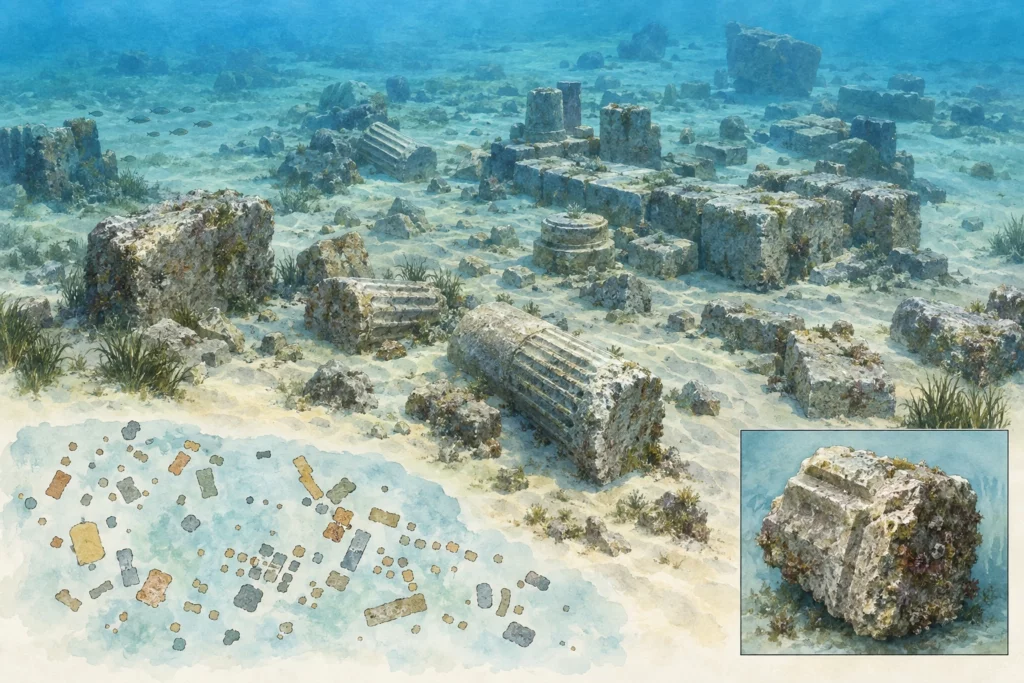
The lighthouse of Alexandria rose at the eastern tip of the former island of Pharos, at the entrance to the Eastern Harbour. This tip now forms the Anfushi peninsula, where the Qaitbay fort, built at the end of the 15th century, occupies the site of the monument. The submerged archaeological site extends east of the fort, at depths of 6 to 8 metres; it covered about 1.6 hectares in 2019, within a submerged zone of about 3 hectares.
A royal commission and a disputed dedicator
According to the Suda, a late Byzantine text, work began in 297 BC under Ptolemy I; it was completed under Ptolemy II, during the 124th Olympiad, that is between 283 and 281 BC. Pliny the Elder puts its cost at 800 talents. Strabo reports that Sostratus of Cnidus, described as a friend of the kings, dedicated the monument, and an inscription commemorated this dedication to the Saviour Gods, the deified Ptolemy I and Berenice. Pliny and Lucian of Samosata make Sostratus the architect; the court title that Strabo gives him suggests rather that he financed the construction. Lucian tells the anecdote of Sostratus’s name carved and then hidden under a plaster bearing the king’s, which the fall of the plaster is said to have revealed.
The tower according to the texts and images
Strabo describes a tower of several storeys, in white stone, dominating the great harbour. The poet Posidippus evokes the great fire burning at its top, and Pliny a fire kept going without interruption. Ancient representations, notably on coins, and medieval descriptions reconstruct three sections, square, octagonal then circular, topped by a statue; the coexistence of the fire and the statue at the top remains an unresolved problem. The height is not known with certainty: the tower of Taposiris Magna, some thirty metres high, is regarded as a reduced-scale copy of the lighthouse.
From the report of 1961 to the CEAlex seasons
As early as 1961, the Egyptian diver Kamal Abu el-Saadat located some submerged monuments; in 1968, the underwater archaeologist H. Frost, commissioned by UNESCO to assess the site, was the first to associate it with the lighthouse. The site then remained little studied, diving being largely forbidden on these coasts. In 1994, the dumping of concrete blocks for a breakwater protecting the fort threatened the remains. The Egyptian Supreme Council of Antiquities then called on the archaeological teams present in Alexandria. Since then, the Centre d’études alexandrines (CEAlex, Centre for Alexandrian Studies) has excavated there, with one or two seasons a year, now under the direction of Isabelle Hairy. Thirty-six pieces raised from the water in 1995 and 1996 are displayed in the city centre.
On 1 January 2020, 3,040 blocks were registered in the descriptive database: granite, quartzite, granodiorite, greywacke, marble and limestone, with elements of lead, iron and bronze. Some architectural and statuary fragments in hard stone, including colossi of royal couples, weigh up to 40 tonnes. Since 2012, a photogrammetric survey has produced a digital model covering about 65% of the site and 154 three-dimensional models of blocks.
Three superimposed developments
The excavations distinguish three groups: the lighthouse in the north-western part of the site, a Roman-period construction to the north-east, marked by a monumental granite honorific column with a base decorated with acanthus leaves, and, to the south, a coastal protection dyke reusing granite columns. The building, severely struck by the earthquake and tsunami of 8 August 1303, was not restored despite the order given in 1304 by the emir Baybars al-Dawadar; its ruins served as a quarry. The underwater remains probably represent a small part of the monument, and attributing each block to the lighthouse rather than to other buildings of the city remains the main challenge of research, as does the reconstruction of its upper parts.
Sources
Main sources (consulted on 30 September 2026): Underwater excavations on the site of the lighthouse, Centre d’études alexandrines (in French); The ancient texts, Pharos programme, Centre d’études alexandrines (in French); The lighthouse of Alexandria, Pharos programme, Centre d’études alexandrines (in French); Jean-Yves Empereur and Nicolas Grimal, ‘Les fouilles sous-marines du phare d’Alexandrie’, Comptes rendus de l’Académie des inscriptions et belles-lettres, 1997 (Persée) (in French).