Identification and location
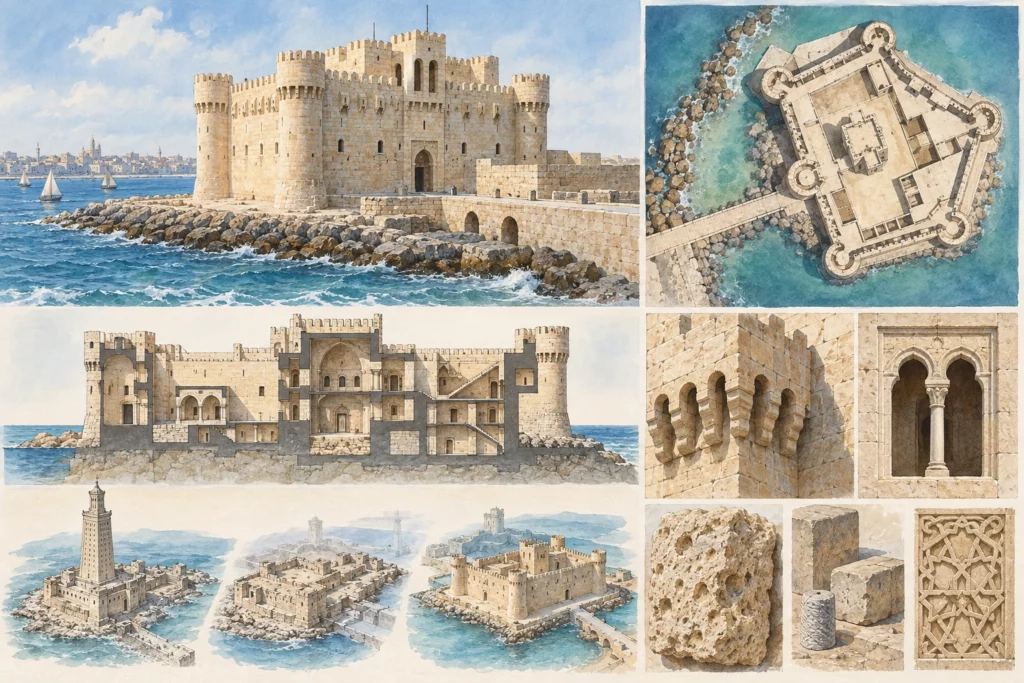
The Qaitbay fort stands at the eastern end of the former island of Pharos, now joined to the mainland, at Alexandria. It occupies the site of the famous ancient lighthouse and commands the entrance to the Eastern Harbour. Its silhouette has become one of the emblems of the city.
Chronology
The fort was built between 1477 and 1479 (AH 882–884, according to the Egyptian ministry) on the orders of the Mamluk sultan al-Ashraf Qaitbay, who had just visited Alexandria. The city had to be protected against the growing threat of the Ottoman Empire and against attacks from the sea. The work reused blocks of the lighthouse, ruined by earthquakes in the 14th century, whose remains still cluttered the tip of the island.
Architecture
The complex consists of a square keep on several levels, flanked by corner towers, in the middle of a vast courtyard. The keep housed a small mosque, rooms for the garrison and storerooms. A double enclosure, flanked by towers and pierced with loopholes, surrounds the courtyard; the side facing the sea was particularly reinforced. Ancient granite blocks, reused in the walls and foundations, are still visible. According to the Egyptian ministry, the building is of limestone and covers about 17,550 m²; the inner courtyard includes barracks, storerooms and a water tank for the soldiers and horses.
History
After the Ottoman conquest of Egypt in 1517, the fort remained garrisoned. Muhammad Ali had it modernised in the 19th century, adapting it to artillery. In 1882 it was badly damaged during the bombardment of Alexandria by the British fleet. It was restored in the 20th century, then laid out as a museum; the ministry mentions further conservation work and an extension in 2003.
The fort and the lighthouse
The Egyptian ministry describes the main keep as a square tower on three levels, flanked by four semicircular corner towers with projecting balconies. It recalls that the monument was built on the ruins of the ancient lighthouse to defend the city against naval attacks. The fort is open to the public every day. The fort belongs to the medieval history of Alexandria and does not reproduce the architecture of the lighthouse. It does, however, keep its site and some of its materials. The underwater excavations carried out at the foot of the fort since the 1990s have located thousands of blocks, columns and statues, some of which may come from the lighthouse; they are studied separately from the Mamluk monument.
State of preservation and research questions
Exposed to the waves, the salt air and coastal erosion, the fort is the subject of protection and restoration work. Research focuses on the Mamluk, Ottoman and modern building phases, and on the identification of the reused ancient blocks.
Sources
Main sources (consulted on 28 September 2026): Egyptian ministry, Qaitbay fort; Egyptian ministry, submerged site of the Qaitbay fort.