In brief
Oxyrhynchus, now el-Bahnasa, lies in the governorate of Minya, in Middle Egypt. Its Egyptian name, Per-Medjed, is recorded by the British Museum; its Greek name refers to a Nile fish. The site is best known for an exceptional body of papyri, but it is not limited to its archives: the town has also left necropolises, objects of daily life and traces of an occupation that continued into the Islamic period.
What you discover
Visitors will not find here a great temple standing in the landscape. The site appears as a series of mounds, cemeteries and areas of housing partly covered by the modern town. The Egyptian Ministry of Tourism and Antiquities describes at el-Bahnasa old cemeteries and burial hills, as well as shrines dedicated to figures of Islam. Three domes are recorded there: those of the Seven Maidens, of Ubada ibn al-Samit and of Muhammad ibn Abi Dhar al-Ghafari. The place thus layers several memories, pharaonic, Graeco-Roman and Muslim, without any one erasing the others.
What to look at
The most telling detail lies in the recently excavated tombs. An Egyptian-Spanish mission, directed by Esther Pons of the University of Barcelona, has cleared a 26th Dynasty tomb consisting of a single chamber of polished limestone, entered from the north. Its ceiling is flat, whereas the neighbouring tombs usually have a vault, and it contained no funerary equipment. Eight Roman-period tombs, with vaulted ceilings and no decoration, were found in the same excavation; they contained inscriptions, bronze coins, small crosses and clay seals. These modest objects, crosses and seals, say more about late funerary practices than any spectacular decoration.
Its history
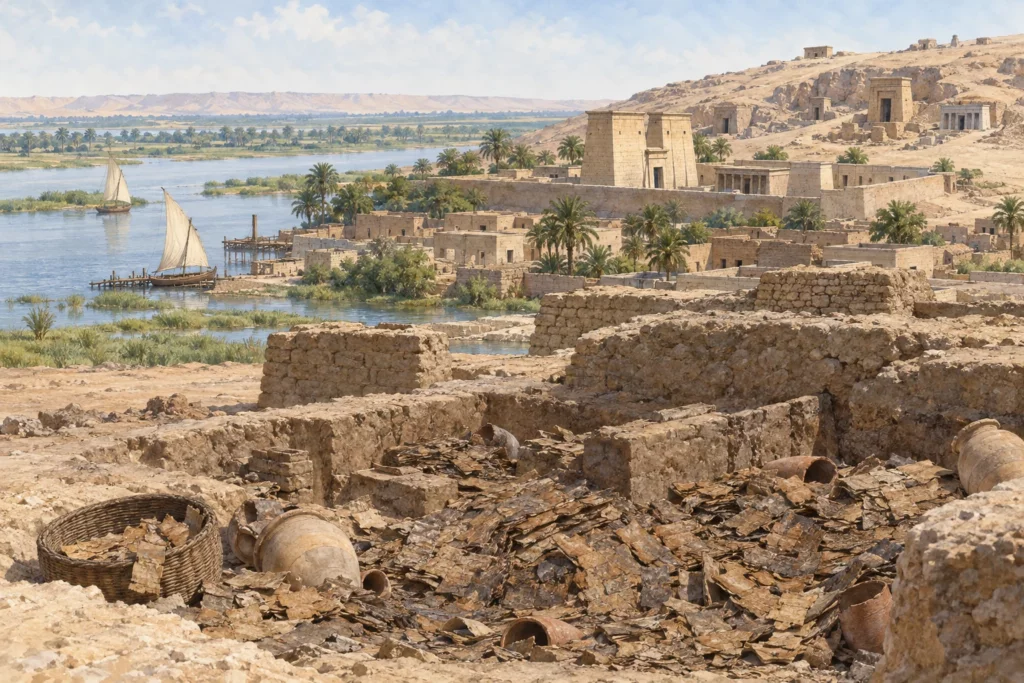
The papyri of Oxyrhynchus were collected between 1896 and 1907 by the Oxford scholars Bernard Grenfell and Arthur Hunt, on behalf of the Egypt Exploration Fund, which became the Egypt Exploration Society. They are now kept in Oxford, in what the university project presents as the largest collection of its kind in the world. The texts are written mainly in Greek, from the 2nd century BC to the 7th century AD, but also in Latin, Demotic, Coptic and Arabic. The variety of languages follows that of the populations and regimes that succeeded one another.
The British Museum holds nearly four hundred objects from Oxyrhynchus, coins, textiles, pottery and architectural fragments, covering a period from the Hellenistic era to the Mamluk world. This continuity is a reminder that the town did not disappear with Antiquity. According to the ministry, it held a strategic commercial position on the route to the Bahariya oasis; its garrison is said to have put up strong resistance to the Muslim army during the conquest, which explains the veneration later paid to its martyrs.
Several limits are worth bearing in mind. A papyrus found in a rubbish dump does not locate the building in which it was written. The texts also reflect what was written, thrown away and preserved by the dry climate, not the population as a whole. Finally, the ancient town is largely inaccessible beneath present-day buildings, so that its overall plan remains poorly known.
Sources
Consulted on 30 September 2026: Oxyrhynchus Papyri Project, University of Oxford; Discovering a unique tomb dates back to the Saite Period in al-Bahnasa, Egyptian Ministry of Tourism and Antiquities; Oxyrhynchus, British Museum.