In brief
At Meidum, in the governorate of Beni Suef, stands a monument of decisive importance in the history of pyramids. Begun as a step pyramid, the structure was enlarged and then turned into a smooth-sided pyramid under Sneferu, the first king of the 4th Dynasty. Its present appearance is surprising: a core of several levels rises from a vast heap of stones. This landscape makes it possible to read the successive ambitions of the building project without confusing them with its lost final form.
What you discover
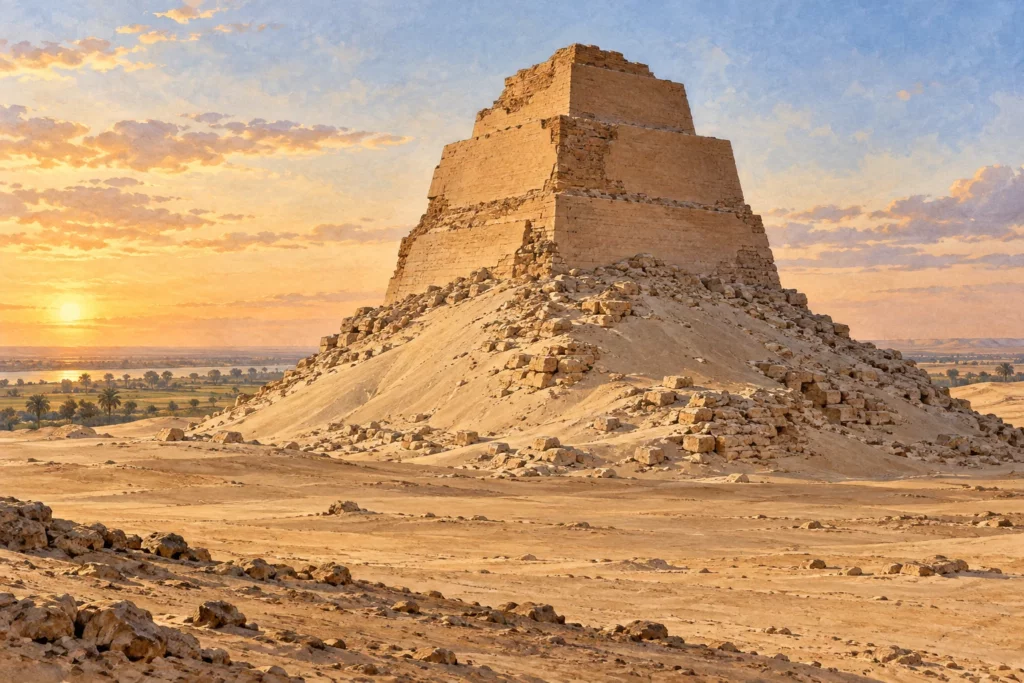
Visitors mainly see a tall masonry core, often described as a three-stepped tower, surrounded by a slope of debris. The pyramid was once wider and higher. Its entrance, on the north face, leads to a descending passage, then to a corridor and to the burial chamber, whose roof is built as a corbelled vault. To the east lie the remains of the funerary temple; the complex also included a small satellite pyramid and a causeway. These elements are a reminder that the pyramid belonged to a complex, not to an isolated building.
Its history
Archaeologists distinguish three main stages: a first step pyramid, its enlargement, and then the addition of an outer casing intended to create smooth faces. They are known as E1, E2 and E3. The monument is now badly damaged. The idea of a sudden collapse during construction was long repeated; the study of the debris layers points rather to gradual destruction. Another debate: earlier scholars sometimes attributed the start of the work to Huni. The name of Sneferu is attested at Meidum, whereas that of Huni has not been found there.
Why this place matters
Meidum sheds light on the transition from step pyramids to smooth-sided pyramids. Its changes of plan reveal technical choices and a determination to transform the outward appearance. The site also shows how a ruin can tell a complex story: its present form corresponds neither to the first project nor to the final elevation. The exact date and manner of the loss of the casing remain to be studied. The images supplied separately are interpretive creations, with no value as a metric survey.