In brief
At Gabal al-Tayr, in the governorate of Minya, an Egyptian archaeological mission announced in June 2026 the discovery of part of a Predynastic cemetery. The burials identified are attributed to the Naqada II and III phases, at the end of the 4th millennium BC. They show that the place was used for the dead long before the historical periods that left other tombs in the same area. Study of the site is still under way: the results published so far are preliminary.
What you discover
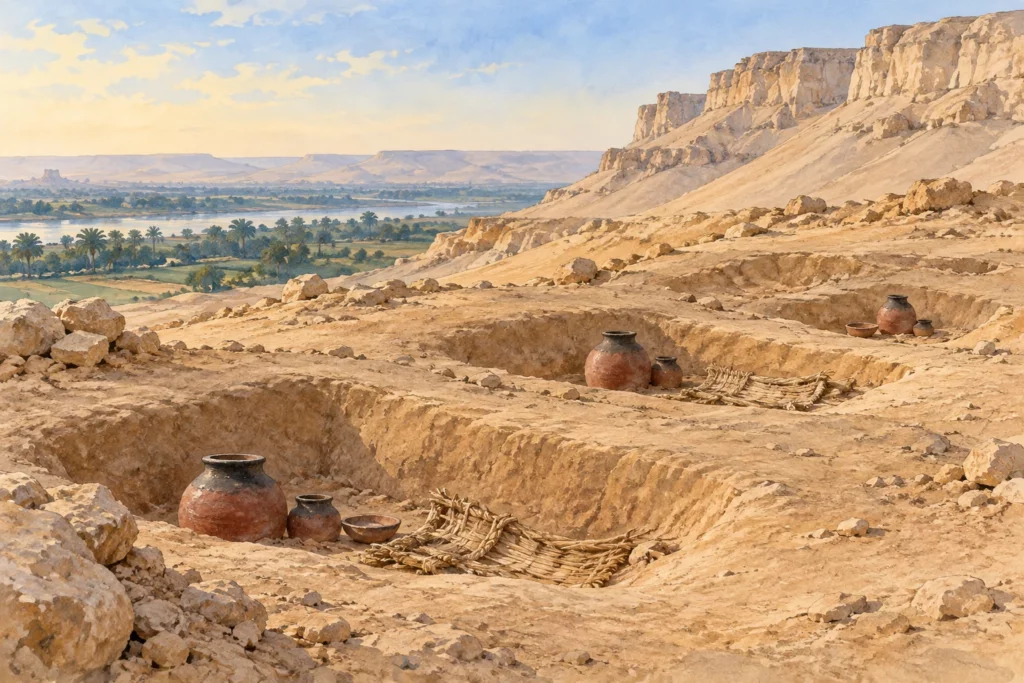
The excavators reported burials in a contracted position, accompanied by the remains of decayed plant mats. Near some tombs lay black-topped pottery, useful for placing the deposits in the chronology of Naqada II and III. These modest elements tell the story of the site’s first burials better than any monumental architecture. In the same area, two tombs of the Early Dynastic period have a different construction and belong to a later phase. Other burials, individual or collective, date from the Late Period. All these remains should not be gathered into a single contemporary cemetery.
Its history
The dating of the Predynastic burials rests in particular on the associated pottery and on comparison with other groups in the Nile valley. The position of the dead and the traces of mats are field observations; the precise meaning of the funerary gesture remains to be studied. Black-topped pots are not a snapshot of an entire era: their form and context must be described tomb by tomb. The total number of burials, their layout and their detailed sequence have not yet been published in an excavation monograph.
Why this place matters
Gabal al-Tayr adds to the map of Predynastic burial places in Middle Egypt. Its interest also comes from the succession of several periods on the same ground, which makes it possible to study changes in practice over the long term. The 2026 discoveries are promising, but conclusions on social organisation, exchange or the development of architecture require published plans, inventories and dates.