In brief
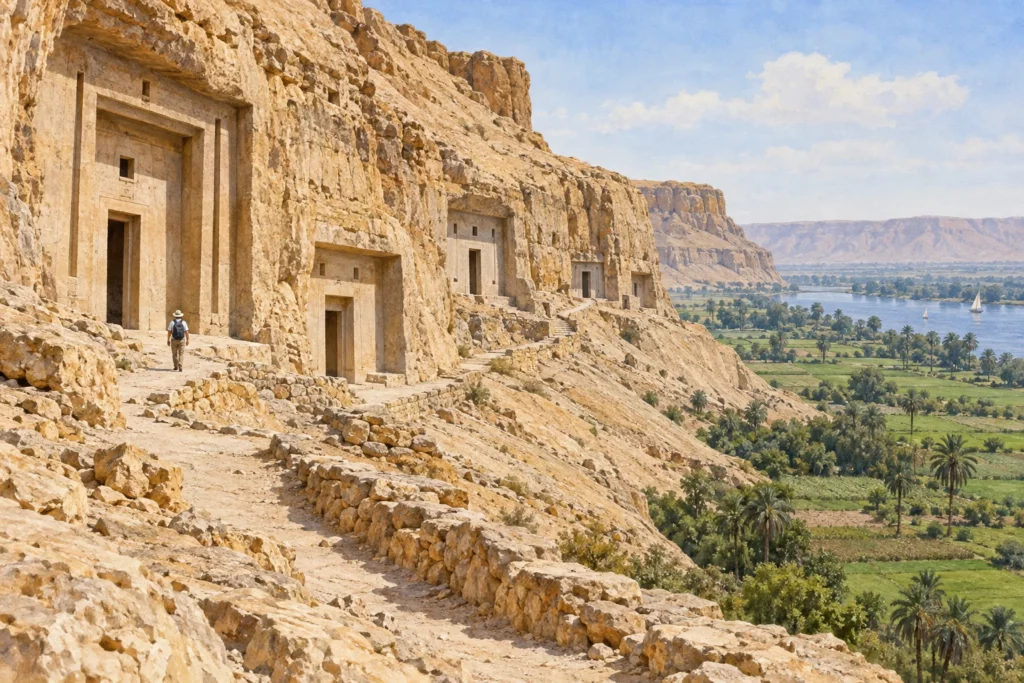
Beni Hasan lies in the governorate of Minya, in Middle Egypt, in one of the most fertile regions of the country. The tombs are cut into the limestone cliff overlooking the Nile valley. The Egyptian Ministry of Tourism and Antiquities distinguishes two groups: a lower cemetery of about 800 tombs, many of them shaft tombs, and an upper cemetery of 39 rock-cut tombs. The site belongs to the province known as the Oryx nome, the sixteenth nome of Upper Egypt, and is not tied to a single generation of governors.
What you discover
The great rock-cut tombs of the upper part belong to provincial officials of the Middle Kingdom, mainly of the 11th and 12th Dynasties (c. 2055–1795 BC according to the ministry’s chronology). The names Baqet, Khety and Khnumhotep recur from generation to generation, which suggests family ties between some of the owners. Twelve tombs preserve painted scenes: farming, crafts, hunting, games, warfare and the arrival of foreigners in Egypt. The lower part is in part older: it includes tombs of the late Old Kingdom and the First Intermediate Period, among them that of Ipi, mentioned by the ministry.
What to look at
The tomb of Khnumhotep II offers several points of interest. The owner, ‘Overseer of the Eastern Desert’ under Senusret II (c. 1911–1870 BC), had an entrance portico built with two fluted columns of the so-called proto-Doric type, preceded by a courtyard. In the chapel, two burial shafts are recorded; four columns, in two rows of two, probably structured the interior space. Along the lower walls runs a biography of 222 columns of text. Fishing and fowling scenes also appear, as well as a more unexpected detail: on the west wall, three monkeys help pickers to harvest figs.
The most discussed scene is on the north wall: a delegation of 37 visitors from abroad presents eye paint to Khnumhotep. Their leader, named Abisha(i), bears the title ‘ruler of a foreign land’ (heqa khasut). The ministry sees in it the earliest attestation of this title, from which the Greek name Hyksos later derives.
Its history
As UCL Digital Egypt points out, large tombs of provincial notables, mayors or district governors appear as early as the 1st Dynasty, and rock-cut tombs become common at the end of the 4th. Beni Hasan is one of the eight great cemeteries of this type in the Middle Kingdom, alongside Elephantine, Qau el-Kebir, Meir, Deir el-Bersha and Asyut. The production of these great tombs ceases at the end of the 12th Dynasty.
The images must nevertheless be read with caution. The scene of the Asiatic visitors shows a delegation within the decorative programme of a tomb; on its own, it is not enough to trace a movement of population. The paintings, moreover, preserved in only twelve of the thirty-nine tombs, should not be generalised to the whole site.
Sources
Consulted on 30 September 2026: Egyptian Ministry of Tourism and Antiquities, Beni Hasan; Egyptian Ministry of Tourism and Antiquities, The Tomb of Khnumhotep II; UCL Digital Egypt, Tombs of Nomarchs and Mayors.