Identification and location
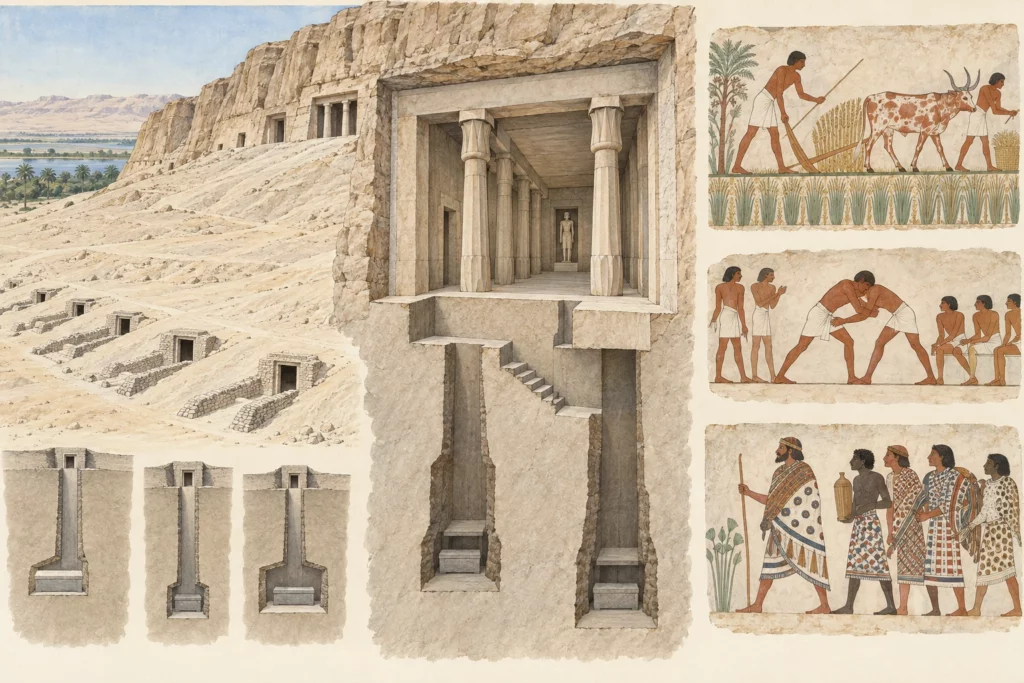
Beni Hasan is a cemetery in Middle Egypt set in the cliff above a fertile farming region. The Egyptian ministry distinguishes a lower cemetery of about 800 tombs, used from the late Old Kingdom to the Middle Kingdom, and an upper cemetery of 39 rock-cut tombs. The great chapels of the upper part belong mainly to the 11th and 12th Dynasties and to the senior officials of the sixteenth nome of Upper Egypt, known as the Oryx nome. The tombs do not form a group built in a single year, nor one reserved for a single family.
General presentation
The interest of Beni Hasan lies in the combination of rock-cut architecture, biographies and surviving paintings. Twelve tombs of the upper cemetery bear visible scenes. They show farming, trades, physical activities, hunting and relations with foreigners. The names Baqet, Khety and Khnumhotep, repeated over several generations, suggest family ties, to be clarified tomb by tomb. The images provide data on provincial society, but their funerary programme also arranges an ideal world for the owner.
Monuments and remains
The cliff tombs were cut horizontally into the limestone. Approaches from the slope led to courtyards, porticoes and cult rooms, sometimes provided with columns and statue niches. The burials could be placed in separate shafts. The tomb of Khnumhotep II, under Senusret II, has a portico with two columns, a columned hall and an end niche. A biography of 222 columns runs along the lower part of the walls, according to the ministry’s description. The lower tombs, often shaft tombs, have other dimensions and statuses: illustrating them as painted chapels comparable to the great tombs would be wrong.
Chronology and building phases
The lower cemetery includes tombs of the First Intermediate Period and even a few burials of the late Old Kingdom. The upper monumental group extends mainly from the 11th to the 12th Dynasty, with no single date for the whole site. The succession of holders of local offices can be traced in the inscriptions and styles, but it calls for a prosopographical study. The monuments were visited, and sometimes annotated by scribes, in later periods. Modern surveys, photographs and facsimiles are documentary stages distinct from the creation of the ancient paintings.
History and functions
The cult spaces received offerings and kept alive the memory of the dead person. Paintings of agricultural and craft production could express the abundance needed for the owner’s survival. Scenes of wrestling, hunting or sailing also enhanced skills and rank. In the tomb of Khnumhotep II, a group of 37 Aamu, men, women and children from the east or north-east, bring eye paint. The Metropolitan Museum stresses that the scene and the associated signs allow several readings. On its own, it proves neither a mass migration nor a clear-cut political relationship.
Excavations and the history of research
The ministry’s descriptions provide the general framework and detailed accounts of particular tombs, including those of Khnumhotep II, Amenemhat and Khety. The Metropolitan Museum holds a modern copy of the Aamu scene and discusses its ambiguities: the museum object is a reproduction, not the original painting removed from the tomb. Excavation publications and on-site surveys remain necessary to locate each motif and examine its condition. A synthesis of the site must avoid automatically transferring to all the tombs the details of one of them.
State of preservation and research questions
The surviving paintings are famous, but they represent only twelve of the thirty-nine tombs of the upper part.
Sources
Main sources: Egyptian Ministry of Tourism and Antiquities, ‘Beni Hasan’, https://egymonuments.gov.eg/archaeological-sites/beni-hasan/; ‘The Tomb of Khnumhotep II’, https://egymonuments.gov.eg/monuments/the-tomb-of-khnumhotep-ii/; ‘The Tomb of Amenemhat’, https://egymonuments.gov.eg/monuments/the-tomb-of-amenemhat/; Metropolitan Museum of Art, ‘Leaders of the Aamu’, https://www.metmuseum.org/-/media/files/about-the-met/curatorial-departments/egyptian/facsimiles/2016-17_walklikeanegyptian_web.pdf?la=en; UCL, ‘Tombs of Nomarchs and Mayors’, https://www.ucl.ac.uk/museums-static/digitalegypt/province/mktombs.html (consulted on 27 September 2026).