In brief
Bawit lies in Middle Egypt, on the west bank of the Nile, south of ancient Hermopolis and north of Asyut, on the boundary between the desert and the cultivated land. Its name comes from Coptic and means ‘monastery’. At the end of the 4th century, the monk Apollo founded a community there that became one of the great monasteries of Christian Egypt. The place matters as much to the history of Coptic art as to that of the daily life of the monks, known from abundant written evidence: ostraca, painted inscriptions, papyri.
What you discover
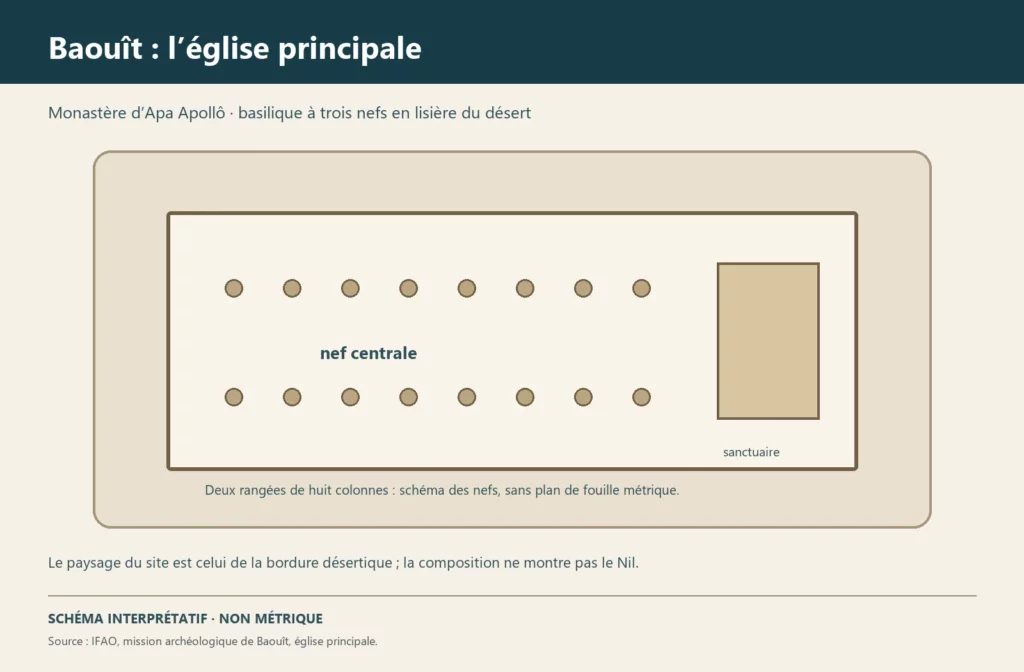
The site appears first as a kom, a vast mound of sand and debris covering about 40 hectares, near the village of Dashlut. Local farmers removed sebakh from it, a fertiliser taken from the ruins, and also extracted various objects. What can be seen today is mainly the result of recent excavations. In the centre of the kom stand the walls of several churches, among them a north church measuring 20.10 m by 12.20 m. The main church, 21 m by 40 m, is built on a three-part plan, with two rows of eight columns. Further north extend residential buildings. Most of the sculpture and paintings discovered at the beginning of the 20th century have left the site.
In the north church, a khurus, a space set in front of the sanctuary, indicates that the building is later than the middle of the 7th century. Graffiti found on the spot suggest that it was dedicated to the archangel Michael.
What to look at
The most telling detail is in room 7 of building 1, a residential complex of the first half of the 7th century. Its painted vault shows the birth of Christ, two of the founders of the monastery, nine prophets and peacocks. In the niche of the east wall, Christ appears surrounded by seraphim, and the archangels Michael and Gabriel belong to the same programme. This decoration shows that a living room could receive a religious programme as carefully made as that of a church.
The inscriptions deserve the same attention. Besides texts for dead monks, some bear an artist’s signature, rare for the period: ‘The sculptor is I, Joseph. Pray for me!’ (translated from the French).
Its history
Jean Clédat, a fellow of the Institut français d’archéologie orientale (IFAO, French Institute of Oriental Archaeology), surveyed the site at the beginning of 1901, then opened an official excavation there at the end of the same year. He linked the place, at the same time as the Englishman Walter E. Crum, with the monastery of Apa Apollo, and copied the paintings in watercolour until 1905. The finds were divided in 1902: about 200 objects remained in Cairo, at the Coptic Museum, and some 400 went to the Louvre, which opened a Bawit room in 1929 where part of the south church is reconstructed. Jean Maspero resumed the work in 1913; the Egyptian Antiquities Organisation intervened in 1976, 1984 and 1985. An agreement between the IFAO and the Louvre, signed in 1995, led to an excavation permit only in 2001; work resumed in September 2003 under the responsibility of Dominique Bénazeth.
Much remains uncertain. The date at which the monastery was abandoned has not been established, and the elements dispersed among museums cannot always be put back into a particular building. The visible ruins no longer convey the height of the rooms or the colour that covered their walls.
Sources
Consulted on 30 September 2026: Baouît, le monastère de Saint Apollô, Institut français d’archéologie orientale (in French); Baouît, présentation du chantier (2009), Institut français d’archéologie orientale (in French); Le site de Baouit, Petite Galerie, Musée du Louvre (in French).