Identification and location
The mountain of Gebel Asyut al-Gharbi, west of Asyut, bears a rock-cut necropolis used over a long period. The great tombs of the governors are particularly important for the First Intermediate Period and the Middle Kingdom. Asyut was a centre of the thirteenth nome of Upper Egypt, according to University College London. The monuments of the period of conflict between regional dynasties cannot be reduced to a single episode: their owners, their inscriptions and their building phases must be distinguished. The project of the University of Mainz has undertaken to record their architecture and decoration systematically.
General presentation
Tombs III, IV and V are major sources on the fighting between Asyut and the forces under Theban command at the end of the First Intermediate Period. The project proposes the chronological order V (Khety I), III (Iti-ibi), then IV (Khety II). The texts are not a neutral chronicle: they express the successes, duties and loyalties that the owners wished to display. The study of changes to the decoration shows that political information can also appear in the stratigraphy of a wall, and not only in a carved formula.
Monuments and remains
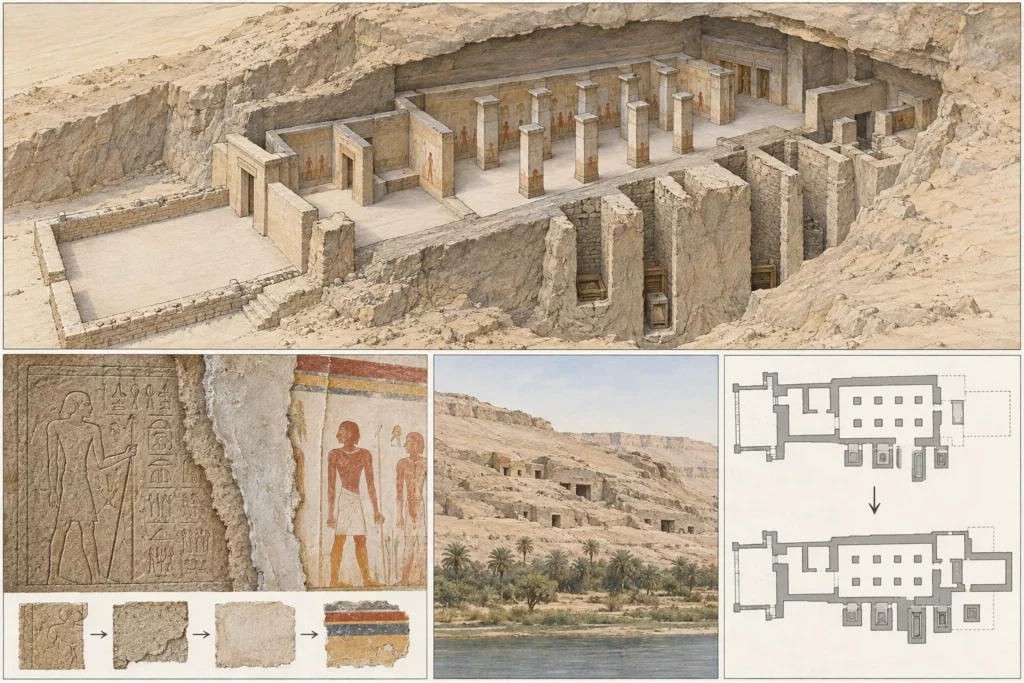
The great tombs were cut into the rock with forecourts, pillared halls, annexes and burial shafts. Tomb III illustrates the need to revisit old plans. During a survey, the project identified a second row of pillars in its main hall. The work also revealed two small rooms in front of this hall and a fourth shaft, in addition to the three already known. These discoveries revised the picture of a plan once considered archaic. They do not allow this plan to be transferred to all the tombs of the necropolis.
Chronology and building phases
The tombs of the governors of the First Intermediate Period were followed by Middle Kingdom monuments, and the mountain then kept a place in Egypt’s cultural memory. The Asyut Project began a first survey in 2003 and carried out a long-term programme from 2005 to 2019. Its research combines mapping, epigraphy, excavation and conservation. Ancient looting and modern interventions have altered the contexts. A sequence of construction and decoration must therefore be deduced from several kinds of evidence rather than from a single old drawing.
History and functions
The tomb was the place of burial and cult of the governor. The autobiographies and the scenes asserted his position in the province and his relations with the king. At Asyut, these statements also reflect political tensions. The project shows that the inscription in tomb III hostile to the Thebans was left unfinished, covered with plaster and replaced by a more neutral image. The material succession of the layers can be observed; the precise motives for the erasure remain a historical interpretation. The funerary cult could continue even as the political context changed.
Excavations and the history of research
The publications and pages of the Mainz project document the tombs by number, their proposed owners and the architectural discoveries. University College London places Asyut among the governors’ necropolises whose texts shed light on the First Intermediate Period. The modern mapping includes hundreds of entrances and aims to set the great tombs within the mountain as a whole. To quote the inscription of Iti-ibi or give an architectural measurement, the epigraphic edition and the survey of the tomb concerned must be used, not a general account of the wars of reunification.
State of preservation and research questions
The mountain of Asyut has been profoundly transformed. Quarries, opened from the early 19th century, caused ceilings and tomb entrances to collapse. Looting and early excavations dispersed the funerary equipment among museums, without recording its context. The site was later occupied by hermits, Coptic monasteries and, more recently, a military zone. It was reopened to archaeologists only in 2003, after some eighty years of closure. The ancient town itself lies buried beneath the Nile alluvium and the modern city.
The German-Egyptian project carried out with Sohag University has recorded more than 300 tombs and structures and inventoried more than 17,000 objects. It has restored several tombs, including tombs I and V. It has also cleared tomb I, that of Djefaihapi I: 55 metres of it survive, out of an original length of at least 120 metres. Several questions remain open: the New Kingdom necropolis has not yet been located; many hieratic graffiti, some barely legible, remain to be deciphered; and the role of Asyut as a centre of exchange is the subject of a follow-up project with the Polish Academy of Sciences.
Sources
Main sources: Johannes Gutenberg-Universität Mainz, ‘The Nomarchs’ Tombs III–V of Asyut’, https://www.aegyptologie.uni-mainz.de/die-gaufuerstengraeber-i-v-von-assiutthe-nomarch-tombs-i-v-of-asyut/; ‘The Project’, https://www.aegyptologie.uni-mainz.de/das-projekt-lage-der-stadt-und-ausgangspunktthe-project-location-of-the-city-and-the-starting-point/; UCL, ‘Tombs of Nomarchs and Mayors’, https://www.ucl.ac.uk/museums-static/digitalegypt/province/mktombs.html; UCL, ‘Asyut, tomb of Mesehti’, https://www.ucl.ac.uk/museums-static/digitalegypt/mk/assiut.html (consulted on 27 September 2026); University of Mainz, ‘The necropolis of Asyut as an important element of Egypt’s cultural memory’, https://press.uni-mainz.de/the-necropolis-of-asyut-as-an-important-element-of-egypts-cultural-memory/ (consulted on 22 October 2026).