Identification and location
Medinet Madi occupies an area of the Faiyum formerly associated with the village of Dja. According to the University of Pisa, its urban history begins in the Middle Kingdom as part of a regional agricultural development. Amenemhat III founded a temple dedicated to Renenutet and to Sobek of Shedet (article on Sobek, in French), and Amenemhat IV then continued the work. The place was still occupied in the Ptolemaic period under the name Narmouthis, and then during the Roman and Christian periods. The ancient core and the visible buildings around it must therefore be dated separately. The Middle Kingdom temple is a rare witness to the religious architecture of the reign of Amenemhat III. The reliefs, sculptures and royal inscriptions make it possible to recognise the involvement of two successive rulers. A statue of the king found in the remains, kept in Milan, confirms this link but must be distinguished from the decoration still in place. The presence of an object in the temple does not automatically fix its original position, especially on a site reworked over a long period.
General presentation
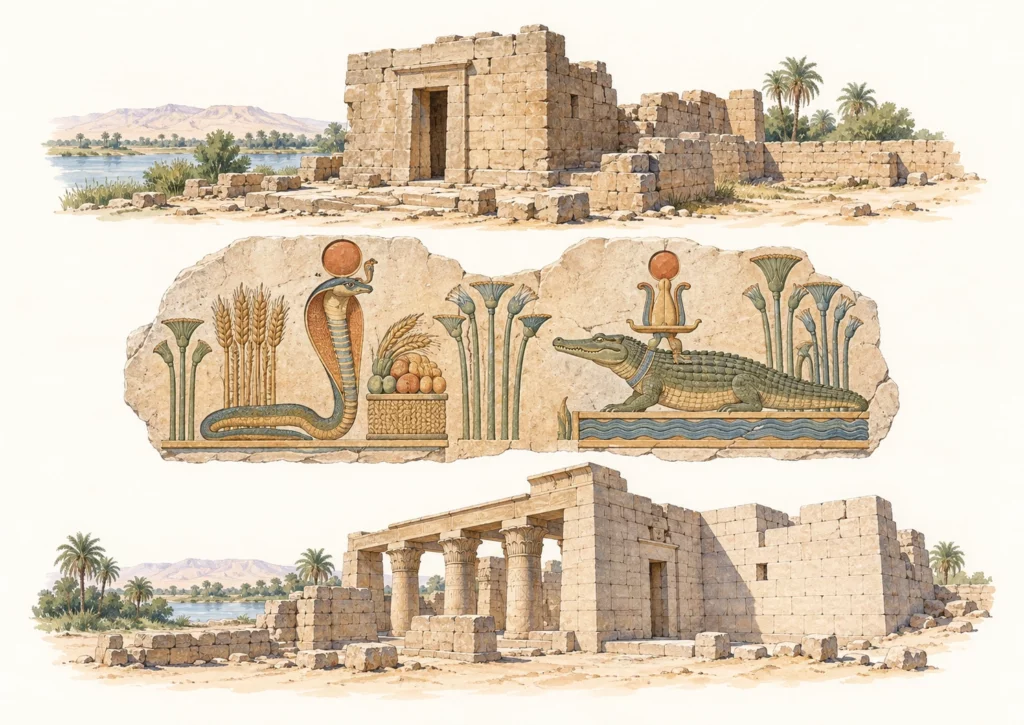
Renenutet is associated with the protection of the harvest and depicted in serpent forms. Sobek, the crocodile god, is central in the Faiyum; his link with Shedet attaches the sanctuary to a wider religious geography. Horus is also named in the programme of the place. The triad should not be reduced to a drawing of three animals: divine images had varied forms and epithets.
Monuments and remains
The Ptolemaic enlargements changed the circulation and presentation of the sanctuary. The Roman buildings and the Coptic churches bear witness to other occupations. An overall view of the site thus mixes several periods in a single field of vision. The University of Pisa describes excavations of urban, domestic and military sectors beyond the temple. The sanctuary cannot be understood in isolation from the town and from changes in the landscape, but these relationships require evidence specific to each period.
Chronology and building phases
The association of the temple with the agriculture of the Faiyum is historically consistent: the goddess of the harvest was honoured in a region where land was being brought into cultivation. It would nevertheless be going too far to deduce from an image of Renenutet the course of a canal, the size of the harvests or the administrative organisation of a particular field. Texts, settlement levels and environmental data must be cross-checked. The site documents the relationship between royal power, cult and village, without revealing all its mechanisms.
History and functions
Modern campaigns have recorded reliefs, architecture and late occupations. The building phases cannot be read from the style of the columns alone: they depend on masonry joints, inscriptions and excavated layers. Pieces bearing a royal name may have been moved or reused. The chronology of the small temple must therefore be kept separate from the date of the annexes. The word ‘first’ in the title refers to the surviving Middle Kingdom core, not to the first cult of Sobek or Renenutet in the whole of Egypt.
Excavations and the history of research
A statue of Amenemhat III from the temple is now in Milan. Objects from excavations have a modern life different from that of the remains left in place. Photographs of the sanctuary also show restorations and arrangements made for its conservation and for visitors. To establish an architectural detail, the excavation team’s publication and the survey of the phase concerned are needed. The reconstructions drawn here do not have the metric precision of those documents.
What we still do not know about Medinet Madi
Discovered by Achille Vogliano between 1935 and 1939, the site has been explored systematically by the University of Pisa since 1978, with major campaigns from 1995 to 2007. The clearance of sand covered an area of about 420 m by 20 m, to an average depth of 4 m, or 35,000 m³ removed. The consolidation of the mudbrick monuments required a million bricks and more than 90 conservators for about a year.
Questions remain: according to the Pisa team, the location of the Middle and New Kingdom necropolises, and that of the sacred animals (cobras and crocodiles), is for the moment still unknown.
Sources
Main sources: Medinet Madi, Egittologia, Università di Pisa (in Italian); Musei del Castello Sforzesco, ‘Statua di Amenemhat III’, https://www.milanocastello.it/it/i-musei/galleria-antico-egitto/highlights/statua-di-amenemhat-iii (in Italian); UCL, ‘Amenemhat III’, https://www.ucl.ac.uk/museums-static/digitalegypt/chronology/amenemhatIII.html (consulted on 27 September 2026).