In brief
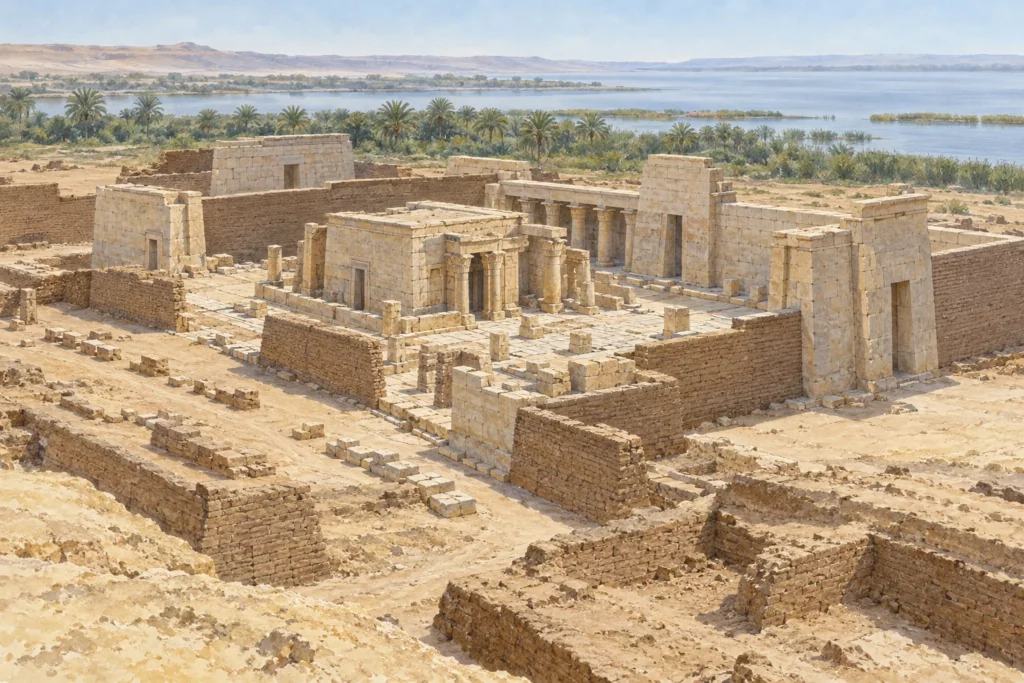
Medinet Madi, in the Faiyum, was called Dja in the Middle Kingdom, then Narmouthis in the Graeco-Roman period, ‘the town of Renenutet’. Its small temple, founded by Amenemhat III at the same time as the town and decorated with reliefs showing this king and his successor Amenemhat IV, is the only Middle Kingdom cult temple known in Egypt to have kept both its texts and its sculptures. More than fifteen centuries later, in the Ptolemaic period, this core was enveloped by a vast complex of courts, gates and processional ways. It is these enlargements that give the site its present form and length.
What you discover
Visitors do not reach the pharaonic temple straight away: they arrive at the end of a long route. A processional avenue, the dromos, lined with sphinxes, passes through the great southern gate of the sacred enclosure and leads to a kiosk. Three courts and a vestibule, probably added under Ptolemy IX Soter II, now stand in front of the sanctuary of Amenemhat III, with its two-columned hall and its transverse hall serving three chapels. Against its north side leans a second temple, also Ptolemaic.
For a long time much of this complex remained under the sand. Work carried out from 2008 by the University of Pisa, in a project funded by the Italian Ministry of Foreign Affairs, cleared a strip 420 metres long, so that the dromos can now be followed for 230 metres from south to north. A visitor centre was built at the same time.
What to look at
Two details are worth a pause. The first lies at the original entrance to the dromos: a sacrificial altar, four statues of lions and a statue of a lioness, a group the excavators consider to have no known parallel. Greek dedicatory inscriptions dated to 116 BC were found in the same area; they give a precise reference point for this Ptolemaic building work.
The second detail is a text. On the jambs of the gate of the first court, Achille Vogliano discovered four hymns in Greek signed by one Isidorus and composed after 96 BC. They are addressed to Isis-Hermouthis, the Greek name of Renenutet, to two local deities, Sokonopis and Anchoes, and to ‘Porramanres’, who is none other than Amenemhat III, the builder of the first temple. A Hellenised Egyptian thus celebrated in Greek, on a Ptolemaic gate, a king who had been dead for more than a thousand years.
Its history
The Middle Kingdom temple was cleared by Achille Vogliano between 1935 and 1939, just before the Second World War. The University of Pisa, under the direction of Edda Bresciani, later resumed the exploration of the site and its surroundings. The enlargements did not stop with the Ptolemies: beyond the secondary northern gate, a large porticoed court was added in the Roman period.
What these transformations say about the cult remains partly open. The sacred place stayed active for more than a millennium, but the continuity of the buildings does not prove that of the rites or of the personnel. Nor do the sources published online fix, building project by building project, the order of the Ptolemaic works between the courts, the vestibule and the north temple; the attribution to Ptolemy IX is still given as probable, and the dedications of 116 BC provide one of the few dated points of reference.
Sources
Consulted on 30 September 2026: Medinet Madi, University of Pisa excavations, Egyptology laboratory of the University of Pisa (in Italian); Medinet Madi (concluded excavations), University of Pisa; Alexandra von Lieven, ‘Some Observations on Multilingualism in Graeco-Roman Egypt’, Max Planck Research Library for the History and Development of Knowledge.