In brief
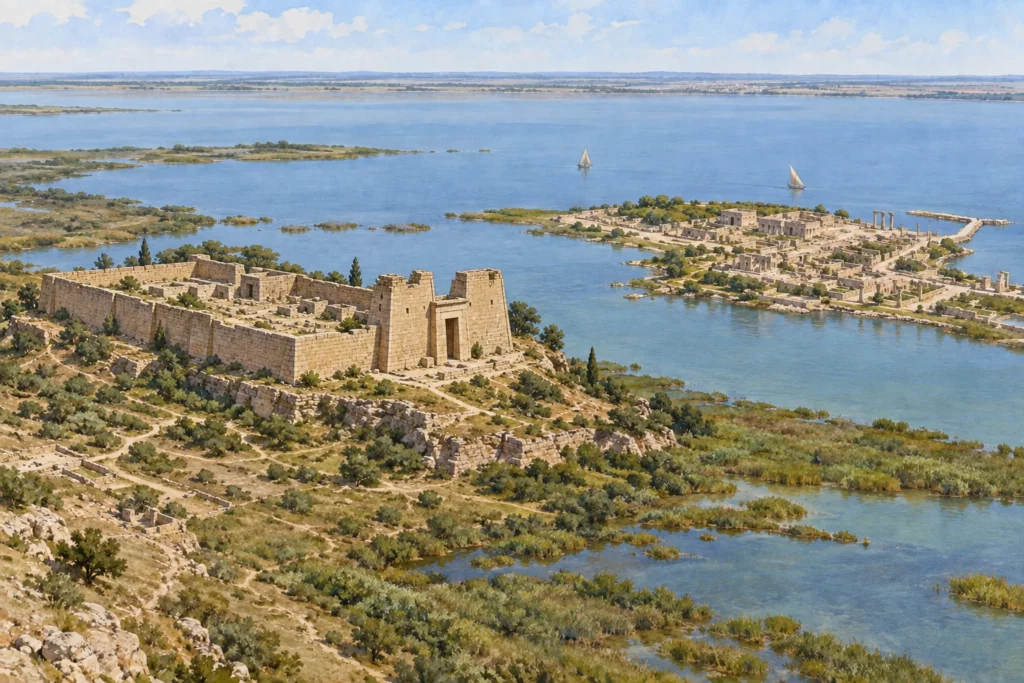
Forty-five kilometres west of Alexandria, Taposiris Magna (today Abusir) and Plinthine (Kom el-Nugus) stretch along the northern shore of Lake Mareotis, today Lake Mariout. The two towns turn their backs on the Mediterranean and come down from the rocky ridge, the taenia of the ancient authors, to the banks of the lake. They are about 2.2 kilometres apart as the crow flies, Plinthine to the east. Their interest lies in their position: over the long term they marked the western frontier of Egypt, first at Plinthine in the pharaonic period, then, probably from the Ptolemaic period, at Taposiris.
What you discover
At Taposiris, the enclosure of the temple of Osiris occupies the height. Below, on the so-called Breccia terrace, stand Greek baths with a double rotunda, a necropolis of mummified animals and a peristyle house: Greek forms and Egyptian traditions in the same district. Lower still, towards the lake, the lower town had an enclosed harbour, with a jetty, warehouses and a basin. Finally, the Tower of the Arabs is the tomb of a Hellenistic notable which reproduces the model of the lighthouse of Alexandria at a quarter or a fifth of its size.
At Plinthine, the horseshoe-shaped kom dominates the ridge. The Hellenistic necropolis, about a kilometre west of the town, occupies a hill from which both the sea and the lake can be seen; it has fewer than a hundred tombs cut into the rock, sometimes vast hypogea reached by a staircase and lined with loculi.
What to look at
The most unusual remain is a wine press uncovered in spring 2016 on the eastern flank of the kom of Plinthine. Set in a vaulted room, it consists of a treading platform and a collecting vat, both of carefully laid blocks of fine limestone. Dated by its pottery to the beginning of the Saite period, it is the best-preserved pharaonic wine press known in Egypt; its best parallels are the grape-harvest scenes painted in the tomb of Nakht (TT 52) at Thebes. It lends weight to a text by Hellanicus, a Greek author of the 5th century BC, who placed the invention of vine-growing at Plinthine.
Its history
Plinthine was occupied at least from the New Kingdom, with a very active phase in the Saite-Persian period, then abandoned in the Roman period. Taposiris took over from the beginning of the Hellenistic period until the end of the 7th or the beginning of the 8th century AD. A late tradition, reported by Pseudo-Callisthenes, has Alexander sacrifice to Osiris there on his way back from Siwa. In AD 41, the emperor Claudius counted the town among the gates of Egypt, with Alexandria and Pelusium: a wall barred the ridge to control the caravans, while the lake harbour forced boats to pass through an enclosed basin.
Evaristo Breccia excavated the terrace in 1905–1906; the French mission, founded in 1998, studies the two sites with the Institut français d’archéologie orientale (IFAO, French Institute for Oriental Archaeology). Several questions remain open, such as the function of the great Hellenistic building in the centre of the kom of Plinthine, interpreted as a temple. As for the media hypotheses about a royal tomb at Taposiris, they carry no weight as proof as long as no inscription or excavated context supports them.
Sources
Consulted on 30 September 2026: Blog of the French mission to Taposiris Magna and Plinthine, Hypothèses / OpenEdition (in French); Bérangère Redon, Matthieu Vanpeene and Mikaël Pesenti, ‘La vigne a été inventée dans la ville égyptienne de Plinthine’, BIFAO 116, 2017 (in French); Marie-Françoise Boussac, ‘Recherches récentes à Taposiris Magna et Plinthine, Égypte (1998–2006)’, CRAI, 2007 (in French).