In brief
Abu Mena lies on the edge of the desert, south-west of Alexandria, beyond Lake Mareotis, about fifty kilometres from the city. The site grew up around the tomb of St Menas, a martyr of Diocletian’s persecution. Between the 5th and the 7th century, it became one of the first and largest Christian pilgrimage centres; the German Archaeological Institute in Cairo regards it as the largest group of churches in the Near East. Yet it was neither a city in the legal sense nor a monastery, but a whole settlement that lived from the cult of a saint and from receiving those who came to pray to him.
What you discover
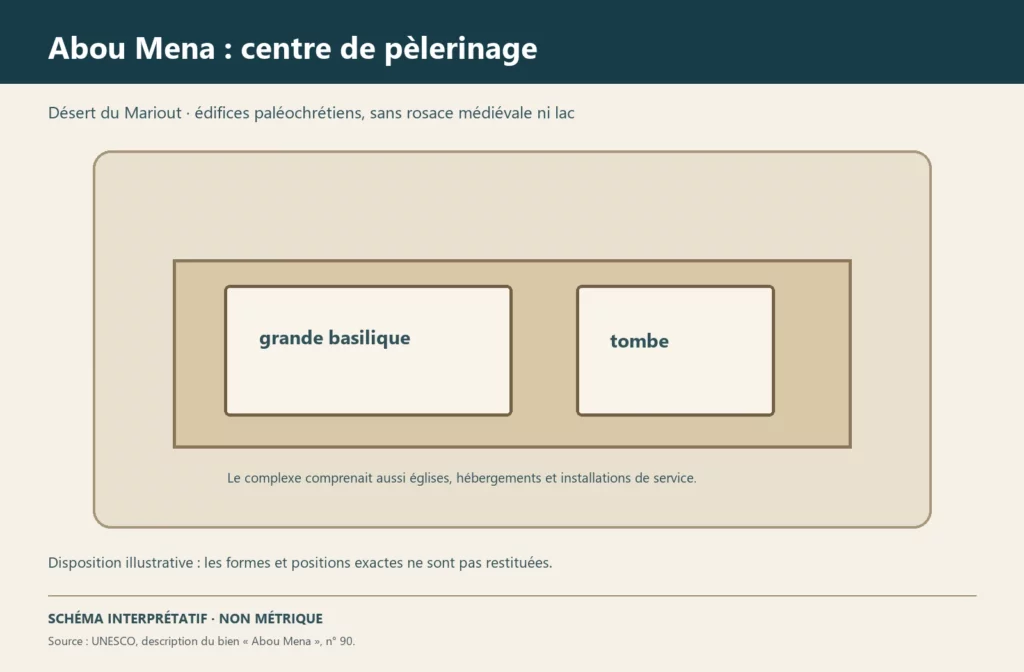
The landscape is that of a vast field of low ruins: ground plans, a few stretches of wall, limestone, brick, mortar and marble. In the centre, three buildings are aligned from west to east: the baptistery, the Martyr Church built over the tomb and the Great Basilica, a transept basilica begun towards the end of the 5th century. North of the church opened a large rectangular courtyard reserved for pilgrims, lined with hostels. It was reached by a long processional way, flanked by colonnades behind which were shops, warehouses and two public baths.
Around this religious quarter extended the ordinary town: mud-brick houses, some very large, workshops, cisterns, oil and wine presses, potters’ kilns. About 1.6 kilometres away, the East Church was surrounded by small two-room cells which served as hermitages.
What to look at
The heart of the site is underground. Beneath the Martyr Church opens a hypogeum older than the sanctuary, a vaulted arcosolium tomb of which was venerated as that of Menas. In the 6th century, the floor of the crypt was lowered by about 1.2 metres, a small domed room, the confessio, was laid out in front of the tomb and a second staircase was dug to separate the entrance from the exit: the crowd could thus go round the tomb without crossing. South of the church, a semicircular colonnaded courtyard served rooms almost equidistant from the crypt; Peter Grossmann probably sees them as rest rooms for the sick who came seeking a cure.
The second detail fits in the hand. The ampullae of St Menas, small flasks of moulded terracotta (the one in the Metropolitan Museum is 10 centimetres high), were used to take home water or blessed oil from the sanctuary. Their decoration shows the saint between two camels, those which, according to tradition, brought his body back to Egypt to be buried. They have been found across much of the ancient world; their spread measures the reach of the cult more than the journeys of individual pilgrims.
Its history
The foundation narratives go back only to the 7th century and attribute to emperors, from Jovian to Zeno, churches and hostels that archaeology cannot confirm. The excavations, on the other hand, show continuous growth, from a modest monument of the late 4th century to the great building works of the 6th century. The buildings were ravaged by fire in the 7th century, probably during the Persian invasion of 619. After the Arab conquest (639–641), a large part of the population left; the church was rebuilt once more in the 8th century, before the site was abandoned in the 9th century.
Excavations began in 1905, and the German Archaeological Institute has worked there since 1961. Inscribed on the World Heritage List in 1979, Abu Mena was placed on the List of World Heritage in Danger in 2001: irrigation of the neighbouring land was raising the water table, which threatened fragile masonry. A solar-powered drainage and pumping system, installed in 2021, stabilised the water table, and the site was removed from that list in July 2025. The ancient name of the town, for its part, remains unknown.
Sources
Consulted on 30 September 2026: The largest early Christian pilgrimage site of the ancient world, German Archaeological Institute (DAI); Ampulla of St Menas (27.94.19), Metropolitan Museum of Art; Abu Mena Rises Again, UNESCO.