Identification and setting
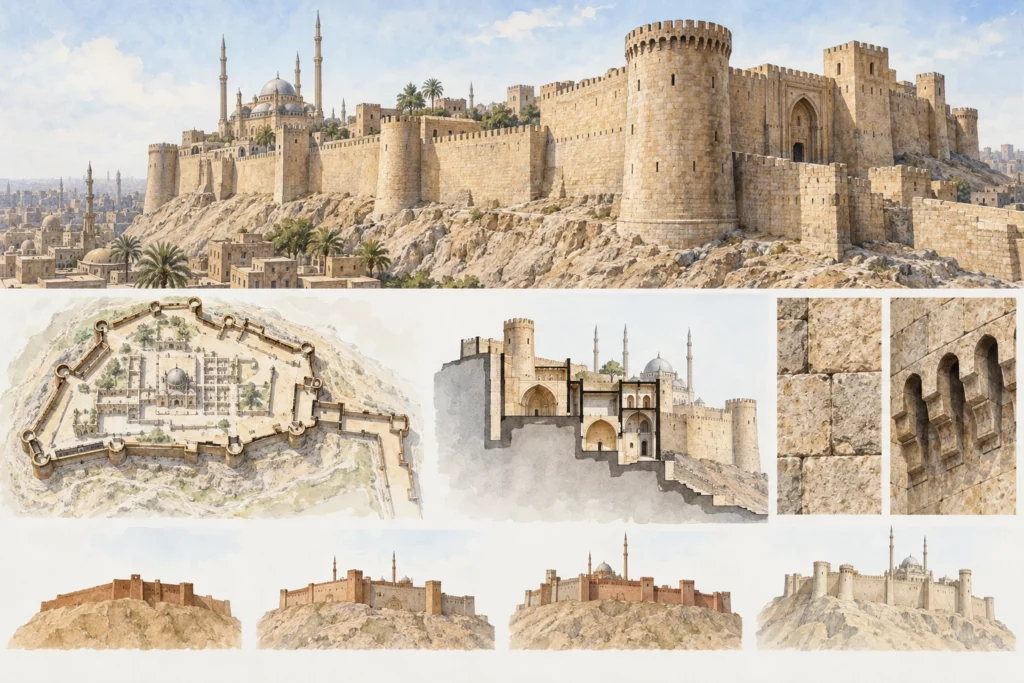
The Citadel of Cairo (Qal’at Salah al-Din) rises on the Muqattam hills, on the eastern edge of the medieval city. It lies within the property ‘Historic Cairo’, inscribed on the World Heritage List (no. 89). The monument is open to the public and managed by the Egyptian Ministry of Tourism and Antiquities, which houses several museums there.
The chronology of the foundation
According to the ministry’s official entry, Saladin (Salah al-Din al-Ayyubi) ordered the construction of the fortress in AH 572, that is AD 1176. The work was not completed during his reign: it was the Ayyubid sultan al-Kamil ibn al-Adil who finished it in AH 604 (AD 1207). The gap of thirty-one years between the two dates is a reminder that we should speak of a long-term programme rather than a single construction.
A seat of power for centuries
The Citadel remained the official residence of the rulers of Egypt under successive dynasties. The ministry states that the residence was moved to the Abdin Palace in the middle of the 19th century, at the initiative of the Khedive Ismail, which put an end to this function. The entry also mentions the revolution of 1952 among the historical landmarks of the place. In the meantime, each regime left its mark, through new buildings and through the adaptation of those of its predecessors.
The surviving buildings
Among the monuments listed in the entry are the mosque of Muhammad Ali Pasha, which dominates the silhouette of the complex (UNESCO dates it to 1815–1865, without specifying the phases of construction and decoration), the mosque of the Mamluk sultan al-Nasir Muhammad ibn Qalawun and the Ottoman mosque of Sulayman Pasha al-Khadim. To these are added the al-Gawhara Palace, the Police Museum and the Military Museum, housed in buildings within the enclosure. The distribution of these buildings between the Ayyubid, Mamluk, Ottoman and modern periods makes the Citadel a document built over seven centuries, but it rules out attributing the date of 1176 to it as a whole.
Its place in historic Cairo
UNESCO justifies the inscription of Historic Cairo on several criteria, including criterion (i), which recognises masterpieces of Islamic architecture, and criterion (v), which emphasises a coherent urban fabric in which several cultures coexisted. Its entry mentions Saladin’s colossal fortress, famous for the fighting against the Crusaders; the overall description stresses the city’s golden age, reached in the 14th century, under the Mamluks.
What the sources do not allow us to settle
The official entries give a chronological framework and a list of monuments, but no detailed plan of the earliest phases. The extent of the Ayyubid enclosure, the exact location of the first residences and the share of later remodelling in the towers and curtain walls therefore belong to specialised archaeological and architectural studies. Consequently, one should be careful not to attribute to Saladin the visible mosques and palaces, which date mainly from the Mamluk, Ottoman and modern periods. For up-to-date practical information (opening hours, prices), the ministry’s page remains the reference; it indicates daily opening from 8 a.m. to 5 p.m.
Sources
Sources (consulted on 30 September 2026): Egyptian Ministry of Tourism and Antiquities, Cairo Citadel; UNESCO, Historic Cairo.