In brief
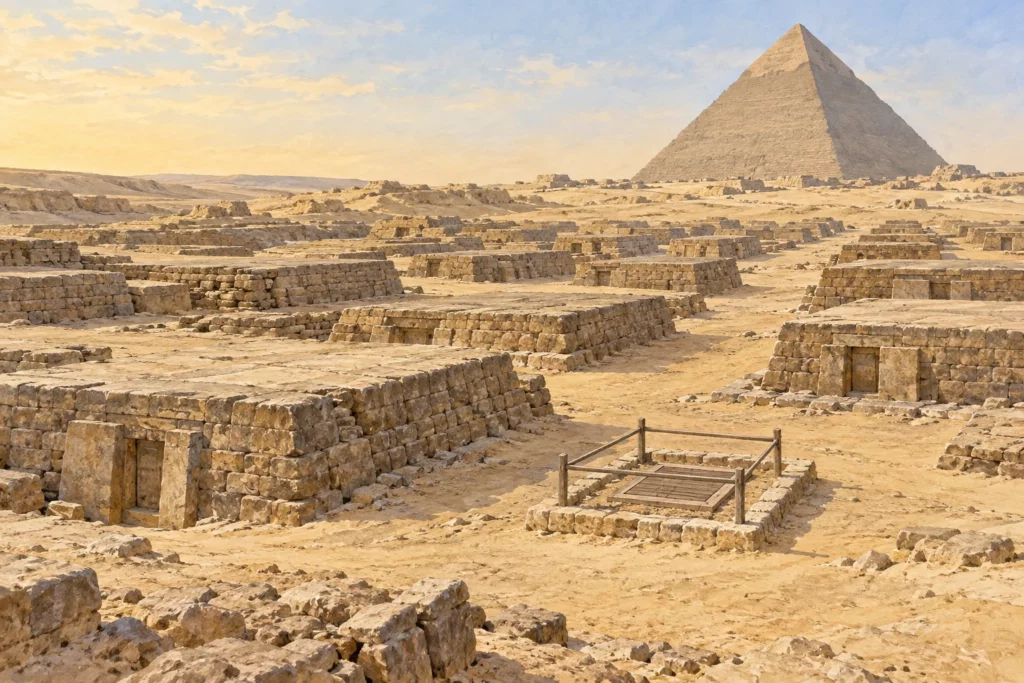
The Great Pyramid of Cheops was surrounded by the tombs of his family and of high-ranking figures. To the east, a necropolis of mastabas forms rows of rectangular monuments. A deep shaft, known by the number G 7000 X, yielded the funerary equipment of Hetepheres I, the mother of Cheops. This exceptional discovery is a reminder that the Giza necropolis is not just its pyramids: the neighbouring burials also shed light on court life and on the craftsmanship of the 4th Dynasty.
What you discover
Mastabas are low tombs with a rectangular plan, often with a chapel and a shaft descending to a chamber. Their arrangement around the pyramid gives physical form to the closeness to the king that their owners sought. Shaft G 7000 X had no large visible monument above it. In its chamber, archaeologists found an alabaster sarcophagus, vessels, jewellery and the remains of wooden furniture decorated with gold. The wood had largely decayed: the pieces seen in museums today are partly reconstructions based on fragments and records.
Its history
The eastern necropolis developed during the reign of Cheops and beyond; each tomb must be dated on its own, rather than everything being attributed to a single year. The expedition of Harvard University and the Museum of Fine Arts, Boston, led by George Reisner, discovered the shaft of Hetepheres in 1925. When the sarcophagus was opened, it proved to be empty. This absence has fed several hypotheses about the history of the burial, but the exact sequence has not been established. Objects from the deposit are now in museum collections: they are no longer in the shaft.
Why this place matters
The shaft of Hetepheres preserves a rare group of objects belonging to the royal family, while the mastabas make the social organisation of the necropolis visible. The empty sarcophagus is an observed fact; the reason for it remains a research question.