In brief
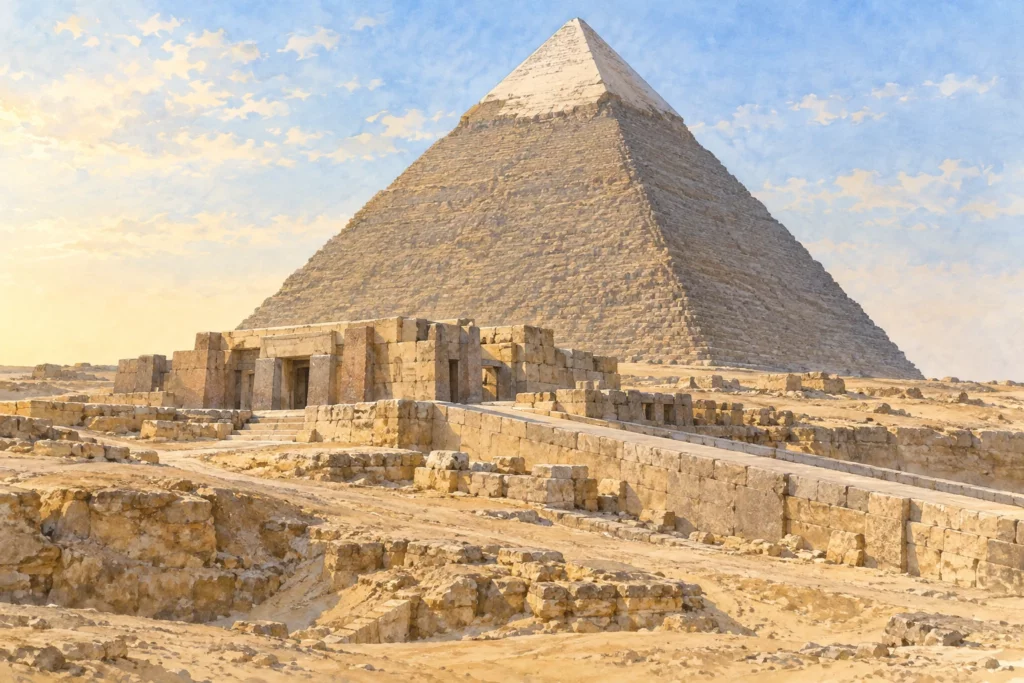
Chephren (Khafre), the son of Cheops, had the second great pyramid of the Giza plateau built c. 2558–2532 BC. Raised on higher ground than his father’s, it can look just as large, but its original height, about 143.5 metres, was slightly lower. A stretch of white limestone casing survives near the top. Two temples linked by a causeway show that the pyramid was the centre of a much larger funerary complex.
What you discover
At the eastern foot of the pyramid lie the remains of the upper mortuary temple. A causeway runs down to the valley temple, whose huge limestone blocks, granite facings and granite pillars remain remarkable. Niches there held statues of the king; some are now kept in museums. Inside the pyramid, passages lead to the burial chamber. The Great Sphinx and its own temple stand close to the valley temple, but are covered in a separate article.
Its history
The complex belongs to the reign of Chephren, after that of Cheops. The white limestone of the casing came from Tura and was brought by boat; most of these blocks have gone, except at the top of the building. The temples and the causeway organised the funerary rites and the lasting cult of the sovereign. The valley temple has yielded important royal statues. Modern research has recorded the buildings, the neighbouring quarries and the relationships between the pyramid, the temples and the Sphinx sector.
Why this place matters
The Chephren complex helps us to understand the pyramid as a route: from the valley, the causeway leads to the upper temple and then to the royal monument. The surviving casing at the top makes visible the difference between the ancient state and the core exposed today. The valley temple also bears witness to the working of enormous blocks and contrasting materials. The two separate images in this article are non-metric interpretive reconstructions, not exact surveys.