In brief
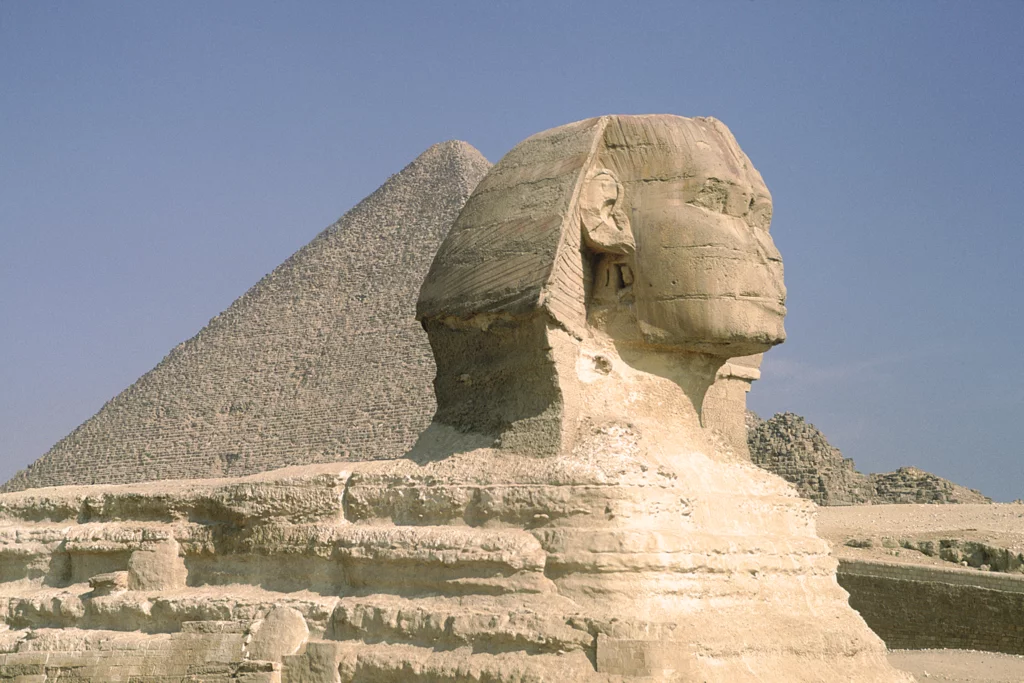
On the Giza plateau, a figure with a royal head and a lion’s body looks towards the east. The Great Sphinx was carved from the natural limestone during the 4th Dynasty, most probably under Chephren, around the middle of the 3rd millennium BC. In front of its paws lie the remains of its temple, next to that king’s valley temple.
What you discover
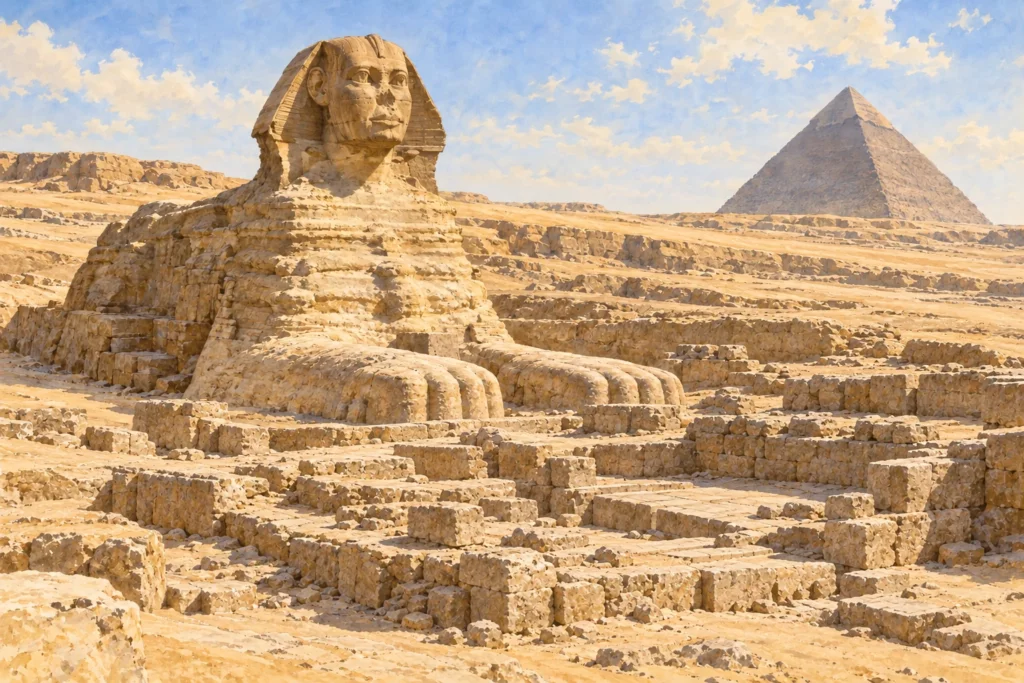
The Sphinx is not a statue assembled block by block: the sculptors freed its outline from the rock. The head wears the royal headdress called the nemes; the body and paws suggest a lion. The whole stands in an excavated hollow whose walls reveal the layers of limestone. To the east, the ruined walls of the Sphinx Temple retain large blocks. Further south, the valley temple and the start of the causeway leading to the pyramid of Chephren help to place the monument in a wider funerary landscape. The parts visible today are also the result of ancient and modern restorations.
Its history
Archaeological observations link the carving of the Sphinx to the building of the neighbouring temples: some of the blocks used in these buildings came from the quarries opened around the statue. The attribution to Chephren rests on this relationship, on the position of the monument and on comparisons of portraits; no surviving foundation inscription makes it absolutely certain. Much later, in the New Kingdom, the Sphinx was associated with Horemakhet, ‘Horus in the horizon’. Thutmose IV placed the so-called Dream Stele between its paws. The small temple dedicated by Amenhotep II also belongs to this later phase: it must not be confused with the Old Kingdom Sphinx Temple.
Why this place matters
The site makes it possible to understand a monument and its building site together. The statue, its excavated hollow and the large blocks of the temple show how the builders transformed the Giza plateau. Its history does not stop with the 4th Dynasty: the cult and the restorations of the New Kingdom show that the Egyptians themselves reinterpreted this place over centuries. The familiar image of an isolated Sphinx therefore hides an architectural complex and a long history.