In brief
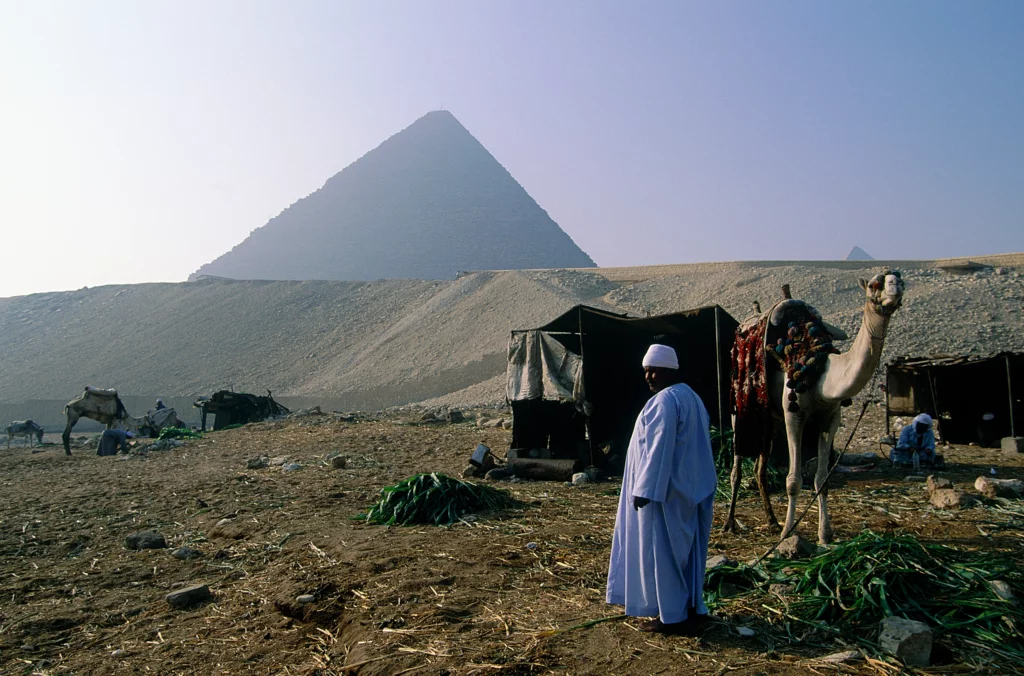
On the Giza plateau, the Great Pyramid was built for Cheops (Khufu), a king of the 4th Dynasty, c. 2589–2566 BC according to the chronology used here. It originally stood about 146.6 metres high. Its core of local limestone was faced with white blocks of higher quality. It is the only one of the seven wonders of the ancient world still standing. Its power lies not only in its size: the passages, the chambers and the neighbouring monuments tell of a complex royal project.
What you discover
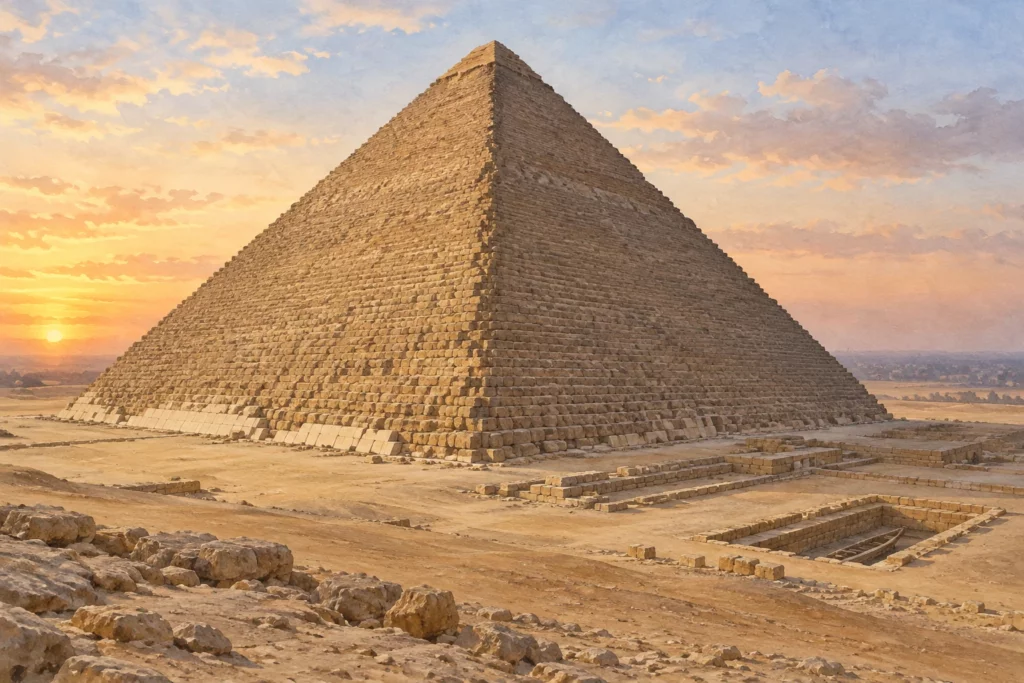
Today the courses of the core remain visible, because most of the white casing has gone. The ancient entrance, on the north face, leads to a descending passage; an ascending branch leads to the Grand Gallery and to the so-called King’s Chamber, where a granite sarcophagus remains. Another chamber, lower down, traditionally bears the name ‘Queen’s Chamber’, though the name does not prove a female burial. Boat pits and the remains of the mortuary temple belong to the complex. The plateau also includes cemeteries and other pyramids, covered in separate articles.
Its history
Cheops’ building site drew on local stone and on fine limestone brought from Tura. The diary of Merer, found at Wadi al-Jarf, describes boat journeys carrying stone towards the pyramid area: it documents part of the supply chain, not the whole method of construction. After antiquity, the monument was visited, studied and partly stripped of its casing. Recent non-destructive observations have revealed internal spaces that are still poorly understood; they give no licence to invent secret chambers or treasures.
Why this place matters
The Great Pyramid makes it possible to study architecture, transport, the organisation of labour and the royal funerary cult together. Its attribution to Cheops is secure; the detailed use of some internal spaces is still debated. It belongs to a wider necropolis, inscribed on the World Heritage List together with Memphis and the pyramid fields. The section that accompanies the in-depth article is a non-metric interpretive composition: the known spaces are simplified, and the volumes detected recently are given no imaginary function.