Identification and location
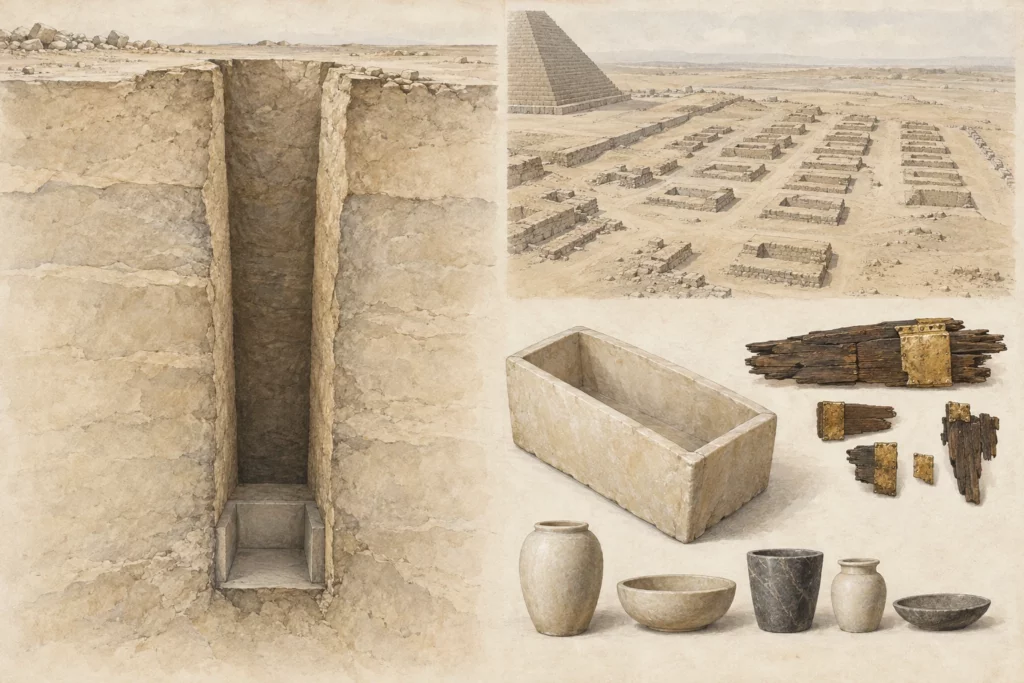
East and west of the Great Pyramid of Cheops, the Giza cemeteries bring together the burials of members of the royal family and of senior officials. This article concentrates on the eastern necropolis, in particular shaft G 7000 X, associated with Hetepheres I, the mother of Cheops. The tombs belong mainly to the 4th Dynasty, but they were not all built and used at the same time. The mastabas, low rectangular tombs, must be distinguished from the small queens’ pyramids nearby. G 7000 X is a deep shaft with an underground chamber and no surviving mastaba superstructure: calling it the ‘mastaba of Hetepheres’ would be misleading. The objects removed from the shaft are now dispersed among collections and cannot be seen in place.
General presentation
These cemeteries reveal the make-up of the court around the sovereign. The arrangement of some mastabas emphasises family and administrative ties with Cheops. Chapels, shafts and chambers link the memory of the dead to the funerary cult. G 7000 X stands out for its particularly rich royal furniture, found in a relatively well-documented underground context. The alabaster sarcophagus was empty when it was opened, while personal objects and pieces of furniture survived. This combination makes the shaft a major case for thinking about the preparation of funerals, the possible moving of a burial and the limits of what objects can prove. It does not provide a continuous account of the death of Hetepheres.
Monuments and remains
The eastern necropolis includes stone mastabas, sometimes grouped in double complexes, with cult chapels and shafts leading to the chambers. Digital Giza documents, among others, the monuments of Hordjedef and Khufukhaf; the attributions and phases of each tomb must be checked individually. The small queens’ pyramids are another type of monument, on the edge of the same sector. Shaft G 7000 X descends nearly thirty metres below the surface, to a chamber fitted out in the rock. It contained an alabaster sarcophagus, stone vessels, items of adornment and the remains of wooden furniture covered with precious elements. The organic parts were sometimes almost entirely destroyed, while the fittings and impressions preserved the shape of some pieces. Beds, chairs and parts of a canopy have been reconstructed for museums on the basis of this documentation.
Chronology and building phases
The layout of the cemeteries developed from Cheops’ funerary programme, then received additions under his successors. Some owners were relatives of the king; others belonged to the administration. The date at which a mastaba was built and the date of its burial are not always the same. The shaft of Hetepheres was attributed to the queen on the basis of inscribed evidence and the context of the objects. The absence of a body in the sarcophagus is an archaeological observation. Several scenarios have been proposed: a secondary deposit, a transfer of the body or an ancient episode affecting an earlier tomb. None can be presented as proven by the empty sarcophagus alone. The objects bear witness to the preparations and to the queen’s status, but they do not make it possible to reconstruct every movement of her remains. After antiquity, the tombs suffered erosion, the removal of stone and excavations that were more or less well recorded depending on the period.
History and functions
The mastabas associated the dead with the royal landscape of Giza. Their chapel received the gestures and images needed to maintain the funerary cult; their shafts led to protected storage spaces. Closeness to the pyramid expressed a place in the king’s family or political network, though not all the tombs had the same function or status. The furniture of Hetepheres reveals skills in carpentry, goldsmithing and stoneworking. Its historical value also lies in the association of the pieces: a single piece of furniture in a museum loses part of the information provided by the excavated deposit. The current reconstructions give an idea of the volumes and luxury of the furniture, but they sometimes incorporate modern elements to replace the lost wood. A distinction must therefore be made between ancient object, original fragment and restoration.
Excavations and the history of research
The discovery of G 7000 X is linked to the expedition of Harvard University and the Museum of Fine Arts, Boston, led by George Andrew Reisner. The shaft was located in 1925 and explored in the following years. The team’s excavation diaries, photographs, plans, object cards and publications form an exceptional body of documentation, partly accessible in Harvard’s Digital Giza database. Reisner published notably on the empty sarcophagus and the queen’s furniture in the late 1920s and early 1930s. The other sectors of the cemeteries were surveyed and excavated over a longer period. Researchers today compare these archives with the remains, the inscriptions and museum collections. Tomb numbers are essential to avoid confusing Hetepheres I with other royal women with similar names, notably Hetepheres II.
State of preservation and research questions
The mastabas and chapels are preserved to varying degrees. Shaft G 7000 X remains a major archaeological context, but the objects are no longer there, and the furniture displayed in museums often includes reconstructed parts. A map of the necropolis can show the relative positions of the tombs; it must not suggest that all the buildings were in use at the same time. The question of Hetepheres’ final burial remains open; neither the label ‘intact tomb’ nor the hypothesis of an ancient robbery is enough to explain the empty sarcophagus. The discovery image provided separately is a created illustration of the setting of the mastabas.
Sources
Main sources: Harvard University, Digital Giza, ‘G 7000 X’, https://giza.fas.harvard.edu/sites/1509/full/; Harvard University, Digital Giza, ‘Eastern Cemetery’, https://giza.fas.harvard.edu/sites/167/full/; Harvard University, Digital Giza, ‘Plan of Cemetery G 7000, NW section’, https://giza.fas.harvard.edu/mapsandplans/53532/full/; Reisner, ‘Hetep-Heres, Mother of Cheops’, Bulletin of the Museum of Fine Arts, 1927, https://giza.fas.harvard.edu/pubdocs/104/full/; Egyptian Ministry of Tourism and Antiquities, ‘Eastern and Western Cemeteries’, https://egymonuments.gov.eg/monuments/eastern-and-western-cemeteries/.