Identification and location
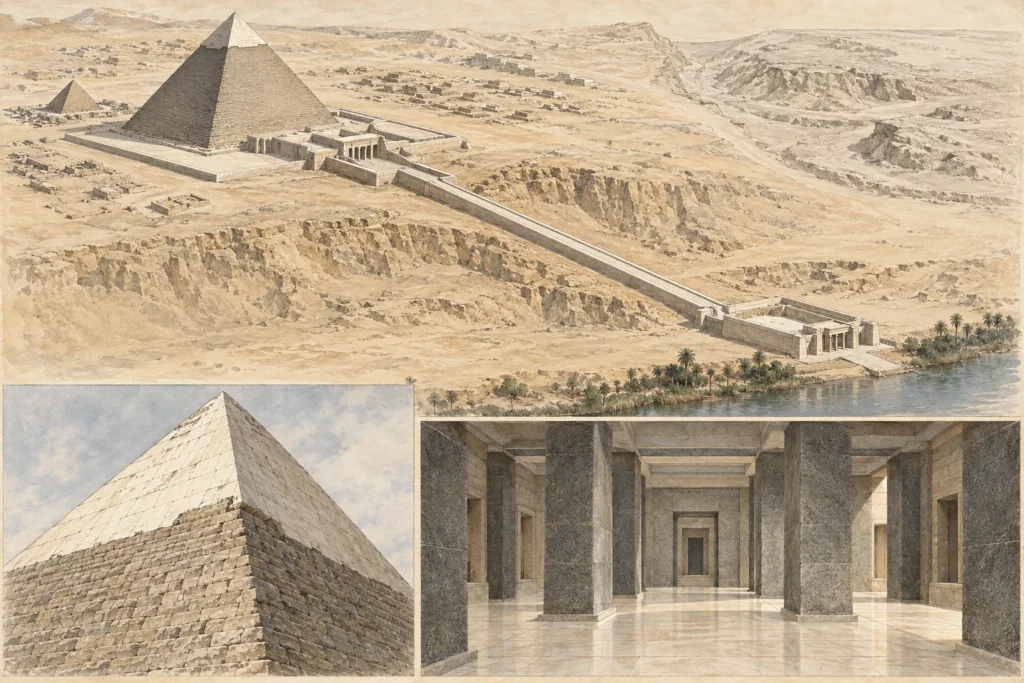
The funerary complex of Chephren (Khafre) occupies the central part of the Giza plateau. The king, a son of Cheops, belongs to the 4th Dynasty; this project’s chronology places his reign c. 2558–2532 BC. His pyramid is the second great pyramid of Giza. It rises on a higher part of the plateau than that of Cheops, which alters the way the two compare visually. The complex comprises the pyramid, an upper mortuary temple at its eastern foot, a causeway and a valley temple. The Great Sphinx and its temple are the immediate neighbours of the lower sector and are linked to the history of the reign, but they form a separate article here. The tombs and other structures around the complex place it within the Memphite necropolis inscribed on the World Heritage List.
General presentation
The interest of the site lies in how clearly the relationship between the pyramidal mass and its two great temples can be read. The building originally reached about 143.5 metres, according to the Egyptian ministry, and retains a portion of its fine limestone casing near the top. The upper mortuary temple, the causeway and the valley temple formed a built sequence running from the plateau to the former edge of the plain. The valley temple, relatively well preserved for the Old Kingdom, uses enormous blocks, granite facings and alabaster floors. The statues of the king once placed in its niches gave the ritual a visual focus. This architecture developed arrangements that were taken up in other royal complexes.
Monuments and remains
The pyramid is built mainly of local limestone. A finer envelope of Tura limestone, brought by boat, originally covered its faces; only an upper sector still keeps part of it. Internal passages lead to the burial chamber, whose known arrangements must be distinguished from the spaces in the pyramids of Cheops and Mycerinus. The upper temple stood against the eastern face and included courts, pillared spaces and places of worship whose layout was important for the rest of the Old Kingdom. The causeway linked this temple to the valley temple. The latter has limestone cores sheathed in granite, alabaster floors and a broad hall with monolithic granite pillars. Symmetrical niches held royal statues; the famous granodiorite statue in which the falcon Horus protects the king’s head comes from this context and is now in a museum, not in its ancient position. The immediate proximity of the Sphinx and its temple forms part of the study of the landscape, without making these monuments a mere backdrop to the valley temple.
Chronology and building phases
The project was developed under Chephren, after the construction of his father’s Great Pyramid. The choice of higher ground did not make his pyramid objectively taller: its original height is slightly lower. The differences in level make comparisons by eye from some viewpoints misleading. The construction of the upper temple, the causeway and the valley temple formed a coherent programme, though the exact timetable of each phase is not known. The archaeological analysis of the lower sector suggests that the valley temple was finished before work began on carving the Great Sphinx and its temple, according to the Egyptian ministry’s overview. After antiquity, the removal of casing and the transformations of the site greatly altered its appearance. The statues were uncovered during modern research and moved into collections. The surviving proportion of each building differs, which calls for cautious reconstructions.
History and functions
The pyramid fulfilled the royal funerary function. The temples hosted the ceremonies connected with the funeral and, afterwards, the offering practices for the dead king. The causeway established a material and symbolic route between the valley and the plateau. The niches of the lower temple manifested the sovereign’s presence through statues, while the spaces of the upper temple were in direct contact with the pyramid. The materials, pale limestone, dark granite and alabaster, produced visual effects as well as a durable architecture. Not all the precise gestures of each ceremony are documented by contemporary texts; the function of the rooms is reconstructed from their plan, their remains and comparisons with other complexes. The place of the Sphinx in this landscape is dealt with separately, because its own temple and the history of its cult followed a distinct path.
Excavations and the history of research
Travellers and modern scholars have described the second pyramid of Giza for several centuries. Explorations and surveys in the 19th and 20th centuries gradually clarified its interior and its temples. The discovery of statues in the valley temple was decisive for its attribution and for the history of royal sculpture. The databases and surveys of Harvard’s Digital Giza now make it possible to consult the plans, photographs and records of the buildings of the complex. Archaeological research on the quarries, the masonry and the relationships between the valley temple, the causeway and the Sphinx is refining the relative chronology. The Egyptian ministry notably highlights the proposed sequence for the completion of the lower temple and the carving of the Sphinx. The architecture of the upper mortuary temple is also studied as a precedent for the complexes of the late Old Kingdom.
State of preservation and research questions
The pyramid retains part of its profile and its casing at the top, but its lower surfaces have lost most of their envelope. The temples are unevenly preserved; some halls of the valley temple are easier to read than the upper spaces. The statues moved to museums cannot be shown on site without indicating their provenance and their new location. Any comparison of height with the pyramid of Cheops must distinguish the altitude of the ground from the height of the monument. The link between the Sphinx and Chephren is strongly supported by its position and by architectural analysis, but its detailed history belongs to another article. The discovery image provided separately is a created illustration.
Sources
Main sources: Egyptian Ministry of Tourism and Antiquities, ‘Pyramid Complex of Khafre’, https://egymonuments.gov.eg/monuments/pyramid-complex-of-khafre-khefren/; Egyptian ministry, ‘The Great Sphinx’, https://egymonuments.gov.eg/en/monuments/the-great-sphinx/; Harvard University, Digital Giza, ‘Royal Pyramid Complexes’, https://giza.fas.harvard.edu/lessons/royal-pyramid-complexes/; Harvard University, Digital Giza, ‘Khafre Valley Temple’, https://giza.fas.harvard.edu/sites/1778/full/; UNESCO, ‘Memphis and its Necropolis’, https://whc.unesco.org/en/list/86.