Identification and location
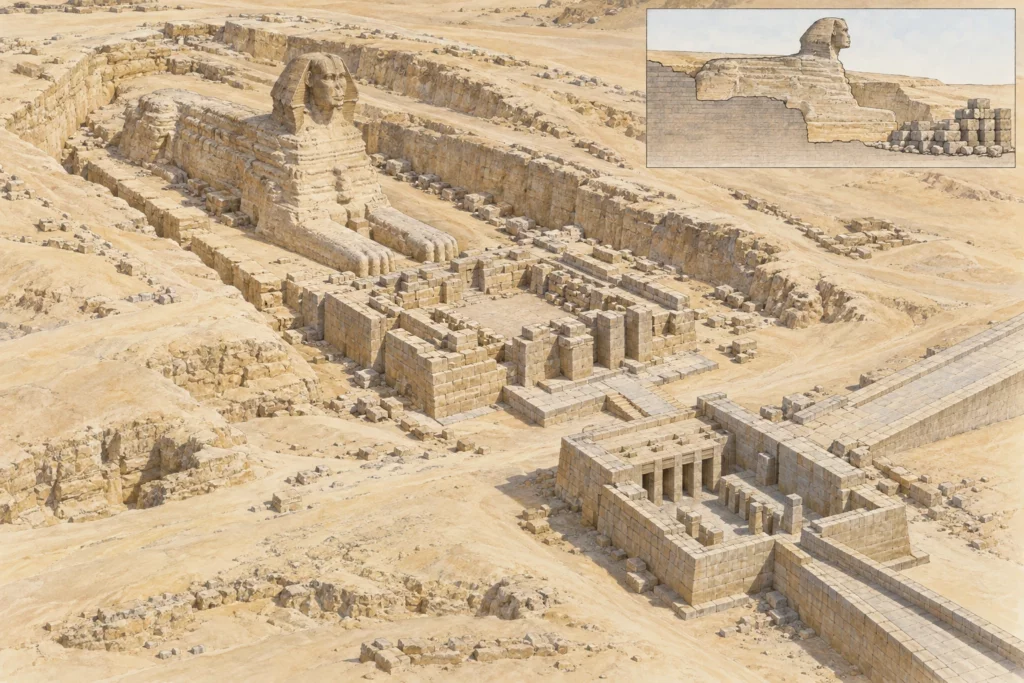
The Great Sphinx and the Sphinx Temple occupy the eastern sector of the Giza plateau, at the foot of the causeway of Chephren’s funerary complex. The Sphinx is a royal lion sculpture freed from the limestone bedrock; its Old Kingdom temple lies in front of its paws, to the east. Chephren’s valley temple is its immediate neighbour, to the south. The whole is generally attributed to the 4th Dynasty and to the reign of Chephren, c. 2558–2532 BC in the chronology of this collection. This attribution is supported by the archaeological context, without being fixed by any surviving foundation inscription of the Sphinx.
General presentation
The monument is at once an image of royal power and the product of a vast quarrying operation. Its form, carved from a mass of rock left in place, cannot be understood apart from the enclosure dug around it or the blocks of the nearby temples. The Sphinx Temple, distinct from Chephren’s valley temple, is part of this monumental programme. The uses of the site changed over time, notably when the Sphinx was venerated under the name Horemakhet in the New Kingdom.
Monuments and remains
The human head wears the royal nemes; the trunk, the outstretched forelegs and the tail belong to the figure of the lion. The natural rock forms the core of the sculpture. Repair masonry covers or stabilises several parts of the body and paws: the present appearance therefore does not everywhere correspond to the original carved surface. The walls of the excavated hollow allow the limestone strata and the stages in freeing the monument to be read. In front of the paws, the Sphinx Temple preserves mainly walls and massive blocks, with open spaces and sectors that are now incomplete. It is not to be confused either with the neighbouring valley temple, faced with granite and associated with Chephren’s causeway, or with the small sanctuary of Amenhotep II built much later. The proximity of these structures is essential for reading the relationships between statue, quarry and architecture.
Chronology and building phases
Chephren’s valley temple is thought to have been completed before the carving of the Sphinx and its temple, according to the archaeological analysis summarised by the Egyptian ministry. Geological studies and stone-by-stone surveys match the limestone layers of the Sphinx’s excavated hollow with the blocks used in the two neighbouring temples. This correspondence makes it possible to reconstruct sequences of extraction and construction, but it does not provide a precise year of foundation. In the 18th Dynasty, Amenhotep II had a sanctuary linked to Horemakhet built near the Sphinx. His son Thutmose IV placed the Dream Stele between the paws, a royal text that sets the monument within a new history of worship. Other repairs and clearances have changed its presentation down to the present day.
History and functions
In its 4th Dynasty setting, the Sphinx combined the royal image with the power of the lion and with Chephren’s funerary complex. The exact ritual function of the Sphinx Temple, like the original significance of its orientations and its programme, is debated; it would go too far to make it a solar sanctuary whose rites are all known. In the New Kingdom, the identification with Horemakhet, ‘Horus in the horizon’, is explicitly attested by the cult tradition and the monuments of the sector. The stele of Thutmose IV presents a royal narrative: it informs us about this phase in the reception of the Sphinx, without being a contemporary witness to its creation in the Old Kingdom.
Excavations and the history of research
The Sphinx has been described, cleared and restored several times since the early modern period. Émile Baraize directed major clearance work at the beginning of the 20th century. From 1979 to 1983, the mapping project of the American Research Center in Egypt, led notably by Mark Lehner, recorded the statue, the Sphinx Temple and the valley temple stone by stone. The combination of photogrammetry, architectural plans and the study of the geological layers strengthened the interpretation of a coordinated building site. The project’s archives, including maps, surveys, slides and photographs, were later digitised and made available with the support of ARCE. They provide a more precise documentary basis than a simple tourist view of the monument.
State of preservation and research questions
The differential erosion of the limestone, the repair campaigns and the restorations make it difficult to separate visually the original sculpture from the added masonry. The temple is preserved in fragments; its complete volumes can no longer be observed directly. The attribution to Chephren remains the most widely held, based on the topography, the relationships between building works and stylistic comparisons, but it should be expressed as an archaeological conclusion rather than as the reading of a dedicatory inscription. Reconstructions of the temple’s elevations, circulation and rites are hypotheses to be tested against the plans and the stratigraphy. The in-depth visual attached to this article is a non-metric interpretive composition; it is neither an excavation plan nor a survey of the exact state of the site.
Sources
Main sources: Egyptian Ministry of Tourism and Antiquities, ‘The Great Sphinx’, https://egymonuments.gov.eg/monuments/the-great-sphinx/; Egyptian ministry, ‘Pyramid Complex of Khafre’, https://egymonuments.gov.eg/monuments/pyramid-complex-of-khafre-khefren/; American Research Center in Egypt, ‘Sphinx Mapping Digital Database’, https://arce.org/project/sphinx-mapping-digital-database/; ARCE, ‘The Long-Hidden ARCE Sphinx Mapping Project Is Unveiled’, https://arce.org/resource/long-hidden-arce-sphinx-mapping-project-unveiled/ (online sources consulted on 27 September 2026).