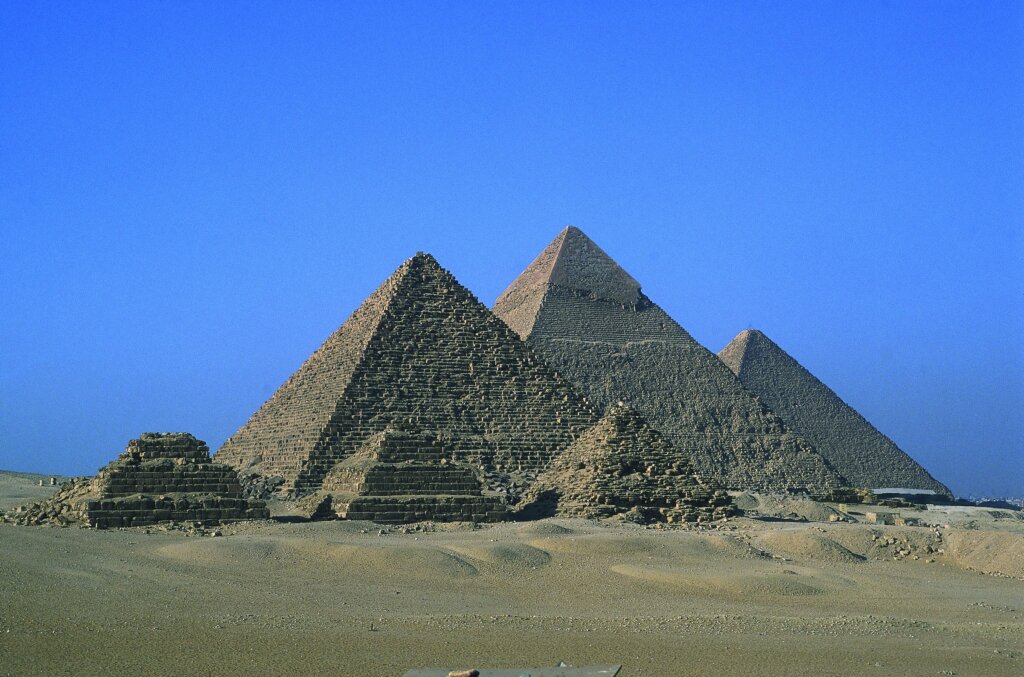
At Giza, three royal pyramid complexes stand side by side with the tombs of relatives, places of worship and the traces of those who worked to build them. This article presents the plateau as an archaeological whole; each monument then has its own article.
In brief
The Giza plateau overlooks the Nile valley west of Cairo. It holds the tombs of three kings of the 4th Dynasty (c. 2613–2494 BC): Cheops (Khufu), his son Chephren and his grandson Mycerinus. The pyramid of Cheops is the oldest and largest of the three; no building would surpass it in height for about 3,800 years. Since 1979 the plateau has been part of the property inscribed by UNESCO as ‘Memphis and its Necropolis’, which extends as far as Dahshur and includes more than thirty-eight pyramids.
What you discover
The three silhouettes dominate the landscape, but they do not sum up the site. Each royal pyramid was only the main element of a larger complex: small queens’ pyramids, a satellite pyramid serving as a second, symbolic tomb, mastabas of family members and dignitaries, and pits holding real or symbolic boats. A valley temple, built at the water’s edge to receive boats, was linked by a decorated causeway to the mortuary temple standing at the foot of the pyramid. Priests there maintained the cult of the dead king and presented offerings to him.
The Great Sphinx and its temple form another major landmark. The tombs of Cheops’ circle, the shaft of Hetepheres and the installations of Heit el-Ghurab widen the picture further: they speak of royal families, senior officials, supplies and the organisation of the building site.
What to look at
At the foot of the Great Pyramid, the mastaba of Queen Meresankh III is well worth a visit. The wife of Chephren and granddaughter of Cheops, she received a very large and finely decorated tomb. It is a reminder that Giza is not just a line of pyramids, but a necropolis in which the king’s relatives had their place. In the photograph, taken from the desert to the south, the pyramid of Mycerinus appears on the left, preceded by small queens’ pyramids.
Its history
The monuments were not built at the same time: they reflect successive projects, carried out reign after reign, and uses that continued after the kings’ deaths. The site was already attracting visitors in the Roman period. Today the Giza Project, an international collaboration based at Harvard University, brings together the archaeological archives of the pyramids, cemeteries and settlements of the plateau. Many questions remain open, especially about the exact organisation of the building sites and the function of certain spaces.
How to explore the articles
Start with the Great Pyramid of Cheops to understand the royal project, then move on to the complexes of Chephren and Mycerinus, and to the article on the Sphinx. The articles on the cemeteries and on Heit el-Ghurab bring in another scale: that of people and work. The excavated areas must not be mistaken for a single, permanent town of all the builders.
Sources
Egyptian Ministry of Tourism and Antiquities, Giza Plateau: https://egymonuments.gov.eg/archaeological-sites/giza-plateau/
UNESCO, Memphis and its Necropolis: https://whc.unesco.org/en/list/86
Harvard University, Digital Giza (Giza Project): https://giza.fas.harvard.edu/