Identification and location
Tebtynis (Egyptian Tp-dbn, Greek Tebtynis or Teptynis) corresponds to Kom Umm el-Breigat, on the southern edge of the Faiyum, about 170 kilometres south-west of Cairo. According to the Institut français d’archéologie orientale (IFAO, French Institute of Oriental Archaeology), the village was founded around 1800 BC, when the kings of the 12th Dynasty undertook to reclaim the depression; it remained the main centre of the south of the oasis until it was abandoned in the 12th century AD. Its last inhabitants then founded, 6 kilometres to the north, a village that took over its name, Touton in Coptic, Tutun in Arabic. The textual and archaeological documentation gathered covers in detail the period from the 3rd century BC to the 9th century AD.
The sanctuary of Soknebtynis and its dromos
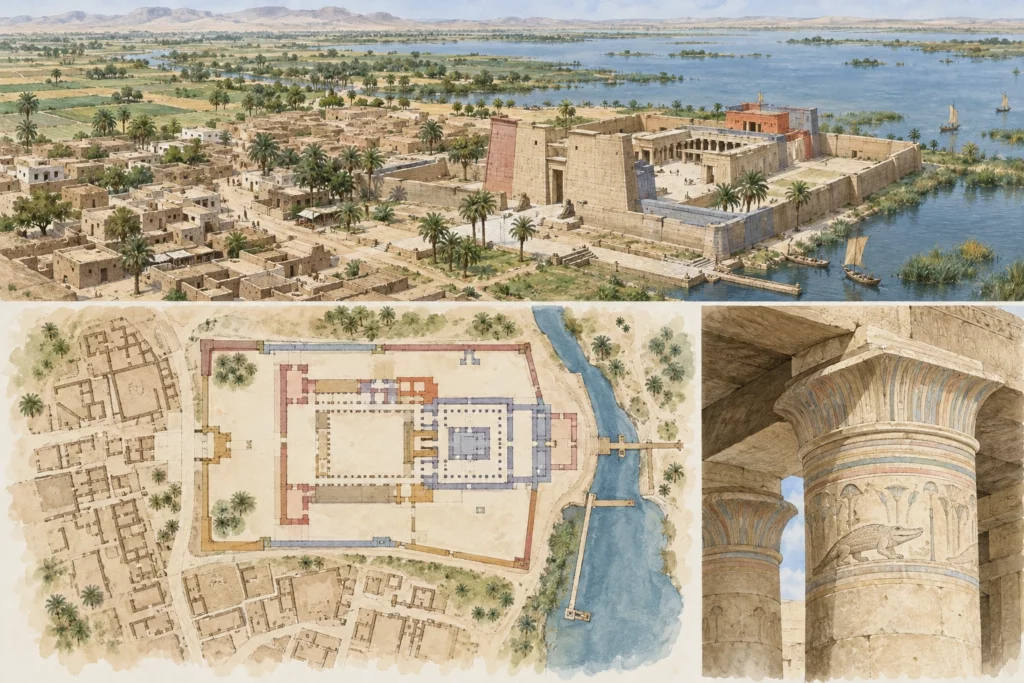
The great temple, dedicated to Soknebtynis, a particular form of Sobek, was cleared with its sacred way between 1931 and 1934 by Carlo Anti’s mission, but never published by its excavators. Vincent Rondot published a study of it in 2004 (Tebtynis II. Le temple de Soknebtynis et son dromos, IFAO), based on the archives of the Padua mission and on the remains still in place. He describes a vast cult complex, whose dromos was intended for the procession of the mummy of the sacred crocodile. He also shows a temple of a purely Egyptian tradition, in a province reputed to be highly Hellenised. The chronology has since been revised: the sanctuary excavated in the 1930s dates from the 1st century BC, and the temple built under Ptolemy I has been found beneath its remains.
The mammisi and the crocodile enclosure
In 2023, two seasons completed the clearance of two superimposed temples, located in 2021, which Claudio Gallazzi identifies as the successive mammisi (birth houses) of the sanctuary, where the god was reborn and regenerated. The older, built at the beginning of the Hellenistic period, was demolished around 100 BC and immediately replaced by a second, in use until the 3rd century AD. To the east, a large enclosure served, from the end of the 3rd century BC to the end of the 2nd century AD, for burying crocodiles offered to the god as ex-votos; in the 3rd century BC it housed an incubator for breeding the animals. This context distinguishes the cult deposits from the cemetery of mummified crocodiles that Grenfell and Hunt had reached on 16 January 1900 on the edge of the human necropolis.
The village and its houses
The Ptolemaic quarters, previously unknown, have been cleared over a large area; the Byzantine sector, buried under sand until 2004, has been identified. Among the buildings uncovered are a chapel of Thermouthis, a desert police post, a granary of the 2nd century BC, public baths of the 3rd and 2nd centuries BC and two bakeries of the 4th and 5th centuries AD. East of the temenos, over about 1,250 m², Gisèle Hadji-Minaglou has published eighteen houses excavated from 1989 to 1992 (Tebtynis IV, IFAO): four of the 3rd, four of the 2nd and four of the 1st century BC, and six of the 2nd century AD. Widely spaced at the beginning of the Ptolemaic period, they close up in the Roman period into compact blocks, before the quarter was abandoned at the beginning of the 3rd century AD.
Papyrologists, sebakh diggers and archaeologists
Bernard Pyne Grenfell and Arthur Surridge Hunt opened the site in 1899–1900 for the University of California, with funding from Phoebe Apperson Hearst; Otto Rubensohn carried out a short campaign there two years later for the Berlin museums. The sebakh diggers then destroyed large areas. Evaristo Breccia worked on the spot in 1929 (University of Florence), then Carlo Anti and Gilberto Bagnani from 1930 to 1936; in 1931 two cellars full of papyri were discovered, and in 1934 Achille Vogliano found a third, containing about 750 Greek papyri. Since October 1988, the French-Italian mission of the IFAO and the University of Milan, directed by Claudio Gallazzi and Gisèle Hadji-Minaglou, has recovered about 10,000 texts in Egyptian, Greek, Aramaic, Coptic and Arabic.
Sources
Sources (consulted on 30 September 2026): Tebtynis, une ville gréco-romaine au sud du Fayoum, Institut français d’archéologie orientale (in French); Claudio Gallazzi, ‘Umm-el-Breigât (Tebtynis) 2023: i mammisi di Soknebtynis e l’incubatoio dei coccodrilli’, Rendiconti of the Istituto Lombardo, 158, 2025 (in Italian); Nicola Aravecchia, review of G. Hadji-Minaglou, Tebtynis IV, American Journal of Archaeology 114.1, 2010.