Identification and location
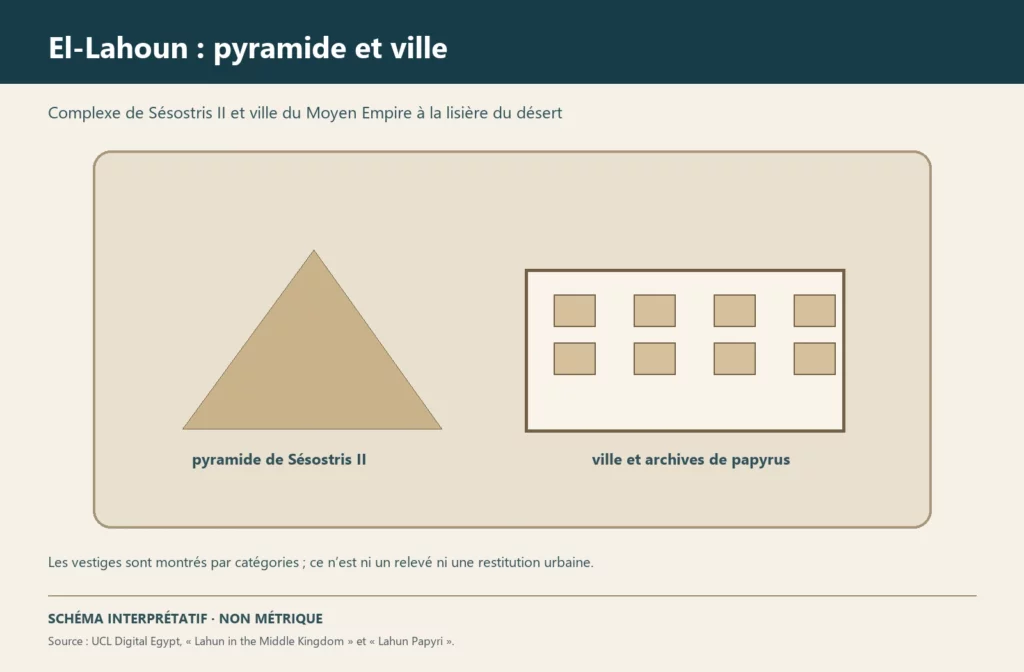
El-Lahun lies at the entrance to the Faiyum, where the desert meets the cultivated land. The pyramid of Senusret II and a large town of the late Middle Kingdom occupy the same landscape. ‘Kahun’ is the name used by Flinders Petrie for the town; UCL points out that its ancient name was probably Hetep-Senusret. The term El-Lahun may refer to the whole site, to its necropolis or to the modern locality. This distinction avoids treating town and pyramid as a single building or attributing all the occupation to the short reign of Senusret II. The royal complex included a pyramid and cult spaces, among them a valley temple near the town. Fragments of relief and of a pyramidion document part of the lost decoration. The superstructure of the pyramid is now heavily ruined, while the annexes have survived only in fragments. The presence of a town nearby sheds light on the needs of construction and of the cult, but a general functional link does not give the name or occupation of the inhabitant of each house. Architectural reconstructions must remain tied to the published surveys.
General presentation
The town is one of the great Middle Kingdom settlements studied archaeologically. Houses of different sizes, streets, tools and domestic objects tell us about social organisation and daily work. UCL stresses that it was cleared as early as 1889, at a time when the precise provenance of objects was recorded for only a minority of them. This limitation affects studies of the distribution of activities.
Monuments and remains
Occupation did not stop with the death of Senusret II. The administrative papers of the royal cult found in a deposit north of the valley temple date mainly from the reigns of Senusret III and Amenemhat III. They bear witness to the management of goods and of the teams responsible for the cult. The manuscripts found across the town cover the end of the 12th and the beginning of the 13th Dynasty. This distinction of provenance and date prevents the archives from being turned into a direct diary of the initial building of the pyramid.
Chronology and building phases
The papyri include accounts, lists, letters and specialised texts, notably mathematical and medical ones. They open a rare window on administration and social life. They are nevertheless not representative of everyone in the town: the surviving writings depend on the uses of papyrus, the chances of preservation and the practices of excavation. The fragments have often been moved and are now divided between collections. Any precise statement must refer to the edited text and its context, not merely to the general name ‘Kahun papyri’.
History and functions
The town may be described as a pyramid town, notably because it housed agents of the royal funerary cult. The expression ‘workers’ town’ sums up neither its later functions nor the diversity of its inhabitants. UCL recalls that the pyramid towns of the Middle Kingdom are on a different scale from the small groups of houses known near some Old Kingdom pyramids. At El-Lahun, the size of the settlement and the administrative documents make visible a lasting institution around the dead king.
Excavations and the history of research
Petrie excavated the town and the complex from the late 1880s, and other campaigns followed in the early 20th century. The finds include the necropolis, the royal buildings, the quarters and objects of different dates. The old documentation remains fundamental, but it must be re-read with the limitations of its methods in mind. An object labelled ‘Kahun’ may come from the town, from fill or from another sector: the detailed inventory is needed to place it back in a house or cult context.
What we still do not know about Kahun
UCL ranks Lahun among the best-preserved ancient Egyptian towns and dates it to about 1850–1700 BC. This good state contrasts with the documentation: as the town was cleared as early as 1889, the precise find spot of objects was recorded only in rare cases.
This gap limits studies of the distribution of activities by house or quarter. The open questions therefore concern less the existence of the town than the possibility of linking each object and each papyrus to its original context, something that only re-readings of the excavation archives and new fieldwork could improve.
Sources
Main sources: UCL, ‘Lahun in the Middle Kingdom’, https://www.ucl.ac.uk/museums-static/digitalegypt/lahun/mk.html; ‘The Lahun Papyri’, https://www.ucl.ac.uk/museums-static/digitalegypt/lahun/papyri.html; Lahun town, UCL Digital Egypt; ‘Pyramid complex of Senusret II’, https://www.ucl.ac.uk/museums-static/digitalegypt/lahun/pyramid.html; ‘Pyramid towns’, https://www.ucl.ac.uk/museums-static/digitalegypt/pyramids/town.html; ‘Lahun’, https://www.ucl.ac.uk/museums-static/digitalegypt/lahun/index.html (consulted on 27 September 2026).