Identification and location
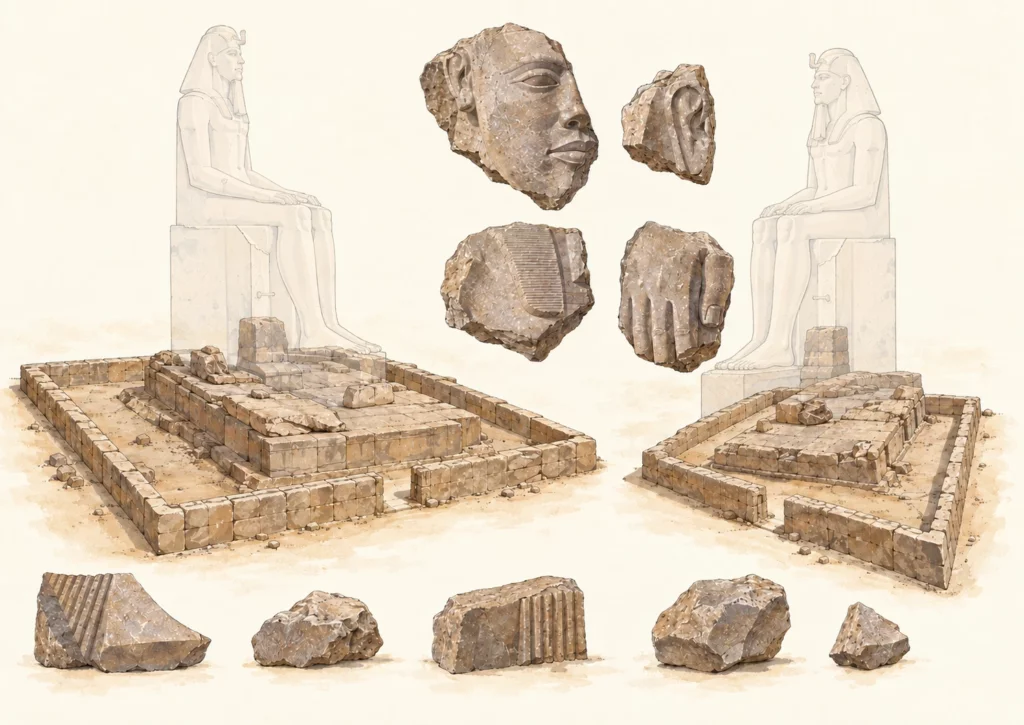
Biahmu lies in the Faiyum, where Amenemhat III multiplied royal works during the 12th Dynasty. The site is distinct from his pyramid at Hawara and from the sanctuary of Medinet Madi. Its main feature is a pair of monumental bases that once carried two colossal statues of the king, quartzite monoliths according to UCL. Each platform was surrounded by a wall. The sculptures no longer stand; their disappearance severely limits knowledge of their original appearance. Flinders Petrie studied Biahmu in 1888 and published his observations the following year. He identified the platforms, the enclosures and fragments of the statues. UCL states that most of these fragments remained on the site, while some are kept in the Ashmolean Museum in Oxford. To analyse an isolated piece, its provenance, any inscription and its place of keeping must be specified. A royal fragment cannot automatically be placed on one of the two bases without argument.
General presentation
The pairing of the colossi is attested by the two monumental supports and by the remains of sculpture. On the other hand, the complete height, the attributes and the exact treatment of the faces cannot be observed directly on the foundations. Old drawings and reconstructions can provide hypotheses, but they are not views of the original state. The visual effect in the landscape must have been considerable; it would nevertheless be unwise to assert a ritual line of sight or a precise orientation without a survey and topographical study.
Monuments and remains
The two enclosures indicate that each statue had a dedicated space. The function of these boundaries may have combined protection, display and symbolic separation, but the archaeology of the surroundings must decide what can be demonstrated. The royal presence in the Faiyum belongs to a group of building projects of Amenemhat III. It cannot be deduced from this that Biahmu, Hawara and Medinet Madi were designed in a single campaign or for a fully known ceremonial route.
Chronology and building phases
The quartzite statues involved quarrying, transport, erection and maintenance, operations requiring substantial resources. Their material is distinct from that of the platforms. The surviving fragments can inform us about the sculptural style of the reign; they do not allow the destroyed volumes to be reassembled without gaps. The absence of the colossi today contrasts with the permanence of their bases.
History and functions
Biahmu has sometimes been described through spectacular accounts of two statues rising from the waters of the Faiyum. The ancient hydrological landscapes varied and call for specific studies. The archaeological bases are not enough to fix the level of the lake at a single date or to prove the scene of statues surrounded by water. This text favours the attested remains and separates the landscape hypotheses from the published field observations.
Excavations and the history of research
The accessible sources give mainly the general features of the site. For a measurement of the platforms or a stylistic attribution of the fragments, Petrie’s excavation report and the collection catalogues must be consulted directly. The absolute dates of the 12th Dynasty vary between chronologies; the association with the reign of Amenemhat III is the relevant reference point here. Modern recording of the dispersed blocks could refine the reconstruction, but the original project remains partly lost.
What we still do not know about the colossi of Biahmu
According to UCL, Biahmu preserves the platforms of two monolithic colossal quartzite statues of Amenemhat III, each surrounded by a wall. The statues themselves have disappeared: most of the fragments found by Petrie in 1888 remained on site, and a few are kept in the Ashmolean Museum in Oxford.
Their complete height, their attributes and the treatment of their faces therefore remain unknown. The dispersed fragments, mostly left out in the open, remain exposed to loss; modern recording of them would make it possible to refine the reconstruction, and the state of the ancient landscape around the bases remains to be studied.
Sources
Main sources: Site index: Biahmu, UCL Digital Egypt; UCL, ‘Amenemhat III’, https://www.ucl.ac.uk/museums-static/digitalegypt/chronology/amenemhatIII.html; W. M. F. Petrie, Hawara, Biahmu, and Arsinoe (1889), cited in the UCL site index (consulted on 27 September 2026).