In brief
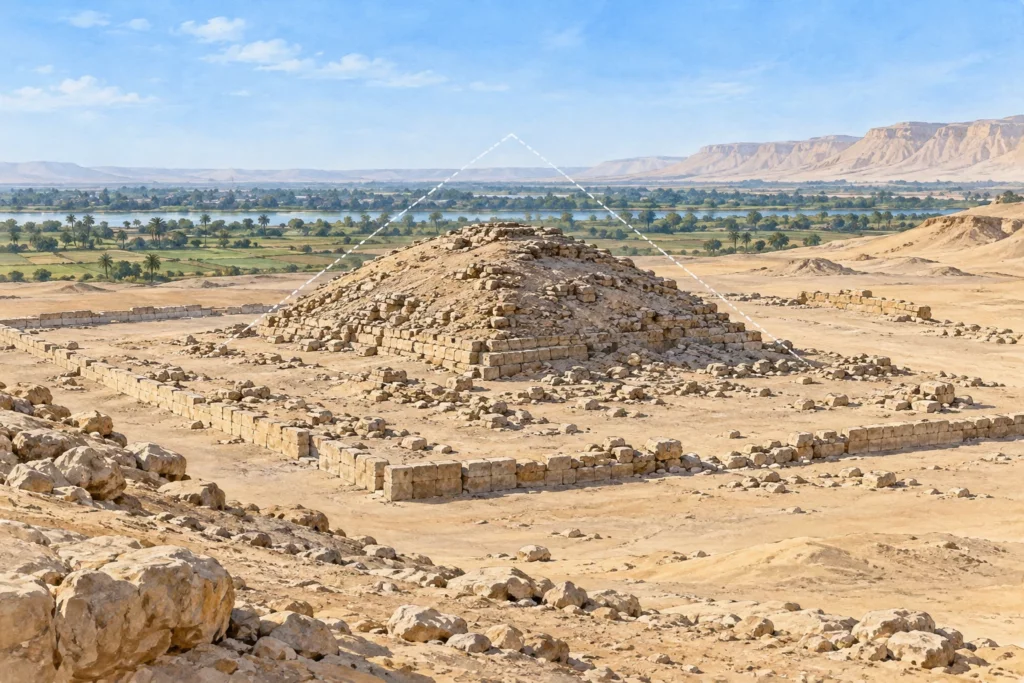
At South Lisht, south of Cairo and Memphis, lies the funerary complex of Senusret I, called Sesostris or Senwosret in many publications. The son of Amenemhat I, he reigned at the beginning of the 12th Dynasty and chose to be buried a short distance from the pyramid of his father, which occupies the northern part of the site. The two complexes lie near the region where Itjtawy, the capital of the Middle Kingdom, is placed, though its exact location remains to be established.
What you discover
The pyramid itself is now very ruined, robbed and stripped of a large part of its stones. What is striking, on the other hand, is the scale of the complex that surrounded it. A stone enclosure wall girdled the royal pyramid; beyond it, a second, outer enclosure delimited a vast space in which nine secondary pyramids were built, as well as tombs intended for members of the royal family and servants of the king’s household. According to the Metropolitan Museum of Art, no other Middle Kingdom pyramid enclosure has been so completely excavated and published.
This wealth of data does not erase the losses. The site has been heavily destroyed and robbed, and a large part of the architecture has had to be reconstructed from ruins and fragments.
What to look at
The decoration of the inner enclosure deserves attention. Its inner and outer faces bore a series of a hundred large carved panels, four of which could be reconstructed from fragments found in excavation. One of them, kept in the Metropolitan Museum of Art (34.1.205), is more than four metres high. It reads from bottom to top as an image of the world. At the bottom, a fertility deity evokes the fertile land. In the middle, a richly decorated palace façade symbolises the king’s domain. Above this façade is inscribed his Horus name, ‘Living of births’. At the top, the falcon of the sky dominates the whole. The panel also bears the names Ankhmesut and Kheperkare. Repeated all around the pyramid, this type of panel made the enclosure a continuous affirmation of kingship.
Another, more modest detail is just as telling: the excavations found timbers from dismantled ships, whose pieces had been embedded in the tracks used to bring in materials during construction. The building site thus left, beneath the finished complex, the trace of its own logistics.
Its history
The Metropolitan Museum of Art excavated El-Lisht from the first years of the 20th century; its campaigns, conducted from 1907 to 1934, yielded among other things the panel displayed in New York. In 1984, the museum’s Department of Egyptian Art reopened the excavation, applying modern recording methods: new plans, stratigraphic sections and surveys of architectural details completed the old archives. Dieter Arnold published the pyramid in 1988, then, in 1992, the monuments within the outer enclosure, in particular the secondary pyramids.
Several questions remain open. The identity of all the people buried near the king has not been established, and the building work, the funerary cult and the later burials form distinct phases that must be untangled block by block.
Sources
Consulted on 30 September 2026: Dieter Arnold, The Pyramid Complex of Senwosret I, Metropolitan Museum of Art, 1992; Dieter Arnold, The Pyramid of Senwosret I, Metropolitan Museum of Art, 1988; Name Panel from Mortuary Complex of Senwosret I (34.1.205), Metropolitan Museum of Art.