In brief
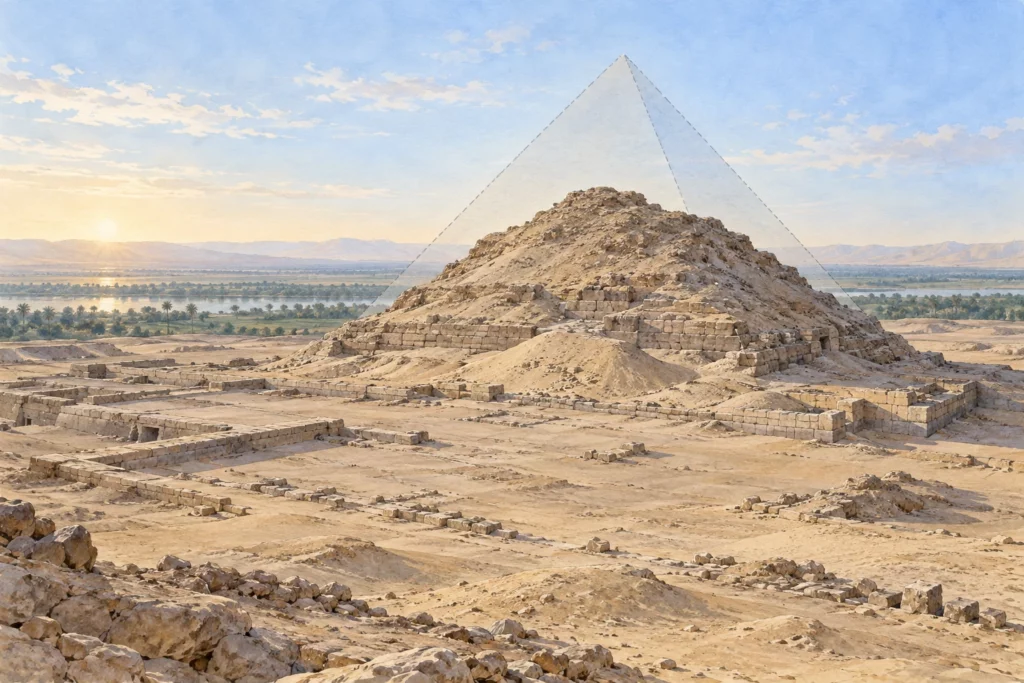
El-Lisht lies some fifty kilometres south of Cairo, on the edge of the desert and the Nile valley. The necropolis is famous for two Middle Kingdom pyramids: to the north, that of Amenemhat I, founder of the 12th Dynasty; to the south, that of his son Senusret I. The site served as the necropolis of the new capital of the Middle Kingdom, Itjtawy, whose remains have not been identified with certainty.
What you discover
The pyramid of North Lisht now appears as a badly degraded mass, far removed from the regular silhouette it had originally. Around it, the ground is dotted with the tombs of dignitaries who wished to rest near their king. Nothing, at first sight, hints at what makes the monument original: its core contained a genuine, unintended museum of the Old Kingdom. The builders placed in it many carved limestone blocks, recovered from older buildings that were probably already dilapidated.
What to look at
The most spectacular of these blocks is no longer on site: it is kept in the Metropolitan Museum of Art in New York (number 22.1.23). Uncovered in 1920–1922 in the core of the pyramid, on the west side, this fragment of painted limestone dates from the 4th Dynasty, under Cheops or Chephren, more than five centuries before Amenemhat I. It shows at least four archers, three standing and one kneeling, holding a large bow in the left hand and two spare arrows. Bands crossed over the chest identify them as soldiers. The poses vary from one man to another, which breaks with the usual repetition of such scenes, and traces of red paint survive on the skin and on the wood of the bows. It is the oldest surviving battle scene in Egypt depicting the siege of a foreign town.
This block makes it possible to read the pyramid in another way. Each reused stone comes from a monument that no longer exists, and its study tells us as much about the Old Kingdom as about the building site of the 12th Dynasty. The Egyptologist Hans Goedicke published in 1971 the reliefs earlier than Amenemhat I; those contemporary with the king or later belong to another study.
Its history
The Metropolitan Museum of Art began its excavations at El-Lisht in January 1907, under the direction of Albert Lythgoe and Arthur Mace, with the help of Herbert Winlock. Its expeditions worked there until 1934, and the clearance of the northern part of the site was completed in 1922.
The reason for the reuse is still debated. Recovering available blocks may simply have made the building work easier. It has also been suggested that it reflects a wish to link the new dynasty to the great kings of the Old Kingdom, by incorporating their images into the royal tomb. No text settles the matter between these readings, which are not mutually exclusive. The exact location of Itjtawy, nearby, remains the other great question of the site.
Sources
Consulted on 30 September 2026: Hans Goedicke, Re-Used Blocks from the Pyramid of Amenemhet I at Lisht, Metropolitan Museum of Art, 1971; Archers (22.1.23), Metropolitan Museum of Art; The Egyptian Expedition, 1906–1936, Metropolitan Museum of Art.