Identification and location
The pyramid of Amenemhat I occupies the northern part of the El-Lisht necropolis, south of Memphis. It belongs to the 12th Dynasty and the beginning of the Middle Kingdom. The absolute chronology varies between works; University College London places the reign c. 1976–1947 BC. The king founded Itjtawy, a new centre of power, but no urban remains identified with certainty fix its position. The proximity of El-Lisht makes a location in the region plausible. It does not allow a town or a precise processional route to be drawn around the monument. The choice of El-Lisht placed the royal tomb in a landscape new to the dynasty, while taking up the ancient principle of the pyramid complex. The pyramid of Amenemhat I lies north of that of his successor Senusret I. Their proximity is a topographical and dynastic fact; their masonry, decoration and excavation histories must be treated separately. The tombs of dignitaries around the complexes make visible a court gathered near the royal residence. They do not on their own prove the exact location of the capital.
General presentation
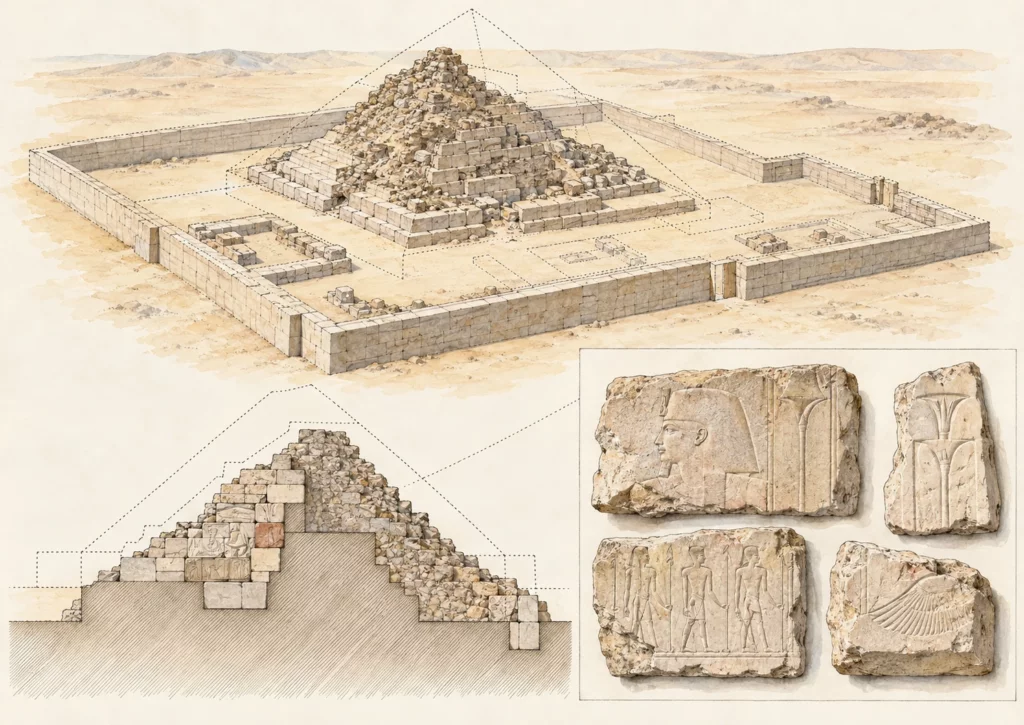
The monument comprised a pyramidal superstructure, cult spaces and an enclosure. The quarrying, transport and use of materials required considerable organisation. Today, the casing and large parts of the structure have disappeared, which makes the original silhouette hard to read on site. The remains of foundations and decoration allow a partial reconstruction, but the published plans belong to different phases of survey and reconstruction. An explanatory section must not be taken for an exact drawing of the surviving masonry.
Monuments and remains
The best-documented feature is the presence of reused carved blocks from Old Kingdom monuments. Hans Goedicke’s study brings together fragments found in the mass of the pyramid, near its surface or in corridors, as well as in the foundations of the temple. This is material proof of reuse, not a mere stylistic resemblance. The fragments studied do not, however, describe all the stones of the monument. Their precise provenance and the stages of their transfer are not all known.
Chronology and building phases
It has been proposed that these reused blocks were a deliberate reference to the prestigious reigns of the Old Kingdom. Goedicke discusses this ideological significance; it must be distinguished from the archaeological observation. Transporting available blocks may also have answered the constraints of the building site. Without administrative documents explaining the builders’ decisions, several motives may have coexisted.
History and functions
The mortuary temple provided for the posthumous cult of the sovereign, while the pyramid marked his burial. This organisation extends an ancient model into the political context of the Middle Kingdom. It means neither that the complex was completed in a single campaign nor that all the parts visible today date from the same moment. Builders’ marks published by UCL suggest that construction began around year 20 of the reign; this reading is a datum to be placed within the chronological discussion, rather than a certain foundation date for each structure.
Excavations and the history of research
The pyramids of El-Lisht were identified in the 19th century; the expeditions of the Metropolitan Museum of Art worked there from January 1907. Research brought together decorated blocks, architectural remains and neighbouring tombs, then new studies took up the architecture of the necropolis again. The stones removed since antiquity and later disturbances limit the reading of the original plan. Excavation publications, surveys and the exact context of each block must be compared before a building sequence can be re-established.
What we still do not know about Amenemhat I
The Metropolitan Museum presents El-Lisht as the necropolis of Itjtawy, the capital of the Middle Kingdom, where tombs of senior officials were also located. The pyramid of Amenemhat I preserves only remains of it: the casing gone, the mass of masonry cut into, the temple very incomplete. This state makes reconstruction fragile and leaves several questions open.
The first is that of the reused Old Kingdom blocks: a symbolic choice or simple convenience on the building site? The second concerns the town of Itjtawy, which the necropolis is not enough to locate. Finally, the exact building sequence is still debated, for lack of administrative documents and of a precise context for each displaced block.
Sources
Main sources: The Metropolitan Museum of Art, Hans Goedicke, Re-Used Blocks from the Pyramid of Amenemhet I at Lisht (1971), https://www.metmuseum.org/ru/met-publications/re-used-blocks-from-the-pyramid-of-amenemhet-i-at-lisht; Dieter Arnold, Middle Kingdom Tomb Architecture at Lisht (2008), https://www.metmuseum.org/de/met-publications/middle-kingdom-tomb-architecture-at-lisht-the-metropolitan-museum-of-art-egyptian-expedition; The Egyptian Expedition (1906–1936), The Metropolitan Museum of Art; UCL, Amenemhat I, https://www.ucl.ac.uk/museums-static/digitalegypt/chronology/amenemhatI.html; UCL, Teaching at Aise, https://www.ucl.ac.uk/museums-static/digitalegypt/literature/teachingaisec13.html (consulted on 27 September 2026).