Identification and location
The temple of Khonsu stands in the south-west corner of the enclosure of Amun-Ra at Karnak. It was dedicated to Khonsu, the lunar god, son of Amun and Mut in the Theban triad. A monumental gateway of the Ptolemaic period, known as Bab el-Amara, opens in front of it to the south, towards the temple of Mut and the avenue of sphinxes leading to Luxor.
Architecture and decoration
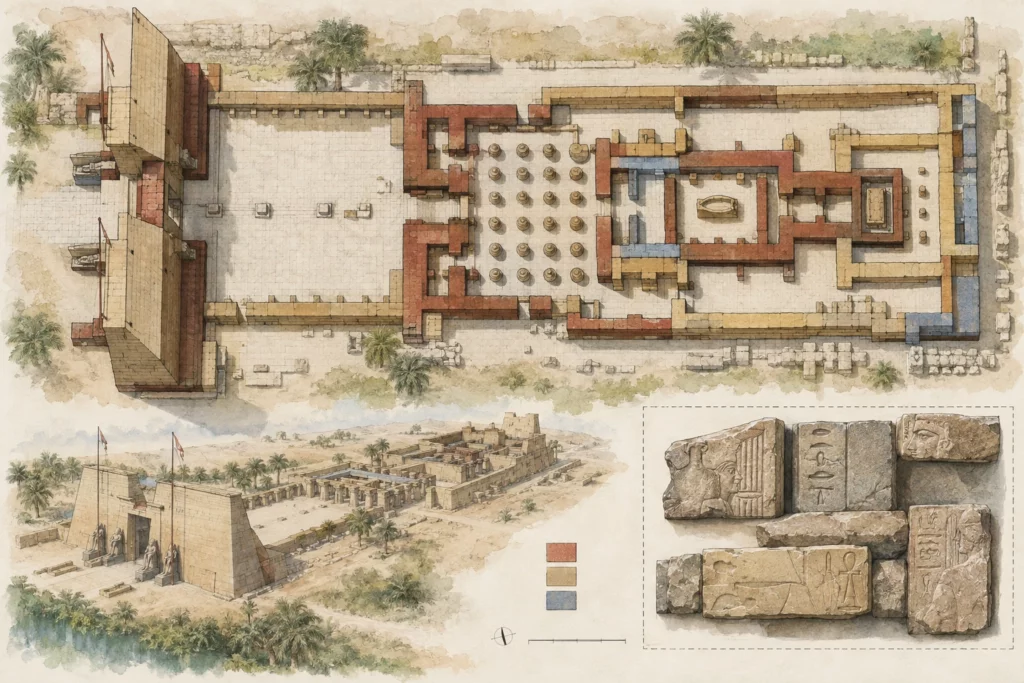
The temple offers a complete example of a New Kingdom temple plan: a pylon, a porticoed court, a hypostyle hall, a hall of the sacred barque surrounded by a corridor, chapels and a sanctuary. The images of Khonsu show him as a child wearing the sidelock of youth or crowned with the lunar disc and crescent.
Chronology and building phases
Construction began under Ramses III and continued under his successors of the 20th Dynasty. The decoration of the court was completed by the high priest of Amun Herihor, who had himself depicted there with royal titles, then by his successors of the 21st Dynasty. The temple thus bears witness to the passage of power from the last Ramesside kings to the high priests of Thebes. The Bab el-Amara gateway was decorated under Ptolemy III.
Excavations and the history of research
The Epigraphic Survey of the Oriental Institute in Chicago published the reliefs and inscriptions of the temple. More recently, the American Research Center in Egypt carried out conservation and epigraphic work, which made it possible to clean the surfaces and document blocks reused in the construction.
State of preservation and research questions
The temple is well preserved in its main lines. The reused blocks, which come from older buildings, are documented by photography and drawing before being protected. Research focuses on the transition between the end of the New Kingdom and the Third Intermediate Period.
Sources
Main sources (consulted on 28 September 2026): Egyptian ministry, Khonsu Temple; ARCE, epigraphy of the Khonsu Temple; UNESCO, Ancient Thebes with its Necropolis.