Identification and location
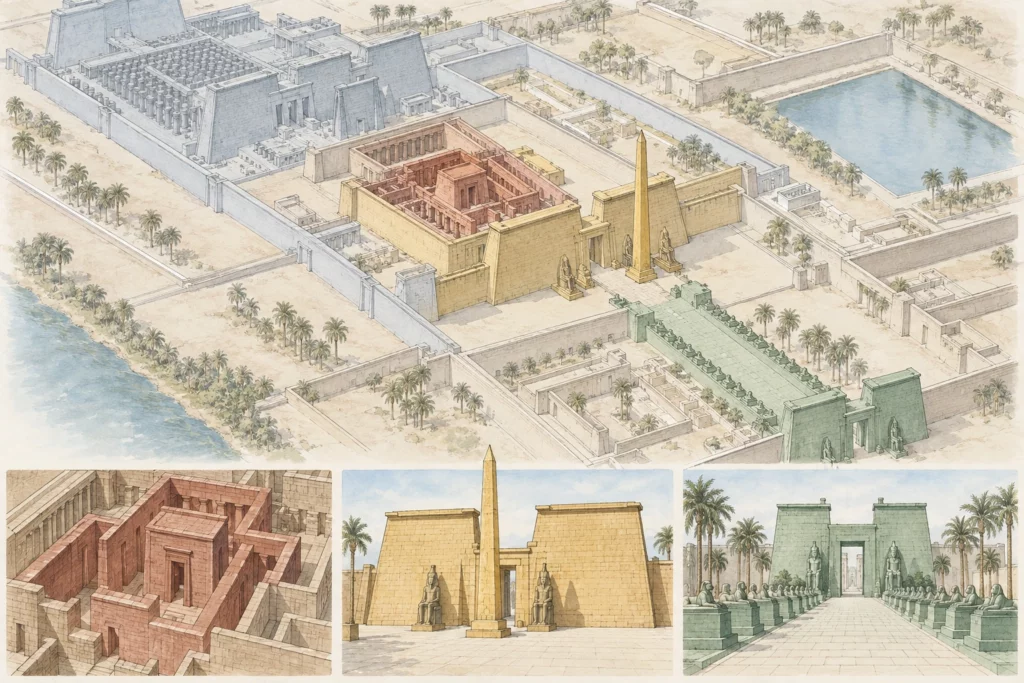
The temple of Amun-Ra extends at the heart of the main enclosure of Karnak, on the east bank of Thebes. This article deals with its New Kingdom enlargements, not with all the sanctuaries of the site: the domains of Mut and Montu, as well as the temples of Khonsu and Opet, have their own history. The cult core existed before the 18th Dynasty. Later works accumulated around it, sometimes dismantling or enclosing earlier buildings. The façade seen today cannot therefore serve as the starting point for an imaginary visit under Thutmose III. To understand a phase, the building must be placed within the network of gateways in use at the time.
General presentation
The main axis of the temple runs approximately from east to west, while a second axis leads south, towards Luxor. These orientations structure two different ritual routes. Hatshepsut marked the domain with her Eighth Pylon, which then formed a southern entrance, and with obelisks. Thutmose III added in particular the Seventh Pylon, north of the previous one. According to the Centre franco-égyptien d’étude des temples de Karnak (CFEETK, Franco-Egyptian Centre for the Study of the Temples of Karnak), this pylon separates two courts and its decoration comprises at least two campaigns of carving: one linked to Megiddo, after year 23 of the reign, the other to the expedition against Mitanni in year 33. It would be misleading to treat these scenes as a simultaneous record of the building work. The Eighth Pylon, for its part, preserves inscriptions linked to the legitimation of Hatshepsut, some of which were later erased.
Monuments and remains
The pylons are not simply repeated façades: their position and date change the thresholds of the enclosure. The Seventh Pylon opens a sequence of courts on the southern axis; the Eighth refers to an earlier state of this entrance. The obelisks inscribe the royal dedication in the sanctuary, but the present existence of a monolith is not enough to reconstruct its pair and its surroundings at all periods. At the eastern end of the great temple, the Akhmenu of Thutmose III belongs to another programme, associated with divine and royal cults. To the west, the great hypostyle hall has 134 columns, 12 of them taller in the central nave; most of its fabric and decoration belong mainly to Seti I and Ramses II. It should not appear in a reconstruction that stops at the reign of Thutmose III.
Chronology and building phases
An architectural attribution rests on several kinds of evidence that do not always coincide: foundations, masonry joints, reliefs, cartouches, traces of erasure and blocks found out of their original position. At the Seventh Pylon, the CFEETK team is inventorying both the blocks in place and scattered granite elements belonging to the monumental gateway. Recording the carvings makes it possible to distinguish the campaigns of decoration from the construction of the pylon. At the Eighth, the texts of Hatshepsut and their later hammering-out document the political history of the monument; the hammering-out does not by itself date each course of the wall. Reused blocks provide evidence older than the structure into which they were inserted. This stratigraphy explains why a panoramic photograph brings together objects from several reigns without being the image of a single historical moment.
History and functions
The sanctuary of Amun-Ra was a place of daily cult and great processions, as well as a space where kings asserted their relationship with the god. The avenue of sphinxes linking Karnak to Luxor played a part in the Opet festival; liturgical movement therefore extended beyond the enclosure. On site, the enlargement of an axis could change the way of entering, of displaying an inscription or of crossing a court. The inscriptions of military campaigns on the Seventh Pylon associate the memory of victories with sacred space, without making the pylon a purely military monument. The multiplication of royal foundations should not obscure the activities of the priests and the maintenance teams. Nor does it mean that all the spaces of the complex were freely accessible to the same people.
Excavations and the history of research
The CFEETK brings together the Egyptian Ministry of Antiquities and the CNRS to document the monuments of Karnak. Its programmes devoted to the Seventh and Eighth Pylons combine photography, epigraphic recording and the examination of blocks; they aim to reconstruct the sequences of decoration and the transformations. Modern conservation can stabilise a gateway, re-erect elements or reveal levels long hidden. It then adds a stage to the material history of the site. In a research file, what is observed in place, what comes from displaced blocks and what results from a hypothesis of fit should be kept separate. A legible drawing of Karnak should show the phases with an explicit key rather than colour all the 18th Dynasty remains in a single tone.
State of preservation and research questions
The stone surfaces are exposed to erosion, salts, earlier interventions and present-day visitor numbers. The study of erased inscriptions requires high-resolution documentation; an earlier reading may be corrected by a new survey. The Seventh Pylon still illustrates the uncertainty, expressly noted by the research team, about the exact stages of its construction and its links with the neighbouring structures. For the Eighth, the reading of the great political texts also depends on distinguishing the original carving from the erasure. The visuals attached to the article are orientation compositions, not metric surveys. They cannot on their own date a wall or show the complete state of the temple at a given date. A reconstruction intended for publication must be checked against the plans and archives of the CFEETK.
Sources
Main sources (consulted on 28 September 2026): Egyptian Ministry of Tourism and Antiquities, Karnak, https://egymonuments.gov.eg/archaeological-sites/karnak/; CFEETK, epigraphic study of the Seventh Pylon, https://www.cfeetk.cnrs.fr/accueil/programmes-scientifiques/axe-1-pouvoir-et-marques-de-pouvoir-a-karnak/axe1-theme8/ (in French); CFEETK, epigraphic study of the Eighth Pylon, https://www.cfeetk.cnrs.fr/accueil/programmes-scientifiques/axe-1-pouvoir-et-marques-de-pouvoir-a-karnak/axe1-theme5/ (in French); CFEETK, Atlas of the obelisks, https://www.cfeetk.cnrs.fr/accueil/programmes-scientifiques/axe-1-pouvoir-et-marques-de-pouvoir-a-karnak/atlas-des-obelisques-karnak/ (in French).