The domain of Amun-Ra is the largest enclosure at Karnak. Its courts, pylons, halls and chapels are the result of successive building works. This article shows how to move from the first phases of the temple to the New Kingdom monuments and the later buildings.
In brief
The domain of Amun-Ra formed the heart of Ipet-Sut, ‘the most select of places’, the ancient name of Karnak. It was the dwelling of the god Amun, whose cult made Thebes the great religious centre of the country. The enclosure is the largest at Karnak; the domains of Mut, to the south, and of Montu, to the north, have their own history and their own articles.
What you discover
From the entrance eastwards, visitors pass through successive pylons and courts, then the great hypostyle hall and its 134 columns. Further on stand the obelisk of Hatshepsut, nearly 30 m high and weighing more than 300 tonnes, then the Akhmenu, the festival hall of Thutmose III. In the south-west corner stands the temple of the god Khonsu. The sacred lake served for the purification of the priests. The Osirian chapels, finally, belong to the late periods.
What to look at
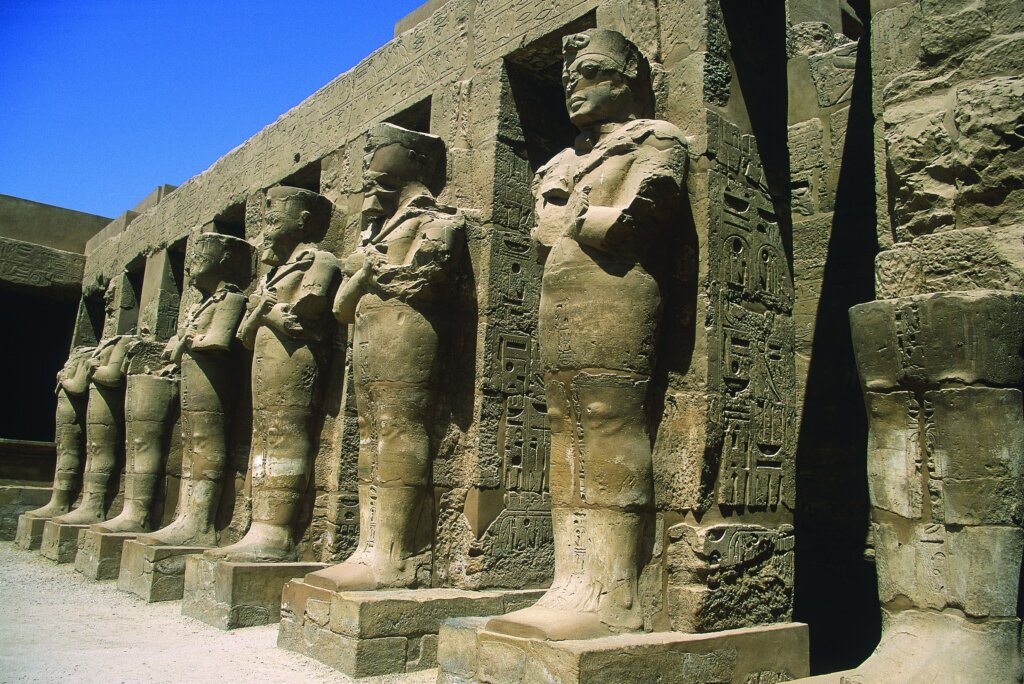
In the photograph, the Osiride pillars of the court of the temple of Ramses III show the king in the form of Osiris. This small temple, set within the domain of Amun, is a reminder that the same space received buildings from different reigns. In the great hypostyle hall, the twelve columns of the central aisle, crowned with open papyrus capitals, reach about 21 m, against 15 m for the others. This difference in height left room, above the side aisles, for stone window grilles through which light filtered. Even in full daylight, the hall was bathed in a half-light suited to the mystery of the cult.
Its history
The oldest traces of the temple go back to the reign of Intef II, c. 2112–2063 BC. Almost all the kings of the New Kingdom then enlarged the domain: the great hypostyle hall, begun under Amenhotep III, was mainly built and decorated under Seti I and Ramses II. It bears in particular the reliefs of the war scenes of Seti I, and the University of Memphis team that studies it presents it as the most richly decorated hypostyle hall in Egypt. The Ptolemies and then the Romans still added buildings. The visible buildings therefore do not all bear the same date, and some blocks were reused.
How to explore the articles
The article on the first great phases of the temple of Amun presents the origins; that on the temple of Amun-Ra follows the New Kingdom enlargements. The Akhmenu of Thutmose III, the great hypostyle hall of Seti I and Ramses II, the temple of Khonsu and the Osirian chapels are dealt with separately: being neighbours does not make them parts of a single programme.
Sources
Egyptian ministry, Karnak: https://egymonuments.gov.eg/archaeological-sites/karnak/
UNESCO, Ancient Thebes with its Necropolis: https://whc.unesco.org/en/list/87
University of Memphis, Karnak Great Hypostyle Hall Project: https://www.memphis.edu/hypostyle/about-architecture/