Identification and location
The Akhmenu lies east of the domain of Amun-Ra, in the complex of Karnak. Thutmose III had it built in the New Kingdom. The expression ‘festival hall’ often refers to the whole, but it may suggest a single room. The Akhmenu, on the contrary, brings together a great hall, sanctuaries on the axis, solar rooms and several groups of chambers. Its study therefore belongs to the history of a specific monument within Karnak, not to a general description of all the temples of the site.
General presentation
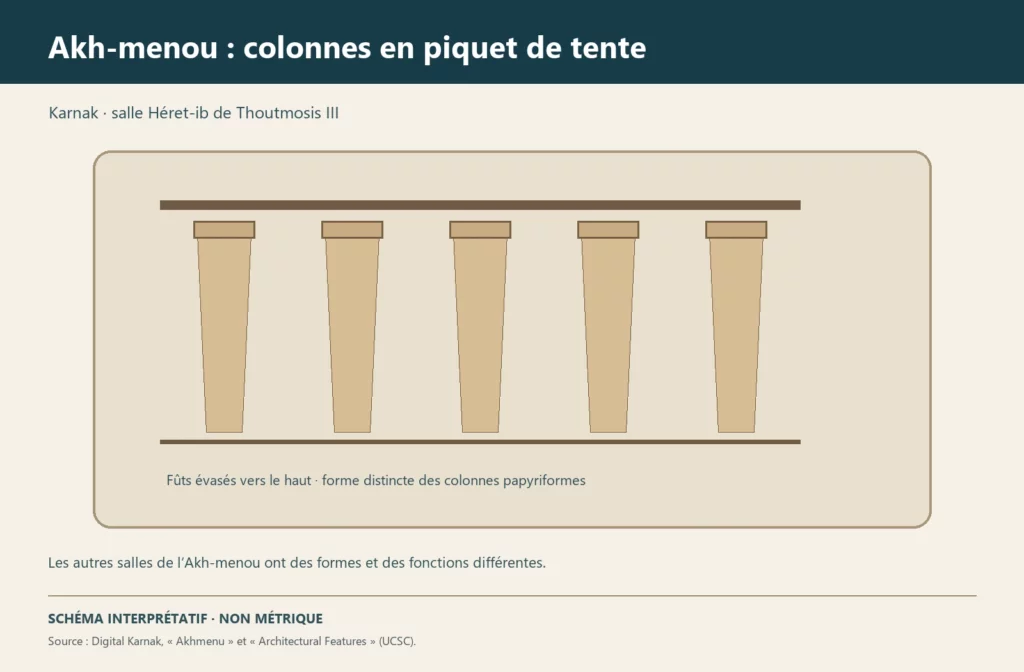
The great Heret-ib hall offers a particularly recognisable arrangement of columns. Passages lead to cult spaces with differentiated functions. The Centre franco-égyptien d’étude des temples de Karnak (CFEETK, Franco-Egyptian Centre for the Study of the Temples of Karnak) distinguishes the axial sanctuaries, the solar rooms to the north, the so-called ‘funerary’ rooms and the southern rooms. These working names do not always establish an ancient name or an exclusive use. The plan must be read together with the inscriptions and thresholds: a scene inscribed on a wall does not necessarily describe the function of all the neighbouring chambers.
Monuments and remains
The reliefs associate the king with the gods and with his predecessors. The area called the ‘botanical garden’ depicts plants and animals in a composition ordered by royal ideology. It is neither an exhaustive herbarium nor a naturalist’s record free of conventions. The sanctuaries and the annexe rooms preserve other inscriptions and images; some decoration has been reworked or moved. The CFEETK also documents the Sokarian rooms, the northern and southern storerooms and the central spaces. This vocabulary specifies where each remain is located, which a general view of the building does not always make clear.
Chronology and building phases
The main building is a work of Thutmose III, but its material history does not stop with his reign. Inscriptions, later interventions and modern restorations need to be distinguished. The CFEETK programme has produced separate studies of the ‘botanical garden’, the architecture and the Heret-ib, followed by surveys of other rooms. This progress of research is a reminder that a phase known in one area cannot be automatically projected onto the whole complex. Each displaced block and each gap in the decoration complicates the reconstruction of a single state.
History and functions
The Egyptian ministry links the Akhmenu to the cults of several deities, of the royal predecessors and of Thutmose III himself. The festive dimension suggested by its usual name is therefore one part of its programme, not its complete explanation. The scenes and the approaches bear witness to differentiated ritual activities. The ‘botanical garden’ forms part of the representation of the known world under the authority of the ruler; its historical value lies in this visual language as much as in the possible identification of some species. Interpreting a chamber requires relating its decoration, its place in the circulation and its transformations.
Excavations and the history of research
The CFEETK, a Franco-Egyptian body associating the CNRS and the Egyptian authorities, is carrying out detailed epigraphic and architectural surveys in the Akhmenu. The vector drawings are checked against the walls during missions on site; high-resolution photographs are used to verify the readings. The programme has studied the central sanctuaries and the northern and southern rooms, and prepared the publication of new corpora. The scientific archives link the images to precise locations in the monument. They make it possible to compare a published inscription, its photograph and the present state of the stone, without confusing a fragment with its original context.
State of preservation and research questions
The CFEETK reports restoration campaigns in the central sanctuaries, the northern storerooms and the Sokarian rooms, while other areas remain to be documented or consolidated. The interventions make the spaces easier to read, but each replaced block must be identified as such. The questions concern the sequence of the decoration, the attribution of fragments and the precise use of some chambers. The modern names ‘festival hall’, ‘funerary chambers’ or ‘storerooms’ do not on their own resolve these questions. The published surveys remain the basis for counting the columns, locating the scenes and establishing an exact plan.
Sources
Main sources: Centre franco-égyptien d’étude des temples de Karnak, ‘L’Akh-menou de Thoutmosis III’ and ‘Restauration et anastylose’; Egyptian Ministry of Tourism and Antiquities, ‘Karnak’. Consulted on 28 September 2026: https://www.cfeetk.cnrs.fr/accueil/programmes-scientifiques/axe-3-cultes-et-lieux-de-culte/axe3-theme3/ (in French); https://www.cfeetk.cnrs.fr/restauration-anastylose/ (in French); https://egymonuments.gov.eg/archaeological-sites/karnak/.