In brief
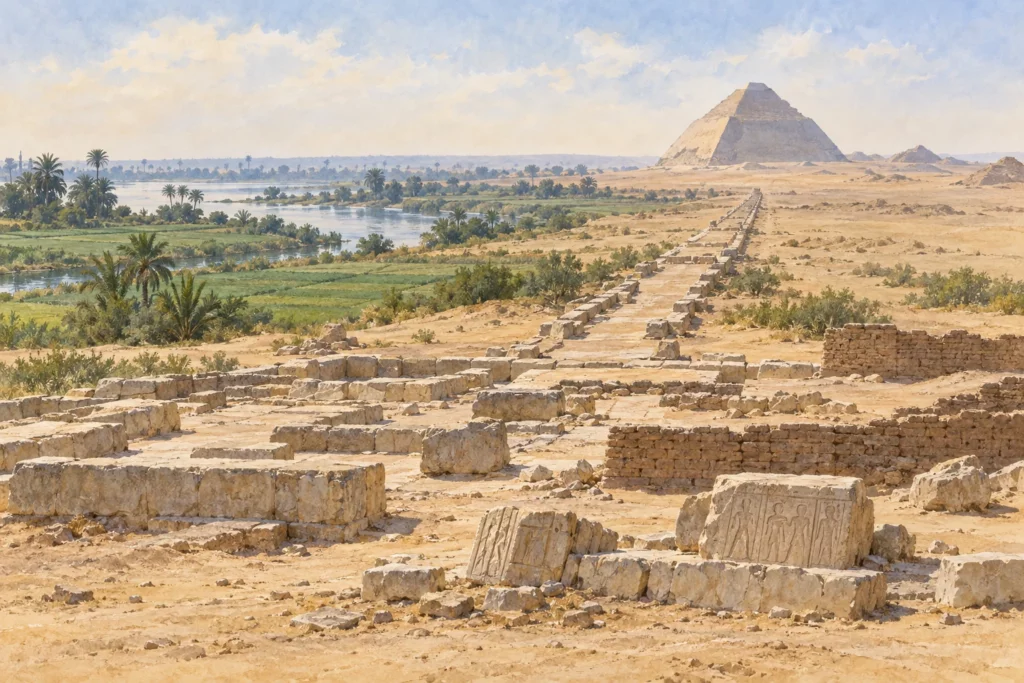
At Dahshur, the pyramids of Sneferu were part of much larger landscapes. East of the Bent Pyramid, a causeway linked the monument to a temple near the cultivated valley. Traces of settlement exist in this sector, and others have been sought near the Red Pyramid, further north. These modest remains tell of the royal cult, of movement and of the lives of the people associated with the great building projects of the 4th Dynasty.
What you discover
The valley temple of the Bent Pyramid survives mainly through its low structures and many relief fragments. The causeway gives material form to the link between the desert plateau and the edge of the valley. Mudbrick houses known nearby recall the presence of inhabitants and staff. Researchers are also studying the traces of an ancient waterscape near the temple. To the north, near the Red Pyramid, surveys concern installations for workers; this is a different sector, not to be confused with the houses of the southern temple.
Its history
The temple and the causeway belong to Sneferu’s funerary programme around the Bent Pyramid. Their history after the Old Kingdom includes transformations and stone robbing. Ahmed Fakhry excavated the temple in the 20th century and uncovered many decorated fragments. The German Archaeological Institute has resumed the study of the remains and their surroundings, notably with geophysical surveys and trial trenches. This research sheds light on the line of the approaches, elements of the decoration and the relationship with the valley, without providing a complete plan of all the settlement areas.
Why this place matters
This article helps us see what a pyramid alone does not tell: the places of worship, the routes and the human occupation. The relief fragments preserve clues to the royal decorative programme, even where the walls are very low. The traces of houses are not enough to reconstruct a whole large town. The southern temple and the northern installations are linked to the reign of Sneferu, but they do not form a single built complex. The two separate images are visual interpretations, not documentary records.