In brief
The royal necropolis of Dahshur, south of Saqqara, brings together five pyramids: the two great stone pyramids of Sneferu and three brick pyramids of the 12th Dynasty, those of Amenemhat II, Senusret III and Amenemhat III. The last, now called the ‘Black Pyramid’, was raised during the first part of the reign of Amenemhat III. Yet it never received the king’s body: technical problems linked to the ground led to its abandonment as a royal tomb, and Amenemhat III had a second pyramid built at Hawara, at the entrance to the Faiyum.
What you discover
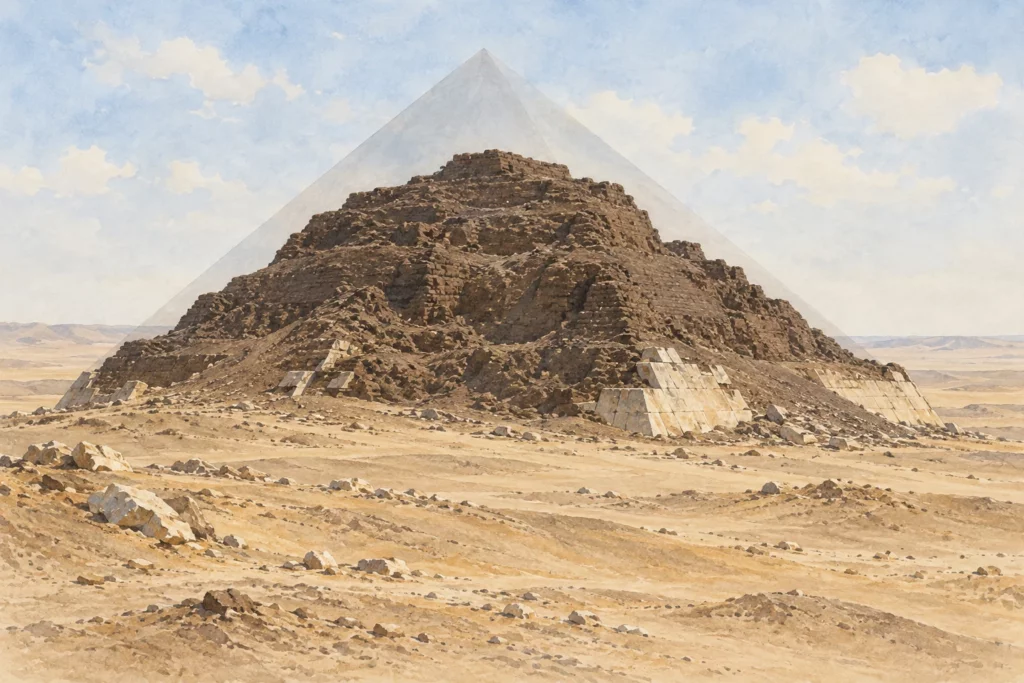
From a distance, the monument no longer has the clean profile of a pyramid. Its dark, worn mass rises at a distance from the pyramid of Sneferu, in a desert where the pyramids are separated by vast expanses scattered with private tombs, quarries, construction ramps, causeways and former workers’ quarters. The Egyptian Ministry of Tourism and Antiquities describes it as badly degraded, eaten away by erosion but still standing.
What you see is essentially the mudbrick core. It is its colour, and not that of a lost casing, that has given the monument its modern name. The royal pyramids of the 12th Dynasty at Dahshur rest on this principle of a brick core faced with limestone, well documented at the neighbouring pyramid of Senusret III excavated by the Metropolitan Museum.
What to look at
The most telling detail of the monument is no longer on site. Its pyramidion, the stone that capped the summit, is on display in the Egyptian Museum in Cairo. On the face turned towards the east, the side of the rising sun, a winged sun disc framed by two uraeus cobras and a pair of eyes dominate a hieroglyphic inscription celebrating Ra. The tip of the pyramid thus carried, in full light, a prayer to the sun.
The second detail is found at the foot of the monument. Near its north-east corner, Jacques de Morgan, then director-general of the Antiquities Service, uncovered on 16 April 1894 the burial of King Hor (Awibra), a ruler of the early 13th Dynasty. The clay soil had made it necessary to place it at the bottom of a deep pit. Robbed in antiquity, it still preserved a gilded wooden mask placed on the head of the deceased. This king’s ka statue, of stuccoed and painted wood, 1.70 m high, with eyes inlaid with rock crystal and quartz, is now in the Egyptian Museum. The two raised arms of the ka sign surmount its head. Fixed on a panel, the figure could be removed from its naos.
Its history
The abandoned pyramid did not remain empty of meaning. According to Wolfram Grajetzki, it served as a burial place for the women closest to the king. Jacques de Morgan’s excavations in 1894–1895 revealed, in the shafts to the north, intact burial chambers, including those of King Hor and Princess Nubhotep. Researchers see in them the trace of an organised funerary programme extending from the end of the 12th to the beginning of the 13th Dynasty around the complexes of Amenemhat II and Amenemhat III. At Hawara, the king’s second complex included the immense building that classical authors called the ‘Labyrinth’.
Several points remain open. The exact nature of the technical problems that doomed the building work remains to be clarified; the reference study remains Dieter Arnold’s architectural publication (1987). The Egyptian Museum speaks of a ‘cenotaph’, a word that interprets in hindsight a complex with successive uses. The family ties between King Hor, the princesses and Amenemhat III have not been established: a bioarchaeological study published in 2026 re-examined their bones, kept in the Egyptian Museum in Cairo.
Sources
Consulted on 30 September 2026: Pyramidion of the pyramid of Amenemhat III, Egyptian Museum, Cairo; Wolfram Grajetzki, ‘Late Middle Kingdom’, UCLA Encyclopedia of Egyptology, 2013; Zeinab Hashesh, Ahmed Gabr, Roxie Walker et al., ‘Bioarchaeological reassessment of Dahshur royal skeletal remains from the Late Middle Kingdom’, Frontiers in Environmental Archaeology, 2026.