In brief
Dahshur stretches along the edge of the western desert, about thirty kilometres south of Cairo. The site has five pyramids: two great stone pyramids raised under Sneferu in the 4th Dynasty, and three smaller mudbrick pyramids built in the 12th Dynasty by Amenemhat II, Senusret III and Amenemhat III. This page is concerned with the first two of the Middle Kingdom. By returning to Dahshur more than six centuries after Sneferu, these kings set their tombs in a funerary landscape that was already ancient.
What you discover
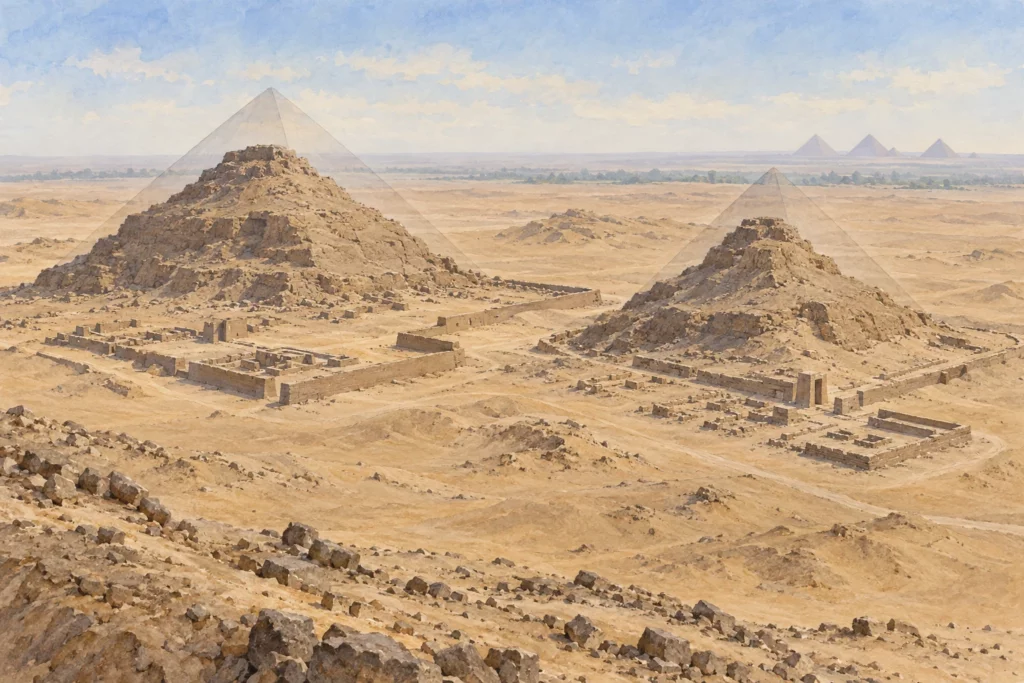
Between the pyramids stretch vast desert spaces, scattered with mastabas and private burials, quarries, construction ramps, causeways and remains of workers’ settlements. The Middle Kingdom monuments look very modest beside the masses of Sneferu. The pyramid of Senusret III, who reigned c. 1878–1840 BC, was nevertheless 62 metres high: a mudbrick core faced with limestone. Stripped of this casing, it is now no more than a mound 21 metres high, hollowed at its centre by a deep crater. The main robbery took place in the Ramesside period, when pyramids and mastabas were exploited as quarries down to their foundations.
The pyramid of Amenemhat II, who reigned from c. 1914 to 1879 BC, is less well known in detail. Its proximity to that of Senusret III invites comparison, but their plans and finds must not be confused.
What to look at
The complex of Senusret III holds two particular features. The first is underground. The entrance to the pyramid opens not on the north, as tradition required, but on the west. A long corridor leads to an antechamber, a serdab and the burial chamber, where a finely cut red granite sarcophagus rests; its base reproduces in relief the design of an enclosure wall. No human remains were found there, which suggests that the king may have been buried elsewhere, and Abydos has been proposed, where he also had a funerary complex laid out.
The second feature concerns the king’s circle. North and south of his pyramid stood seven small pyramids. To the south, the easternmost was intended for the king’s ka. That of Queen Weret I was only a cenotaph, as the queen was buried elsewhere. That of Weret II concealed, in a niche at the bottom of its access shaft, a deposit of jewellery discovered in 1994: scarabs, bracelets, a girdle of gold cowries and anklets. To the north, a gallery of eight chambers received the burials of eight women of the royal family; Jacques de Morgan found two groups of jewellery there in 1894. Each woman’s pyramid had a small chapel decorated with offering scenes and with the names and titles of the deceased.
Its history
Jacques de Morgan excavated the necropolis in 1894–1895. The Metropolitan Museum of Art resumed work on the complex of Senusret III in 1990 and has since conducted annual three-month seasons there. Its work has shown that the complex was enlarged in two stages, until it formed a long rectangle. To the south a large temple was then raised, which seems to mark the appearance of a new type of building in royal complexes. Its exact function and the true place of the king’s burial are still under discussion.
Sources
Consulted on 30 September 2026: The Pyramid Complex of Senwosret III in the Cemeteries of Dahshur, Metropolitan Museum of Art; Queens and Princesses in the Pyramid Complex of Senwosret III, Dahshur, Metropolitan Museum of Art; Amenemhat II, Digital Egypt for Universities, University College London.