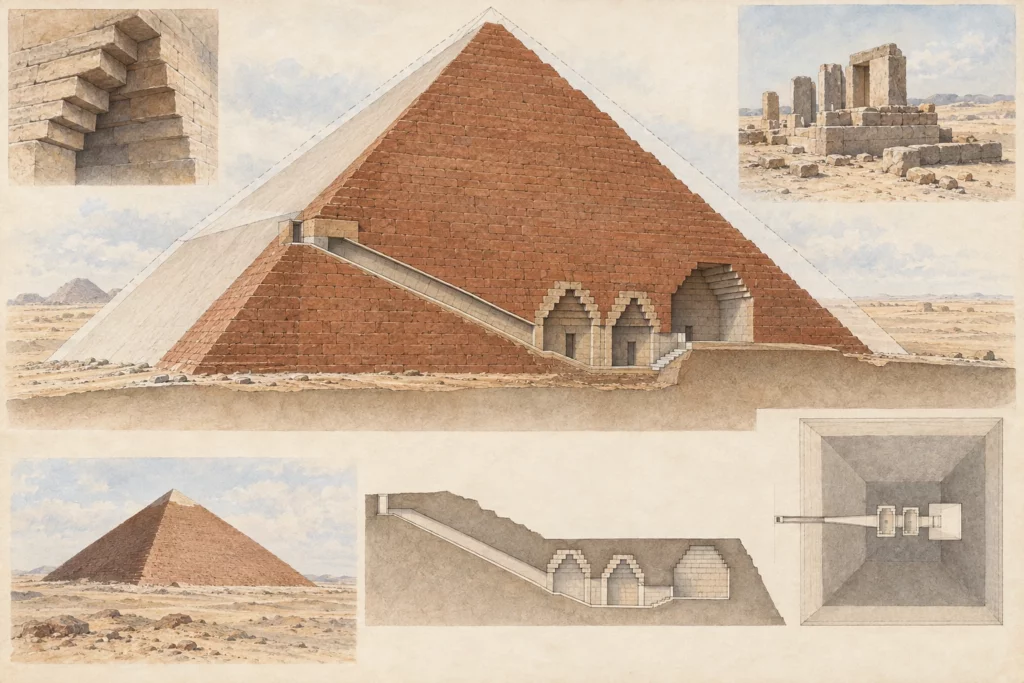
Identification and location
The Red Pyramid, also called Sneferu’s North Pyramid, stands at Dahshur in the Memphite necropolis. It belongs to the 4th Dynasty and to the reign of Sneferu, conventionally placed in the 27th or 26th century BC depending on the chronologies. The modern nickname ‘red’ describes the tint of the core limestone now exposed. It does not correspond to the ancient external appearance, dominated by the white limestone of the casing. The pyramid is distinct from the Bent Pyramid, the same king’s southern monument, and from the Middle Kingdom pyramids on the site. It is the tallest surviving pyramid at Dahshur and one of the great constructions of the Old Kingdom.
General presentation
Its silhouette with a regular slope embodies a project for a smooth-sided pyramid pursued after the experiments of Meidum and the Bent Pyramid. The angle, more moderate than that of the lower part of the Bent Pyramid, gives the monument its broad profile. A northern corridor leads to three chambers arranged in sequence, roofed with corbelled courses. This substructure shows the continuity and the transformations of the solutions developed under Sneferu. The pyramid belonged to a royal funerary complex whose eastern buildings are less spectacular today than the mass of stone. Research on its surroundings shows that the monument was associated with a landscape of work, tombs and worship, not with an empty desert.
Monuments and remains
The superstructure is made of limestone blocks whose reddish tint is visible on the faces stripped of their facing. The original casing, of white Tura limestone, would have produced a lighter and more regular surface. The entrance on the north leads to a narrow, descending passage. This opens onto a first chamber with a corbelled roof, then onto a second chamber on the same principle. A passage set higher up gives access to a third chamber, interpreted as the burial chamber. The progressive stepping of the courses creates vaults in inverted steps capable of transferring the loads. The internal spaces are known from direct exploration, but the exact functions of each chamber are not recorded in any founding text. On the east side, the remains of the mortuary temple and its surroundings reveal the cult dimension of the complex. In the necropolis, excavations have identified elements linked to the workers and to the occupation of the plateau.
Chronology and building phases
In the general sequence of the reign, the Red Pyramid comes after the Bent Pyramid of Dahshur. The latter’s change of angle is often connected with the adoption from the outset of a gentler slope for the northern pyramid. This technical relationship is plausible, but it does not turn the previous project into a simple failure, nor does it give the detail of the royal decisions. The Egyptian ministry cautiously suggests a start of work around the thirteenth year of the reign and a duration of about ten years. These indications depend on the reading of builders’ marks and on the system of counting years; they should not be taken as indisputable absolute dates. The works on Sneferu’s different complexes may have overlapped. After completion, the loss of much of the casing changed the appearance of the monument. The uses and transformations of the surrounding spaces continued over the centuries.
History and functions
The pyramid had a royal funerary purpose and symbolised the permanence of the sovereign. The layout of its chambers concentrates the effort on an internal space protected by an enormous mass of stone. The third chamber is generally designated as the burial chamber, but an architectural attribution of function is not direct proof that Sneferu was buried there. The temples and annexes took part in the king’s cult and in the management of offerings and staff. Titles of priests and administrators known at Dahshur show that the king’s two great pyramids kept distinct cult identities. The present red colour, often used as a distinctive sign in popular presentations, must be placed back in the material history of the monument: it is that of the exposed core, not an attested intention for the façade.
Excavations and the history of research
Modern explorations and surveys gradually distinguished the northern pyramid from the other monuments of Dahshur. In the 20th century, the campaigns of the German Archaeological Institute renewed the study of the pyramid, its temple and the surrounding necropolis. Rainer Stadelmann and his colleagues published preliminary reports on the Red Pyramid and its surroundings; UCL Digital Egypt gives the references. The institute’s more recent investigations have dealt with the archaeological landscape of Dahshur, notably the sectors linked to the building work near the pyramid and buried occupation areas. Research today combines the reading of the architecture, the material traces of the building site, the excavation of the neighbouring installations and a critical examination of royal chronologies. It must also take account of the damage caused by the loss of the casing and by the reworking of the site.
State of preservation and research questions
The pyramidal mass remains imposing, but the white casing has largely disappeared. The modern name of the monument therefore reflects a state of preservation. The three chambers can be described and diagrammed, while some details of their ancient use remain unknown. A comparison with the Bent Pyramid is indispensable for understanding the choice of slopes, but it does not prove a simple and immediate chain of cause and effect. The dates of the building work, the stages of construction of the annexes and the place of Sneferu’s burial call for nuanced wording. The discovery illustration supplied separately is a created evocation of the monument as it stands today.
Sources
Main sources: Egyptian Ministry of Tourism and Antiquities, ‘The Red Pyramid’, https://egymonuments.gov.eg/monuments/the-red-pyramid/; German Archaeological Institute, project ‘Der Pyramidenfriedhof von Dahschur’ (in German), https://www.dainst.org/forschung/projekte/noslug/2772; UCL Digital Egypt, ‘Dahshur, the Bent Pyramid’, with a bibliography of the excavations of the Red Pyramid, https://www.ucl.ac.uk/museums-static/digitalegypt/dahshur/bentpyramid.html; UCL Digital Egypt, ‘King Snefru’, https://www.ucl.ac.uk/museums-static/digitalegypt/chronology/kingsnefru.html.