Identification and location
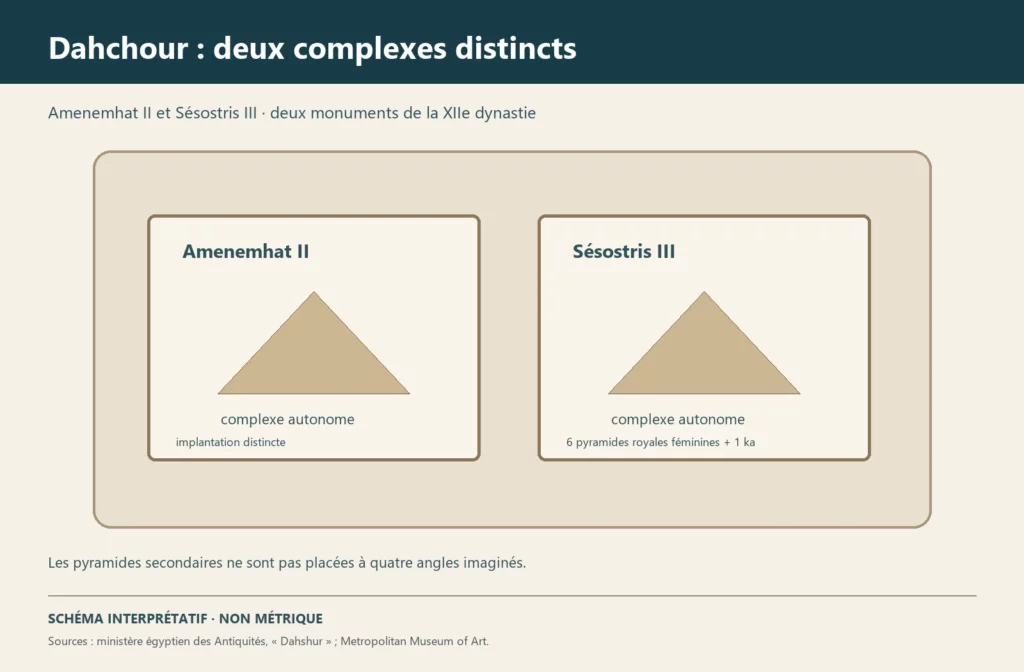
Dahshur is a necropolis with several horizons. The two great monuments of Sneferu date from the Old Kingdom; in the Middle Kingdom, Amenemhat II, Senusret III and later Amenemhat III had mudbrick pyramids built there. This article deals only with the first two. Grouping them in a single chronological entry is useful for comparing the 12th Dynasty, but must neither mix their plans nor attribute to one the objects found with the other. The stone envelopes have largely disappeared and the superstructures have been heavily levelled. Amenemhat II has a pyramid complex at Dahshur whose archaeological documentation is not as complete as that of Senusret III. The surrounding Middle Kingdom necropolis has yielded tombs of princesses, some of them preserving exceptional jewellery. The discoveries of Jacques de Morgan and later studies require each excavation context to be cited before a burial is associated with the royal pyramid. An isolated piece of jewellery from Dahshur does not automatically come from the complex of Amenemhat II. Its interest lies in the reinstallation of the royal tomb in an ancient funerary landscape.
General presentation
The complex of Senusret III has been better studied, by the Metropolitan Museum of Art. Its central pyramid was surrounded by cult spaces, tombs of relatives and a large temple to the south. The Met describes this ‘South Temple’ as an innovation or a possible extension of the functions of the traditional pyramid temple. It would go too far to present it as a certain replacement of every earlier cult. The construction and the neighbouring burials form several stages; they do not represent a single project frozen on the day of the king’s burial.
Monuments and remains
Seven smaller pyramids flanked that of Senusret III to the north and south. Most are associated with women of the royal family, but one pyramid of the southern group may have served for the king’s ka. Some owners are identified, including Queens Weret I and Weret II; others remain unknown. The funerary chapels and their relief fragments evoke the offerings to the deceased women. In one case, the absence of a burial chamber beneath a small pyramid suggests a memorial rather than a burial: the function of these monuments therefore cannot be deduced from their form alone.
Chronology and building phases
The chamber of the pyramid of Senusret III contains a finely worked red granite sarcophagus, but no human remains were found in it. The Met stresses the cleanness of the inside of the sarcophagus and considers it possible that the king was buried elsewhere, notably in his complex at Abydos. This proposal is an inference from the archaeology, not direct evidence of the body being moved. The relationships between the pyramid at Dahshur, Abydos and the king’s funerary cult remain an open question.
History and functions
The excavations of Jacques de Morgan in 1894–1895 made it possible to identify a large part of the necropolis. The Met resumed work on the complex of Senusret III from 1990, studying architecture, reliefs, royal burials and private tombs. Ancient robbery and stone extraction, particularly in the Ramesside period, profoundly altered the structures. Later burials were added in the sector. The stratigraphy and provenance of each object are essential to avoid turning all these traces into a single moment of the 12th Dynasty.
Excavations and the history of research
Amenemhat II and Senusret III share the general form of the pyramid tomb, but the data available for each are uneven. The former is documented mainly through his complex and its funerary surroundings; for the latter, the chapels, the South Temple and the chambers have been analysed in detail. The differences observed reflect both ancient choices and the state of preservation. A rigorous comparison must always distinguish the absence of remains, the absence of published excavation and the absence of an element in the original project.
What we still do not know about Dahshur
According to the Metropolitan Museum, the pyramid of Senusret III, originally 62 metres high, is now no more than a mound 21 metres high hollowed by a deep crater: the limestone casing was torn away by robbers, exposing the mudbrick core. Robbery is attested in the Hyksos period, followed by systematic quarrying in the Ramesside period. The museum continues annual three-month seasons on the site.
The most debated question is that of the king’s burial: the granite sarcophagus is decorated, but clean and without human remains, which leads to the possibility of a burial at Abydos. This hypothesis has not been demonstrated.
Sources
Main sources: UCL, ‘Dahshur’, https://www.ucl.ac.uk/museums-static/digitalegypt/dahshur/bentpyramid.html; UCL, ‘Amenemhat II’, https://www.ucl.ac.uk/museums-static/digitalegypt/chronology/amenemhatII.html; UCL, ‘Senusret III’, https://www.ucl.ac.uk/museums-static/digitalegypt/chronology/senusretIII.html; The Pyramid Complex of Senwosret III, Dahshur, The Metropolitan Museum of Art; ‘Queens and Princesses’, https://www.metmuseum.org/fr/essays/queens-and-princesses-in-the-pyramid-complex-of-senwosret-iii-dahshur (consulted on 27 September 2026).