Identification and location
The so-called ‘Black’ Pyramid belongs to the first funerary programme of Amenemhat III at Dahshur, during the 12th Dynasty. It is distinct from the monuments of Amenemhat II and Senusret III in the same necropolis, as well as from the two much older pyramids of Sneferu. The modern name comes from the dark appearance of the weathered mudbrick core. It does not describe the colour of the original casing: the complex also used limestone. The present ruined mass is therefore the result of losses of facing, degradation and long transformations. The project included a pyramidal superstructure and complex underground spaces. Their study has revealed difficulties with the ground. UCL states that these problems led to the choice of Hawara for a second pyramid towards the end of the reign. This relationship is widely accepted, but the precise technical causes and the timing of the decisions are not recorded in a complete account of the building work. The existence of a second project does not imply that the Dahshur monument was immediately abandoned in all its functions.
General presentation
The pyramid at Hawara is generally regarded as the burial place of Amenemhat III. UCL specifies that the first pyramid at Dahshur was not used for the king. The Egyptian Museum in Cairo, for its part, describes Dahshur as a cenotaph. These formulations converge in distinguishing the initial project from the final tomb, but the word ‘cenotaph’ interprets the later function of a complex that went through several phases. The burials and monuments associated with the sector must be studied for themselves, without automatically transferring the royal burial to them.
Monuments and remains
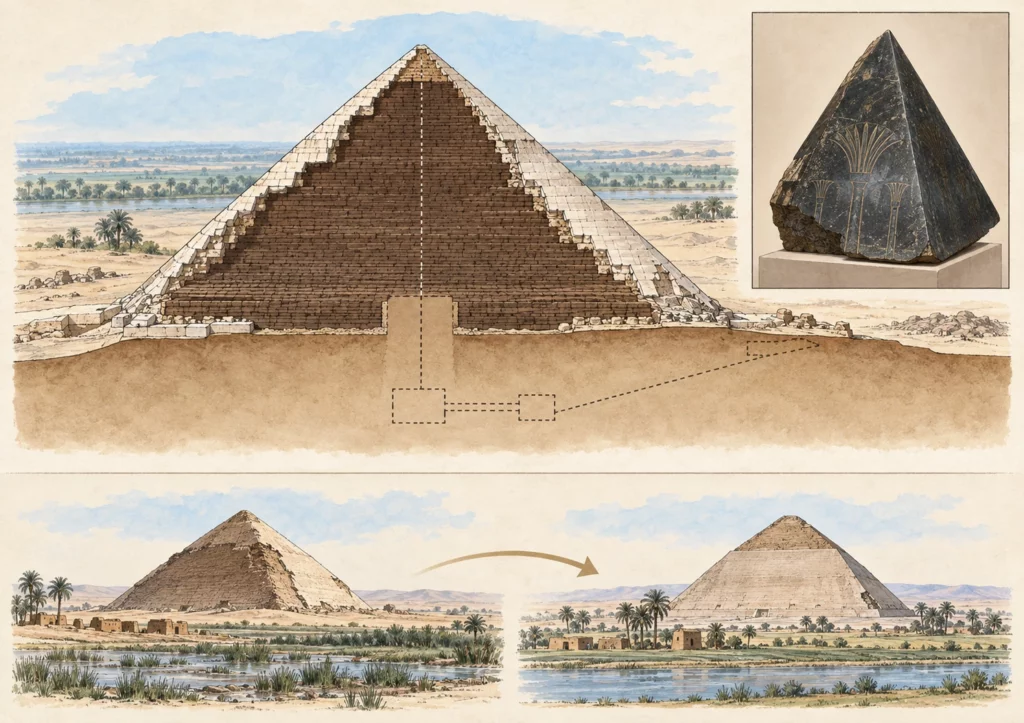
A dark stone pyramidion discovered at Dahshur is now on display in the Egyptian Museum in Cairo. The museum’s entry attributes it to Amenemhat III and describes solar motifs, notably a winged disc and protective eyes around an inscription dedicated to Ra. This piece shows that the top of the pyramid could receive highly meaningful decoration.
Chronology and building phases
The choice of mudbrick for the core and of stone for certain parts followed the practices of Middle Kingdom pyramids. Stability nevertheless depended on the foundations, the excavated spaces and local conditions. The state of ruin may hide repairs or defects that are not all contemporary with the construction. An explanatory section is therefore not enough to demonstrate the mechanism of a ground problem. Precise diagnoses must rest on surveys of the masonry and on the excavation publications.
History and functions
The relationship between Dahshur and Hawara also reveals the growing role of the Faiyum in the works of Amenemhat III. Besides his second pyramid, the king had other monuments built there, notably at Medinet Madi and Biahmu. It would nevertheless be misleading to tell the story of these projects as if they had all been decided at the same time in response to the problem at Dahshur alone. Each site has its own chronology, function and history of preservation. This article concerns the first pyramid and refers to Hawara for the rest of the funerary programme.
Excavations and the history of research
The Cairo pyramidion and the remains at Dahshur are sources of different kinds. The former is a movable object with a find spot and a modern place of keeping; the latter are structures in place but heavily altered. Combining them in a single reconstruction must remain explicitly hypothetical. The absolute dates of the reign vary between chronologies, and the succession of building projects matters more here than a single year. The word ‘black’ should not lead to drawing a complete facing of black stone, which is absent from the documentation.
What we still do not know about the Black Pyramid
The Black Pyramid is now no more than a ruined mass, whose mudbrick core has been exposed since the loss of the casing. UCL links the abandonment of the project for the royal burial to difficulties with the ground, while the Egyptian Museum in Cairo speaks of a cenotaph. These two formulations do not have the same scope and do not rest on a complete account of the building work.
Still open are the exact nature of the problems encountered, the timing of the decisions and the use of the pyramid after Hawara was chosen. The Cairo pyramidion, a movable object, is not enough to reconstruct the summit of the monument without further survey of the remains in place.
Sources
Main sources: UCL, ‘Amenemhat III’, https://www.ucl.ac.uk/museums-static/digitalegypt/chronology/amenemhatIII.html; Egyptian Museum, Cairo, ‘Pyramidion of the pyramid of Amenemhat III’, https://egyptianmuseumcairo.eg/artefacts/pyramidion-of-the-pyramid-of-amenemhat-iii/; UCL, ‘Pyramidia of Royal Pyramids’, https://www.ucl.ac.uk/museums-static/digitalegypt/pyramids/pyramidia.html; Dahshur, UCL Digital Egypt (consulted on 27 September 2026).