Identification and location
The Bent Pyramid occupies the southern part of the necropolis of Dahshur, south of Saqqara in the Memphite region. It was built for Sneferu, the first king of the 4th Dynasty, in the 27th or 26th century BC depending on the chronologies used. Its modern nickname describes the break in slope visible on all four faces. Later Egyptian sources distinguish the ‘southern pyramid’ of Sneferu from his northern pyramid, known as the Red Pyramid. The precise ancient name of the monument and the identification of the king’s actual burial call for more caution than the general attribution of the complex. Dahshur also has pyramids of the Middle Kingdom, which belong to another history of the site.
General presentation
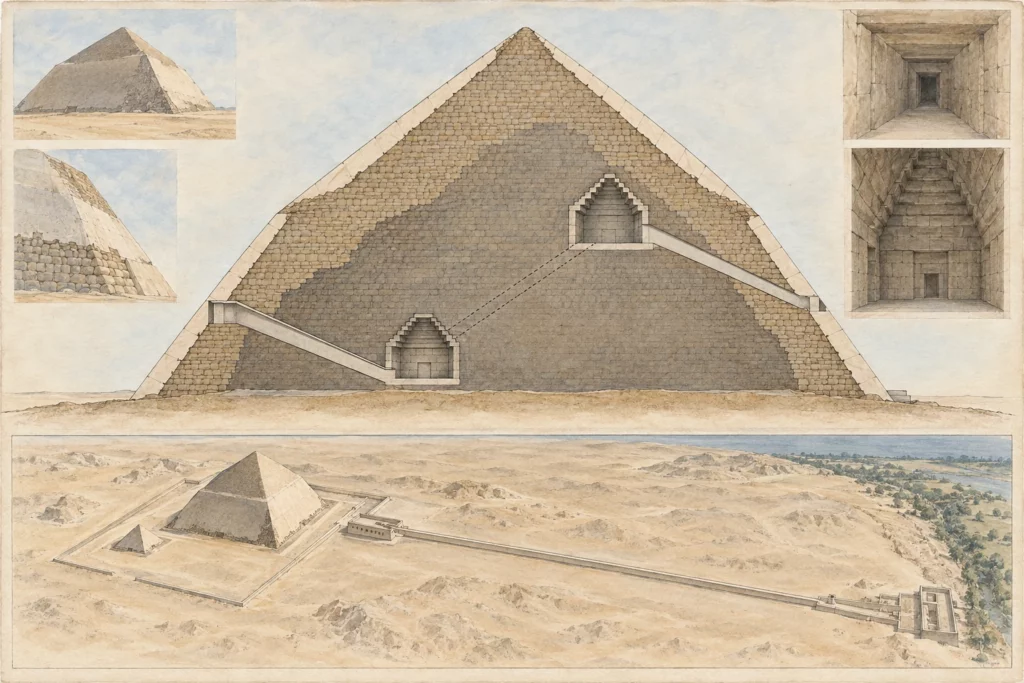
This pyramid is a major witness to the development of the great smooth-sided pyramids. The lower part rises at a steep slope, then the slope becomes gentler in the upper part. The change was built into the finished structure; it is not a break caused by later ruin. A large part of the outer casing has survived, which makes the silhouette particularly clear. Inside, two systems of entrances and chambers show a complex underground and internal programme. The building formed the centre of a complex with a satellite pyramid, a chapel, a causeway and a valley temple. These components make it possible to study construction, the royal funerary cult and the organisation of the necropolis together.
Monuments and remains
The change of slope is generally described by approximate values of 55 degrees for the lower part and 43 degrees for the upper part; the measurements vary according to the points and conventions used. The limestone casing remains visible over large areas. An entrance on the north leads to a low chamber, while another, placed high on the west face, serves a chamber located higher in the mass of the pyramid. Both chambers have corbelled roofs, a technique in which the courses of stone are stepped progressively towards the centre. A connection between the systems has been studied, but the simplified diagram of a plate cannot show all the stages or the modifications of the substructure. To the south stands a satellite pyramid. To the east, an adjoining chapel and a long causeway led to a valley temple, near the cultivated zone. Remains of settlement and cult linked to the complex are known in these surroundings.
Chronology and building phases
The building work was begun under Sneferu with a steep lower slope, then continued above a break in slope at a lower angle. This sequence can be read in the silhouette. Load constraints, defects observed in the masonry and the wish to complete the structure are often invoked to explain the decision. The ancient documentation, however, gives neither an order for the modification nor an explicit justification: attributing the whole change to a specific accident would go beyond the evidence. The construction of the Red Pyramid in the north of Dahshur followed, with a gentler, regular slope. The chronological relationship between Sneferu’s three great projects, Meidum, the Bent Pyramid and the Red Pyramid, was probably complex, with teams and works that may have overlapped. A year-by-year chronology is still debated. The phases of the temple, the causeway and the valley installations cannot be deduced mechanically from the pyramid’s change of slope alone.
History and functions
The royal funerary function explains the place of the pyramid, the internal chambers and the association with temples and a causeway. The monument contributed to representing the permanence of the king and to cult practices that could continue after his death. Later attestations of priests and administrators mention the two pyramids of Sneferu at Dahshur and the southern pyramid; they show that the complex kept an identity of its own. They do not on their own prove where the ruler’s body lay. The satellite pyramid and the valley installations had functions within the funerary programme, but the detail of each rite cannot be reconstructed directly from the surviving walls. The surrounding private tombs and settlement underline the presence of staff and of a society around the monument.
Excavations and the history of research
William Matthew Flinders Petrie carried out a season of surveys at Dahshur in 1887, published the following year. Jacques de Morgan then studied the necropolis and the neighbouring complexes at the end of the 19th century. Ahmed Fakhry’s campaigns in the 20th century were decisive in documenting the complex of the Bent Pyramid and its valley temple. Architectural studies and research on the slope have extended this work. UCL Digital Egypt states explicitly that the reasons for the change of angle may be practical, ideological or both, and are not documented by any ancient statement. The Egyptian ministry presents a technical reading linked to the stability of the construction. These two formulations can be reconciled if the material observation, the change of slope, is separated from the hypothesis about its motive. The inscriptions associated with the complex and the neighbouring tombs also provide reference points for the attribution to Sneferu.
State of preservation and research questions
The state of preservation is exceptional for the casing, but the internal arrangements, the temples and the living spaces are unevenly known. A representation of the complex must therefore distinguish the surviving volumes from the reconstructions. The lower and upper slopes can be measured; the choice that led to their difference remains a historical question. The famous claim that the pyramid ‘failed’ oversimplifies the problem: the building was completed in its modified form and integrated into a cult complex. The Red Pyramid does not erase the history of the southern pyramid. The discovery image attached to this article is a created illustration.
Sources
Main sources: Egyptian Ministry of Tourism and Antiquities, ‘The Bent Pyramid’, https://egymonuments.gov.eg/en/monuments/the-bent-pyramid/; UCL Digital Egypt, ‘Dahshur, the Bent Pyramid’, https://www.ucl.ac.uk/museums-static/digitalegypt/dahshur/bentpyramid.html; UCL Digital Egypt, ‘King Snefru’, https://www.ucl.ac.uk/museums-static/digitalegypt/chronology/kingsnefru.html; UCL Digital Egypt, ‘Pyramid towns’, https://www.ucl.ac.uk/museums-static/digitalegypt/pyramids/town.html; Petrie, A Season in Egypt, 1888; Fakhry, The Monuments of Sneferu at Dahshur, 1959–1961, references cited by UCL.