Identification and location
Kom el-Dikka lies in the centre of Alexandria, near the main railway station. Its Arabic name, ‘the mound of rubble’, refers to the heap that covered the site. In 1960, during works planned for a housing project, an urban district of the Roman and Byzantine periods was discovered there, which has since been excavated and laid out for visitors. It is now one of the few places where one can walk the streets of the ancient city.
The theatre
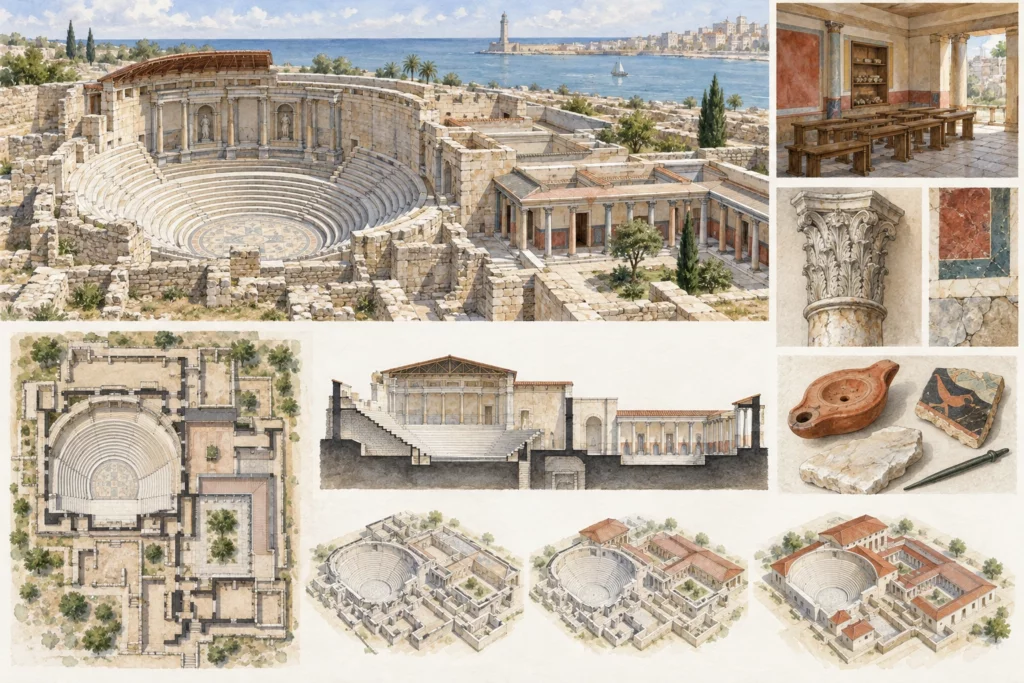
The best-known monument is a small theatre, often called an odeon, whose marble tiers form a horseshoe. Built in the late Roman period and altered several times, it may have served for concerts, public readings or civic meetings. The question of its roofing, perhaps a roof or a dome, remains debated.
Baths, streets and houses
Around the theatre extended large public baths, supplied by cisterns, colonnaded streets, shops and houses. One of them, the Villa of the Birds, built in the first centuries AD, owes its name to a mosaic showing different species of birds; it is protected by a shelter and open to the public.
The lecture halls
More than twenty rooms with tiers arranged in a U, lined up along a portico near the baths, have been interpreted as lecture halls. Dated to late Antiquity, they bear witness to the intellectual activity of Alexandria, which remained a great centre for the teaching of philosophy, medicine and rhetoric. Their discovery has renewed the image of the school of Alexandria, known mainly from texts.
The later periods
After Antiquity, the district was abandoned and covered with debris. A Muslim cemetery was established there in the Middle Ages, and its tombs have been excavated above the ancient levels. This layering illustrates the long history of the city.
Excavations and state of preservation
Since 1960, the Polish Centre of Mediterranean Archaeology of the University of Warsaw has been excavating, studying and restoring the site, in collaboration with the Egyptian authorities. Research focuses on the chronology of the buildings, the identification of the lecture halls and the development of the district between the Roman period and the Middle Ages.
Sources
Main sources (consulted on 28 September 2026): Polish Centre of Mediterranean Archaeology, Kom el-Dikka.