Identification and location
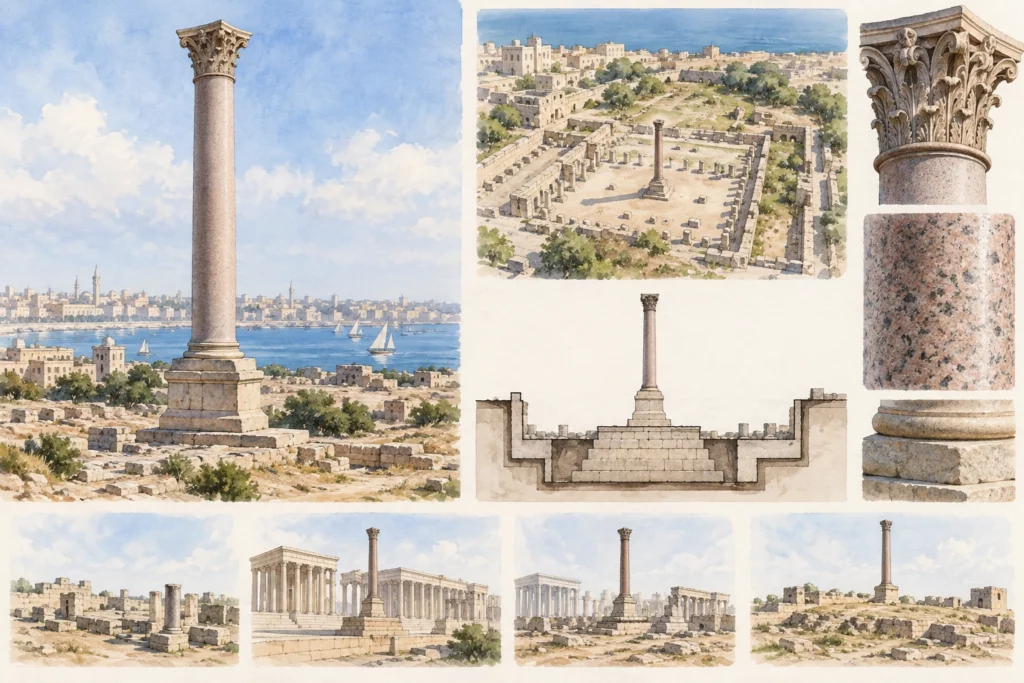
The column known as Pompey’s Pillar stands on the hill of the Serapeum, in the Karmouz district, in south-western Alexandria. It is one of the few ancient monuments still standing in the city, and the tallest. It dominates an archaeological site that preserves the remains of the great sanctuary of Sarapis.
The monument
The column, of red Aswan granite, reaches about 27 m in height according to the Encyclopædia Britannica, which dates it to around AD 297. Its shaft is monolithic: quarrying it, transporting it from Aswan and raising it represented a technical feat. It probably originally carried a statue of the emperor, now lost.
The inscription and the dating
A Greek inscription carved on the base states that the column was dedicated to the emperor Diocletian by the prefect of Egypt, around AD 297 (the end of the 290s, according to the Egyptian ministry). It probably commemorates Diocletian’s recapture of Alexandria after the revolt of Domitius Domitianus, and the distributions of grain that followed. The name of Pompey comes from a mistaken medieval tradition, which saw in it the tomb of the Roman general murdered in Egypt in 48 BC.
The Serapeum
The hill carried the Serapeum, temple of Sarapis, a Graeco-Egyptian god promoted by the Ptolemies. Foundation plaques found on the spot attribute its construction to Ptolemy III, in the 3rd century BC; it was later rebuilt in the Roman period. The sanctuary housed a library, sometimes called the daughter library of the great Library of Alexandria. The Egyptian ministry recalls that the Serapeum was destroyed in AD 391, when the emperor Theodosius banned paganism; tradition also links this episode to the patriarch Theophilus, an event that marked the end of the great pagan cults of the city.
The visible remains
Around the column survive foundations, underground galleries cut into the rock, which may have served for worship or storage, a nilometer and several granite sphinxes, some of them Ptolemaic, which have been placed near the monument.
According to the Encyclopædia Britannica, the column stands on the site of the ancient fort of Rhakotis, the Egyptian quarter of the ancient city, and is among the few classical monuments still standing in Alexandria. Its modern name is therefore misleading: it has no connection with Pompey, who died in Egypt more than three centuries before it was raised, and it honoured the emperor Diocletian.
State of preservation and research questions
A single photograph of the column does not show the density of this religious quarter. Research focuses on the topography of the Serapeum, its Ptolemaic and Roman phases and the function of the underground galleries.
Sources
Main sources (consulted on 28 September 2026): Egyptian ministry, Alexandria; Pompey’s Pillar, Encyclopædia Britannica.