In brief
The pyramid of Niuserre stands among the royal monuments of Abusir, built during the 5th Dynasty. The king had his own tomb built and took over a causeway previously planned for his father Neferirkare. Niuserre’s complex linked the pyramid to temples where his funerary cult was performed. Its upper temple has an unusual plan, adapted to the buildings already present.
What you discover
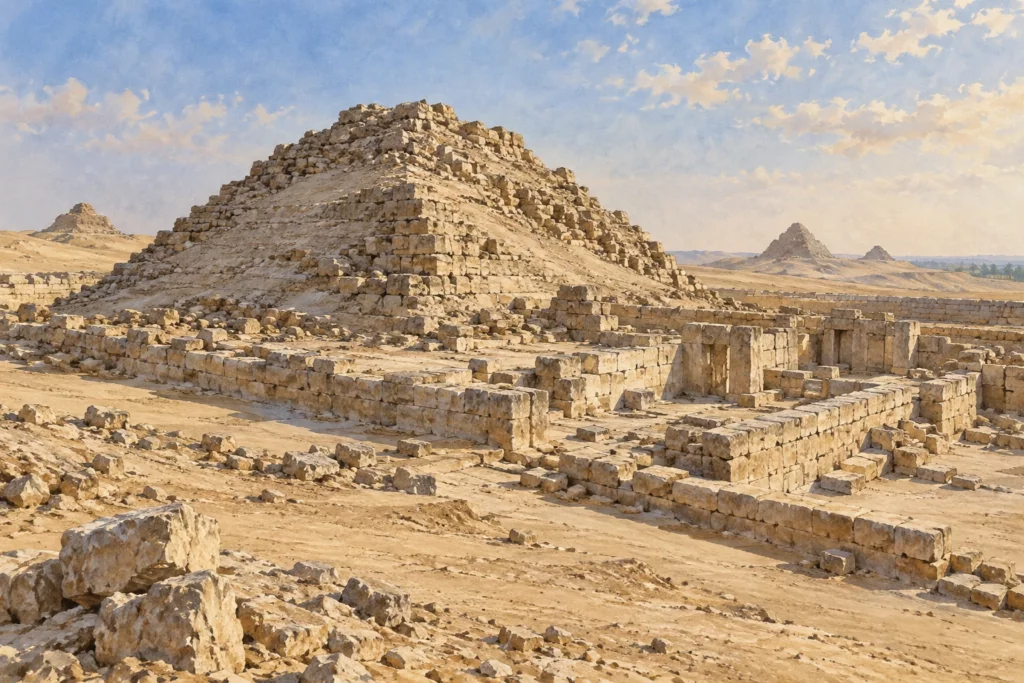
The pyramid now appears as a heavily eroded mass of limestone. At its foot, low walls mark the site of the mortuary temple. Its L-shaped layout is not immediately obvious from an overall view: you need to follow the plans produced by the excavations to understand how the halls skirted the neighbouring buildings. A causeway ran down to a valley temple, at the former edge of the cultivated land. The site belongs to a crowded necropolis in which the complexes of Sahure, Neferirkare, Raneferef and Niuserre touch or answer one another without becoming a single monument.
Its history
Niuserre reigned after several members of his family and was the last king to build his funerary complex at Abusir, according to the Czech Institute of Egyptology. He also took part in completing or adapting monuments of his mother Khentkaus II, his father Neferirkare and his brother Raneferef. Neferirkare’s unfinished causeway was reused for his own project. The German excavations of the early 20th century studied his complex; Czech and Egyptian research continues to clarify the landscape of the necropolis and its different phases.
Why this place matters
This monument shows how a king built in a space that was already occupied. The architecture of the temple and the route of the causeway result from choices made in contact with older projects. One should avoid drawing a simple series of identical complexes: Niuserre’s reveals reworkings, constraints and dynastic ties. Its ruins are also a good starting point for comparing the royal tomb with the mastabas of officials set around Abusir.