In brief
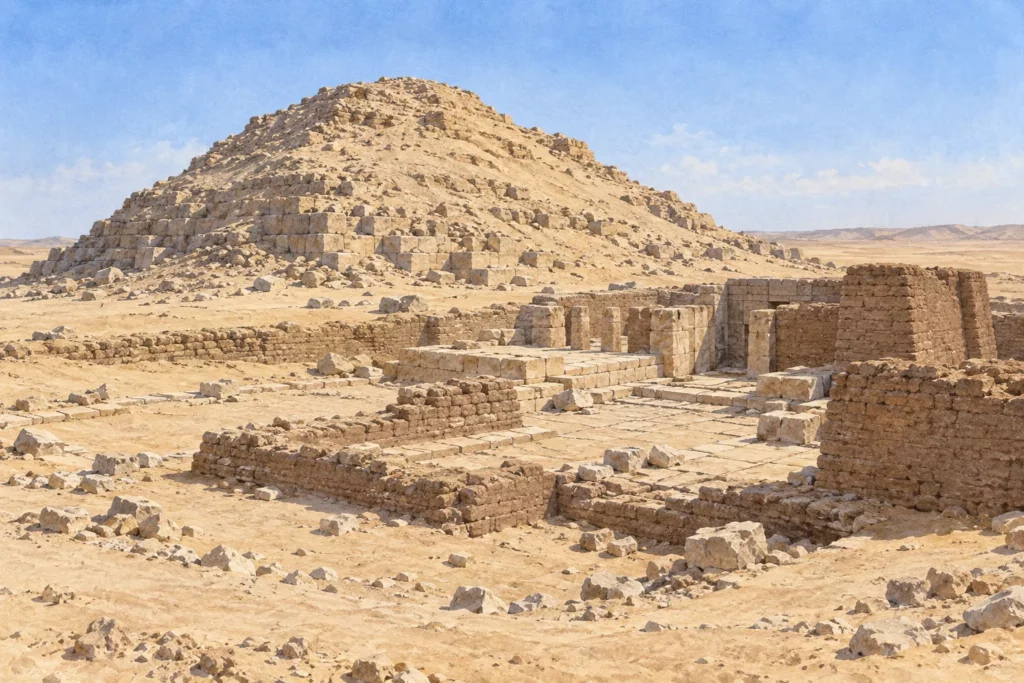
At Abusir, the pyramid of Neferirkare Kakai still dominates the central sector of the necropolis despite its ruined state. This king of the 5th Dynasty succeeded Sahure. His funerary complex was not entirely completed according to the planned programme: the valley temple is missing, and the causeway that had been planned was later used for the complex of Niuserre. The remains are also famous for the papyrus archives linked to the king’s cult.
What you discover
The pyramid has lost its casing and now appears as an irregular mass of stone. On its eastern side, the ruins of the mortuary temple show stone buildings completed in mudbrick. The spaces where the cult’s staff worked have yielded administrative documents. These papyri are no longer on the site: they are kept and studied in collections. No completed valley temple can be shown as belonging to Neferirkare. In the neighbouring landscape, other pyramids of Abusir are a reminder that several kings of the 5th Dynasty built their own complexes here.
Its history
The monument seems to have been unfinished at the king’s death. The temple was adapted so that his cult could continue, notably with mudbrick buildings. The causeway begun for this complex was reused in Niuserre’s programme. From the end of the 19th century, fragments of papyrus from Neferirkare’s funerary service entered several museums; later excavations and studies have explained their context more fully. They record tasks, goods and staff, giving access to the daily running of a royal temple.
Why this place matters
The great interest of the site comes from bringing architecture and documents together. The ruins show what was built or altered; the papyri tell us about the rites and the organisation of the staff long after the initial building work. The pyramid should therefore not be described as a project that was simply abandoned: the cult functioned within an adapted complex. The archives do not, however, provide a complete description of every room or every ceremony.